Influential Woman · Wellness
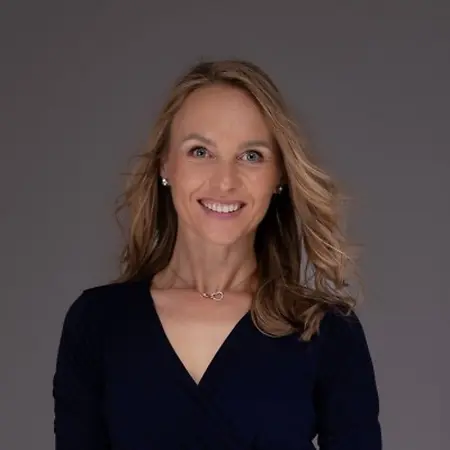
Margo Gladys
Wellness and Performance Consultant and Coach, Pro Well Hub LLC
Carmel, NY 10512
Her Story
About Margo
Margo Gladys coaches professionals and teams to perform at their highest level — without sacrificing their well-being.
She believes that well-being fuels ambition and success. Her philosophy is simple: performance comes from within.
As a wellness consultant, coach, and founder of Pro Well Hub, Margo specializes in helping busy individuals and organizations prevent burnout and restore sustainable energy using practical, nervous system–based tools that fit into real life.
With over 15 years in high-pressure healthcare business operations at leading NYC health systems, she understands the relentless pressure to perform in challenging environments. Her work is also deeply personal. After facing chronic health challenges, after a serious accident, that conventional medicine couldn't resolve, she discovered holistic practices that transformed her health and energy — and set the course for her life's work.
She has spent over a decade studying coaching, psychology, nutrition, Chinese medicine, and mind-body practices including Qigong, breathwork, yoga, and mindfulness. She holds an MS in Health and Human Performance and over 1,500 hours of training in mind-body and somatic practices — combining rigorous knowledge with real-world experience to create an approach that is both science-backed and deeply human.
Today, she is known for making wellness doable. She helps people reset their energy, sharpen their focus, and feel better — without needing more time or a complete lifestyle overhaul.
Margo offers coaching, workshops, and classes for both individuals and organizations, with a particular focus on women who are tired of feeling depleted and ready to feel clear, energized, and in control again.
Her approach is simple: wellness should support your life — not compete with it.
Her Interview
Ten minutes with Margo
01What do you attribute your success to?
I attribute my success to resilience.
When I reflect on where that comes from, I think of my parents and those who came before them. They didn't have the chances I had. My parents grew up under communism, where there was no opportunities — yet they had the strength and inner resilience to keep going, no matter what. I inherited that from them.
Coming here alone from Poland in 2006 with nothing, I had to not only start from scratch but also adjust to an entirely new way of life — and work through my own self-imposed, culturally ingrained limitations. I was raised being told to stay quiet, not to stand out, never to take up too much space. Overcoming that mindset — learning to show up fully, to be self-compassionate and self-confident — is something I'm still working on.
But deep inside, there is a very quiet resilience. It doesn't roar. It's not loud or showy. It simply endures. That's the quality I most want to pass on to younger women: you have to keep going, because life will knock you down. It always will. But we all have it in us to rise.
It's actually the topic I chose for my first keynote speech, which I delivered at an International Women's Day event last year — a full-circle moment I'm incredibly proud of.
02What’s the best career advice you’ve ever received?
The best advice I ever received came from my boss who became a wonderful mentor. As an immigrant, as a woman, as someone with no safety net, I had built a habit of over-apologizing and being relentlessly nice — shrinking myself to make everyone around me comfortable.
He noticed it and called it out directly: "Margo, stop apologizing. Stop just being nice. Men never do that."
Coming from a boss, and from a man, those words opened my eyes. I didn't need to shrink. That was my default — making myself smaller so others could feel at ease — and he gave me permission to stop.
It's been a process, of course. You don't wake up one day and suddenly own every room you walk into. But that one piece of advice had a profound impact on me, and I'm deeply grateful to him for seeing something in me that I couldn't yet see in myself.
03What advice would you give to young women entering your industry?
My advice would start here: be prepared to be resilient, and have a strong reason for being in it — because this industry is not what it looks like from the outside.
Many people — and I was one of them — come into wellness thinking it means teaching classes, meditating, doing what you love. And yes, you do what you love. But there is an entire world of unglamorous responsibilities that nobody warns you about. You have to learn how to hustle. You have to find clients. It's far harder than it appears.
We also live in a culture that sells the idea of overnight success — that you can take an online course, build a following, and suddenly arrive. It doesn't work that way. In all the fields I've worked in and all the people I've collaborated with, I have never once seen that be true. Real, lasting success is built quietly, over time, through consistent work.
So be prepared for long hours, rejection, self-doubt, and hard work. That is exactly where your reason — your why — becomes everything. It's what keeps you going when nothing else does. Believe in yourself, do all the manifestation work, set your intentions — but then do the actual work.
Stay humble, keep going, and trust the process.
04What are the biggest challenges or opportunities in your field right now?
The opportunity right now is extraordinary. We have access to tools, platforms, and information that allow us to reach and connect with people in ways that weren't possible even ten years ago. The potential to make a real impact has never been greater.
But that same abundance is also the biggest challenge.
We are all drowning in information, and much of it is low quality. Wellness is a booming industry, and with that growth has come an flood of people promoting diets, biohacks, routines, and coaching without the experience or depth to back it up. The barrier to calling yourself a wellness expert has never been lower — and that does a real disservice to clients who are genuinely trying to improve their health and lives. AI is accelerating all of this even further, adding more noise to an already overwhelming landscape.
For someone like me — who has been on my own wellness journey for over 20 years, who has studied physiology, Eastern practices, coaching, and psychology since 2012, and who keeps studying because I want to keep getting better — the challenge is this: how do you authentically stand out? I know that what works for one person won't work for another. My work with clients takes time, experimentation, and real understanding. But I'm competing against people who may not offer that depth, yet are simply brilliant at Instagram and YouTube and personal branding.
The people who prioritize quality over visibility are often the quietest — and quiet doesn't get rewarded by algorithms.
So the real challenge for our industry right now is twofold: for practitioners, how do you rise above the noise without becoming the noise? And for clients, how do you find someone truly qualified when everyone sounds equally convincing?
Those are the questions I think about constantly.
05What values are most important to you in your work and personal life?
There are three values that guide everything I do — in my work and in my life.
The first is integrity. Do what's right, and don't hurt others. Do what you promise, take responsibility for your actions, own your mistakes, respect people. That sounds simple, but it's really important — especially in a world obsessed with self-image over being genuine and decent.
The second is growth. I believe we are at our most alive when we are pursuing something — learning, expanding, evolving. It doesn't have to be grand. It can be a new skill, a new perspective, a small challenge at home. But the moment we stop growing, we stop truly living. To me, growth isn't optional — it's what makes life feel meaningful.
The third is humility — and I mean that in its truest sense, not as a synonym for shrinking or self-doubt. To me, humility means having an honest, grounded view of yourself — knowing your strengths, but acknowledging your limitations. It means keeping your ego quiet enough to genuinely see other people: their perspectives, their contributions, their value. Humble people stay open.
We live in a moment of very loud egos, and I think we can all see where that leads. If we all led with more humility and integrity — and kept expanding our horizons through learning— the world would be a better place.
Join Influential Women and start making an impact. Register now.