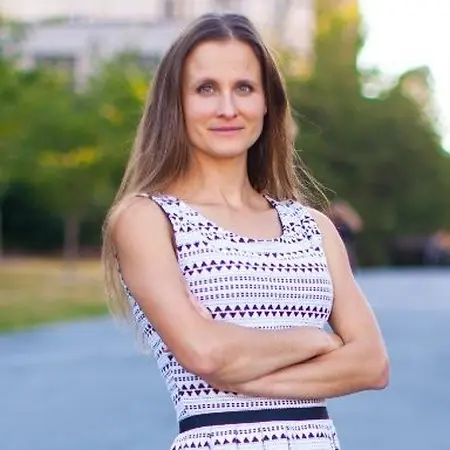
Her Story
About Mari
My career in water chemistry and biotechnology has taken me across the globe over the past 20 years. I started with my bachelor's degree, which included ocean research in Australia, then completed my master's at the University of British Columbia in Canada. After working as a salesperson for water equipment in southern Germany and Austria, I pursued my PhD in biotechnology in the Netherlands, with part of it at Columbia University in New York, focusing on engineering and optimizing wastewater treatment plants. I worked for a construction company that built wastewater treatment plants, then obtained the Marie Curie Postdoctoral Fellowship to do mathematical modeling in Belgium. In 2015, I joined the University of Washington as a professor, where I've been for 11 years. I supervise students, postdocs, research scientists and technicians, though I prefer to say I collaborate with them because they bring so much knowledge to the table. When I started at UW, I shifted away from wastewater and moved into agriculture and medical fields. I'm now co-founding two companies: Therate, a therapeutic bubble tea company that implements wastewater treatment principles in the gut to help kidney failure patients reduce their need for dialysis, and Biobeat, an agricultural company that harnesses microbes to fix nitrogen from the air and transfer it to plants, reducing the need for fertilizer while providing environmental benefits. My days involve teaching, research, writing proposals for funding, working on these startups, and of course, getting my son to school, which is often the biggest achievement of the day.
Her Interview
Ten minutes with Mari
01What do you attribute your success to?
Success is relative, and relative to the people you're around, there's always someone better. I don't know how to define success because there are so many things I'm not successful in, like all the research grants that are written and rejected. I think focusing on things that are not working and could be improved is probably the biggest driver I have. There have been so many important people that I try to mimic, not necessarily them telling me what I need to do, but just seeing them operate. I learn by observing, both positive and negative experiences. Negative experiences are quite important to see how you're not doing it, and that makes you stronger. I pick out the things that make the most sense and resonate, and that drove my success. Then I try to give it back and have the people I work with thrive, because their success is my success.
02What’s the best career advice you’ve ever received?
The best career advice I've received came from observing my PhD advisor, who I call Dr. Father. He's probably the most well-known person in wastewater treatment, and he has always worked hard, but he has also always taken time off. He would travel and be away a lot, still responding whenever he could, but he always made sure to decompress. He would go to areas where there was no internet, mostly high up in the mountains. I kind of follow that path now. It's really about learning by observing rather than someone explicitly telling me what to do. I've learned from both positive and negative experiences, because negative experiences are quite important to see how you're not doing it, and that makes you stronger. I pick out the things that make the most sense and resonate, and then try to give it back to have the people I work with thrive.
03What advice would you give to young women entering your industry?
For a lot of my career, I was not thinking much about gender bias at all. I mean, it's obviously a real thing, but thinking that everything could be a bias, sometimes people just aren't nice, and there's a difference there. It just didn't occur to me to put myself into a weak position and see being a female as a hindrance. I didn't consider that as something I should see as a problem. Just push through it and work really hard. Being successful requires that you push yourself to a level where people see that you are accelerating to the level of excellence you can bring to the table. And then just go for it. It's hard, but be nice, not weak. Maybe stay balanced, though that's very hard for me.
04What are the biggest challenges or opportunities in your field right now?
The funding situation has been challenging recently, but I would say it's temporal and it will come back. The small business program has recently started up again, and I've had some luck with private companies giving some funds to bridge the gap. I don't think there's any particular thing I would call a struggle. What brings me the most joy is switching tasks and being really diverse in the exposure of the challenges that this job brings, both scientifically and on the entrepreneurial end. That's really rewarding.
05What values are most important to you in your work and personal life?
The most important values to me are staying honest to yourself and keeping professional life separated from private life. Not being cold, but definitely there should be a separation. It's an interesting balance to strike because if you want people to be happy, you need to provide an environment that allows for exchange beyond work. I do believe there are some areas where you can share generic things without necessarily getting deeply emotional, and it's okay to do that, especially if I work with young people who just need to find themselves. There's an aspect where vulnerability sometimes impacts work performance, and then there needs to be a deep understanding to support their personal lives because it impacts professional life. But even that conversation can focus on how we can get back on track in the professional world. It should be clear that it's a business relationship and doesn't drop into just the personal realm, because everyone wants to grow in a career, so it should center on getting whoever from A to B. There's this saying that the top is lonely, and I think that comes with it, because there are so many situations where you need to communicate to people you really care about that a contract can't be extended or something that puts a personal and work relationship into a weird position. It's a hard one to be responsible for, and it's best to keep things separated because if I could personally choose, I would always try to support everyone, but sometimes I can't.
Join Influential Women and start making an impact. Register now.