Influential Woman · Education
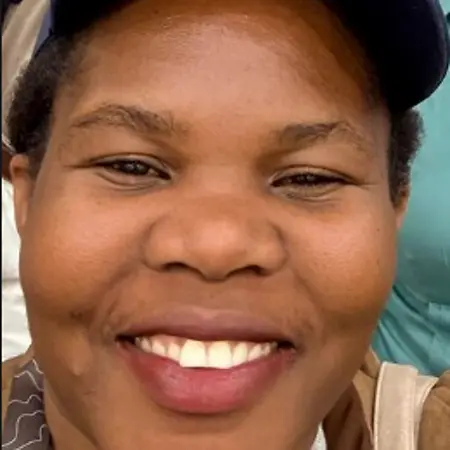
Dr. Maria A Komugabe
Data Scientist, Researcher, Innovator and Educator, Claremont Graduate University
Claremont, CA 91711
Her Story
About Maria Assumpta
Dr. Maria Assumpta Komugabe is a Geospatial data scientist and solutions innovator, researcher, and educator dedicated to closing the "implementation gap" in global health. Her work moves beyond theoretical modeling to provide actionable, data-driven solutions for the world’s most persistent healthcare challenges.
Building on the Esri ecosystem as a framework, Dr. Komugabe builds dashboards and spatial data science tools that could empower government bodies to address real-world public health crises like malaria. Her system predicts climate considerations and redistributes medical supplies, ensuring that healthcare resources reach the populations that need them most. She has, built a system that ensures life-saving interventions (like malaria nets or medicine) are in the right place, at the right time, even when the Climate environment is unpredictable.
Dr. Komugabe has developed the Adaptive Digital Resilience Framework (ADRF). By integrating machine learning with real-time GIS, this framework is designed to:
· Adapt: Utilize Artificial Intelligence to respond to shifting health landscapes.
· Digitize: Transform raw data into actionable, high-impact insights.
· Strengthen Resilience: Build robust systems capable of optimizing malaria interventions and other critical health deliveries in low-resource settings.
Dr. Komugabe’s research, spanning five published studies, establishes a blueprint for the protection of high-risk populations. Her work is a vital contribution to Sustainable Development Goal (SDG) 3.3, which aims to end the epidemics of malaria and neglected tropical diseases by 2030. By incorporating predictive dashboards within the distribution framework that traditionally stall malaria elimination efforts, with a specialized focus on pregnant women and reducing neonatal mortality.
Her doctoral research at Claremont Graduate University provides the necessary technical framework to transition from reactive data monitoring to proactive, automated reallocation of resources based on predictive spikes. Through her research, she offers a scalable framework designed to synchronize technological innovation with field-level operational realities in emerging economies. Dr. Komugabe’s work ensures that the digital revolution in healthcare is not just innovative, but inclusive—leaving no community behind in the race toward a malaria-free world.
Following the completion of her Ph.D., Dr. Komugabe aims to translate her research into global action. She is focused on replicating and refining her geospatial frameworks to address the unique health delivery challenges of different regions, ensuring that data-driven resilience becomes a standard for communities everywhere.
Dr. Komugabe’s path to the pinnacle of academia is a testament to the power of persistence. After earning her Bachelor in Education and her first Master's in Information Technology from Uganda Martyrs University, she transitioned to Claremont Graduate University (CGU) for advanced specialization. Demonstrating extraordinary discipline, she completed a Master of Information Systems & Technology (GIS Concentration) and her Ph.D. in Information Systems & Technology in 3 and a half years, maintaining a rigorous pace while navigating life as an international student and researcher.
Impact Through Education and Leadership
Today, Dr. Komugabe is a multifaceted leader across industry and academia:
- Curriculum Consultant & Liaison: At Harvey Mudd College, she serves as a Curriculum Consultant within the Computer Science Department. In this role, she acts as a liaison, guiding students in designing technical curricula for international institutions, specifically supporting the growth of Musizi University in Uganda.
- Educator: She is a Lecturer in Cyber and Decision Sciences at California State University, San Bernardino, and maintains a long-standing role as a Lecturer of Information Technology at the University of Kisubi.
- Technologist & Analyst: She supports the Office of Information Technology at CGU and recently served as a Human Resource Data Analyst Intern for the Sacramento Municipal Utility District (SMUD).
Dr. Komugabe is more than a scientist; she is a bridge-builder. Whether she is creating frameworks for high-impact challenges or facilitating international academic partnerships, her work exemplifies the Adaptive Digital Resilience framework she champions. She remains committed to transforming high-level geospatial knowledge into tangible societal impact, proving that with persistence and Geospatial machine learning, data can indeed save lives.
Her Interview
Ten minutes with Maria Assumpta
01What do you attribute your success to?
When people ask what drives me, I always point back to my father. My success is, quite literally, a result of his belief. He was willing to do the unthinkable—trading his only land and security for my education—because he valued my education above all else.
As the eighth of ten children, reaching these academic heights isn't just a personal win for me; it’s the realization of my conviction that education is the one asset that can never be taken away. He always told me that the mind is our most valuable piece of real estate, and that wisdom is the engine behind every solution I build and every challenge I overcome. I don’t just work for myself; I work to fulfill a vision he started
02What’s the best career advice you’ve ever received?
The best career advice I ever received actually came in two stages, and both completely changed how I see myself. The first was a massive wake-up call. Early in my career in Uganda, I was doing all the heavy lifting for my department but getting zero recognition. A colleague sat me down and gave me a reality check I’ll never forget. He said, Maria, right now, you aren't sitting at the table; you’re on the menu. Everyone is consuming your work, but no one is inviting you to sit. You need to get out, get your Ph.D., and build your own table.'
That gave me the 'why,' but it was my advisor who gave me the 'how' when things got difficult. He told me bluntly: 'You simply have to get things done, no matter what.' At the time, I didn't even have the tuition to finish my studies, and I felt stuck. But that advice flipped a switch in my brain. It moved me from feeling like a victim of my circumstances to being a relentless problem-solver. I learned that when you refuse to accept 'no' as the final answer, your mind automatically shifts into solution mode.
03What advice would you give to young women entering your industry?
My Advice: Find the Place Where You Can Shine and Keep Learning
To the young women stepping into this industry: I want you to start by knowing your own value, even when the room doesn't see it yet.
It’s a hard truth that in many STEM spaces, we still have to work at a "higher resolution" just to be seen. You might find yourself working twice as hard just to prove your baseline competence. My advice is to meet that reality with a steady, quiet discipline. Don't let a difficult environment make you shift your gears or doubt your path. Consistency is your greatest power.
Let the quality of your work speak for you, but keep this in mind: your goal isn't just to be "tolerated" or "acknowledged." Your goal is to find—or build—a space that truly values what you bring to the table.
If you ever feel like an environment is trying to dampen your spirit, don't stay and let it. Keep moving. There are places and people out there who will recognize your fire and help you fan the flames, rather than trying to put them out. You deserve to be in a "map" that was built for your success.
04What are the biggest challenges or opportunities in your field right now?
In Geospatial Science, we spend all day talking about 'visibility analysis' and 'digital elevation models.' But the irony is that the biggest challenge in our field right now is a human visibility gap.
As a woman of color in a male-dominated STEM space, you often feel like you've been 'filtered out' of the data before you even open your mouth. It’s an exhausting reality where you’re forced to work at a much higher resolution—twice as fast and twice as hard—just to be 'rendered' accurately and seen as a peer in the room.
But here’s what I’ve realized: that 'cluttered signal' isn't about us; it’s a product of the environment. My time at Claremont Graduate University showed me what’s possible when the 'base map' actually changes. I had research partners and committee members who didn't just give me a seat; they acted as true allies to clear the 'topographic barriers' that usually slow us down.
The real opportunity isn't just for women to work harder. It’s for the industry to fix its own bias. When you clear the signal for diverse voices, you don't just help the individual—you improve the accuracy and the vision of the entire field.
05What values are most important to you in your work and personal life?
I’ve always believed that the most meaningful work happens when we lead with our values first. My own journey is anchored by a triad of principles: Prayer, Courage, Determination, and Fearlessness. These aren't just words to me; they are a legacy of belief. I think of my father, who traded his only land because he believed so deeply in the power of my education. He taught me that the most fertile soil for growth isn’t in the ground, but in the human mind.
As the eighth of ten children and an international student navigating the pressures of a Ph.D., I had to turn that family belief into a deep, personal Discipline. But I’ve learned that discipline isn’t just about a rigid schedule; it’s the quiet, steady confidence that your worth isn't defined by your accent or where you started—it’s defined by the caliber of your work.
I believe that we do our best work when we feel "okay" and supported. To me, a professional environment should be built on:
- Respect and Equity: Knowing that every voice and background adds value to the room.
- Trust and Honesty: Being able to speak openly so we can solve problems together.
- Emotional Support: Remembering that we are people first, and it's okay to have human moments while we pursue excellence.
- Independence and Healthy Boundaries: Giving each other the space to own our work and protect our personal peace.
I live by the mantra that "Determination determines Destiny." I believe that she who dares, wins—not through luck, but by staying true to her vision until the world around her matches the one in her mind. My goal is to use my journey to help others realize that their destiny is theirs to shape, too.
Join Influential Women and start making an impact. Register now.