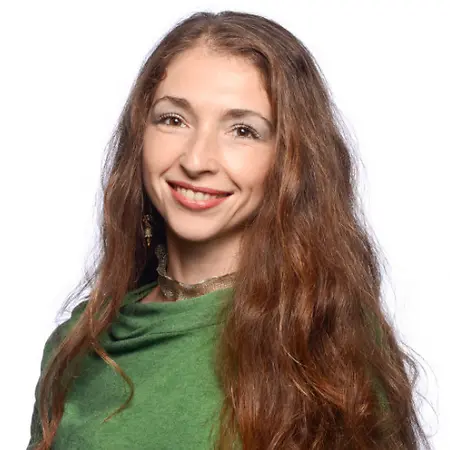
Her Story
About Marina
I have been in academia since I received my PhD in 2015. After graduating, I taught for a couple of years at John Jay College, then held a faculty position at Mercy University before moving to St. John's University, where I currently am and just received tenure. I teach three classes a semester, which is about two days a week - one graduate class online and two undergraduate classes in person. Most of my time is spent working on various research projects. I work on wrongful convictions, which is a big part of my ongoing research and advocacy work. I organize events for students and the community, raising awareness about wrongful convictions. I also do research on technology-facilitated sexual violence and gender-based violence. I do a lot of writing and research on a typical day. I'm currently working on my first solo-authored monograph book, and we have an edited volume in production where I'm the co-editor and author of several chapters. I'm a board member and conference program committee chair for the Society for Police and Criminal Psychology. I'm also involved with the Jeffrey Deskovic Foundation for Justice as a long-term partner in organizing various events and supporting their work both financially and through advocacy.
Her Interview
Ten minutes with Marina
01What do you attribute your success to?
I attribute my success to being very goal-oriented and having support from my family to make it happen. I set a goal and then get to it - that's how I operate. If I don't have a goal, there's no movement, but if I set a goal, I'll get there, no matter what. The support from my family has been crucial in allowing me to achieve what I have, especially while juggling family and a career in academia.
02What’s the best career advice you’ve ever received?
The best advice I've received is to learn how to say no. When starting as a junior tenure-track faculty member, it's really important to be able to tell what things to take on and become part of because they're interesting and important and will get you closer to your goal, versus busy work that distracts and detracts from your ability to actually focus on the things that will get you to your destination. Knowing how to say no to the less important stuff is very important. Work-life balance is also crucial - actually setting boundaries of 'this is my family time, and I'm not going to be responding to my emails.' Especially now with technology making work very intrusive because you get notifications and feel compelled to respond, you have to be able to prioritize life in those moments and not go to work 24-7. When you're doing research or in academia, your mind is kind of working 24-7, but you can't really stop thinking, so setting those boundaries is essential.
03What advice would you give to young women entering your industry?
I would really recommend setting clear goals and not taking any setbacks or delays as a sign of failure. Just keep on doing what you're doing, and eventually, you will get to where you want to be. Don't let obstacles discourage you - stay focused on your goals and persist through challenges.
04What are the biggest challenges or opportunities in your field right now?
Academia is in a huge turmoil state nowadays. There's an overall decline in college-age population, which means fewer students get enrolled overall, but there's also significant disillusionment in how important or needed a college degree is. We're really in the process of rethinking what a college education is and needs to be, especially now with the advent of AI and people thinking 'I can do anything, why do I need to go to college?' We're rethinking what we're teaching our students and how we need to teach them in order for them to not be replaceable by AI, but to be able to use AI in ways that help as a tool, as an assistant, as opposed to a replacement for actual intellect and intelligence. It's quite a significant shift - a major change of philosophy and understanding of what education really needs to be in order to be useful, and not just a diploma mill that doesn't actually add useful, applied, and advantageous skills and knowledge. We're not there anymore to just give you textbook info - we need to be there for skills and transferable skills that will be useful no matter what the field is going to look like tomorrow. We need to make education adaptable. We have no way of knowing where things are going because everything is changing nonlinearly - it's not a gradual process that we can definitively predict. We just have to be ready for it all.
05What values are most important to you in your work and personal life?
It's important for me to do what I believe in. Believing in the impact - doing things that actually are useful and applied in the world that can make a change, can make a difference - is very important to me. I think that would be the big one for me.
Join Influential Women and start making an impact. Register now.