Her Story
About Marissa
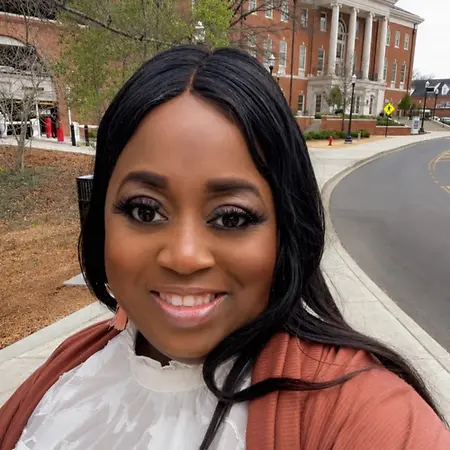
Marissa Boglin is an academic and English educator based in Birmingham, Alabama. She is currently in the fifth year of her PhD program at the University of Alabama and has four years of experience as an educator. She is a published academic with three publications, including contributions to the anthology Mama's Martyrs and Jezebel: myths, legends, and other lies told about Black women by Black Lawrence Press and Farewell to an Old Friend, A Final Goodbye to South Town Court in the Brill Anthology Rhetorics of Southern Place. Prior to entering education, she worked in corporate America for over a decade. Her educational background includes starting at Miles College, earning a bachelor's in healthcare administration from Ashford University, a master's of arts in organizational management, and a master's in English from the University of North Alabama. She holds the GISO credential from the Global Society of Online Educators, which qualifies her to teach online. As a single mother, she pivoted her career after earning her second master's degree and pursued her PhD under a fully funded scholarship.
Her Interview
Ten minutes with Marissa
01What do you attribute your success to?
I attribute my success to resilience, faith, discipline, and an unwillingness to allow difficult circumstances to define the limits of my life. My path has not been traditional or easy. I have had to continue moving forward through financial hardship, housing instability, motherhood, personal loss, and the demands of pursuing higher education while working and raising a child.
I also attribute my success to my willingness to keep learning and to begin again when necessary. Each degree, publication, teaching opportunity, and professional accomplishment has required persistence, sacrifice, and the courage to continue even when the outcome was uncertain. I have learned that success is not simply about talent. It is about showing up, doing the work, accepting correction, and refusing to quit.
My son has also been one of my greatest sources of motivation. I want him to see that where a person begins does not determine where that person can go. Ultimately, I attribute my success to God’s grace, the people who supported me along the way, and my determination to create a meaningful life through education, writing, teaching, and service.
02What’s the best career advice you’ve ever received?
The best career advice I have ever received is to keep doing the work, even when recognition is slow to come. Careers are not built through one opportunity, one publication, or one position. They are built through consistency, preparation, relationships, and the willingness to continue growing.
I have also learned not to disqualify myself before anyone else has the opportunity to consider me. Sometimes women, especially Black women, feel that we must meet every qualification before applying for a position, submitting our work, or entering a professional space. The best advice has been to apply anyway, submit the work, ask the question, and allow the people making the decision to decide.
That advice has taught me to remain prepared, trust the value of my experiences, and understand that rejection is not always a judgment of my ability. Sometimes it is simply redirection. My responsibility is to continue building, learning, and making room for the opportunities that align with my purpose.
03What advice would you give to young women entering your industry?
I would advise young women entering education and academia to trust their voices, document their accomplishments, and never assume that hard work will always speak for itself. Do the work, but also learn how to advocate for yourself, build professional relationships, and make your contributions visible.
I would especially encourage young Black women not to shrink themselves to make other people comfortable. There may be spaces where your ideas are questioned, your confidence is misunderstood, or your qualifications are overlooked. Do not allow those experiences to convince you that you do not belong. Prepare thoroughly, remain teachable, and enter each room knowing that your perspective has value.
I would also tell them to find mentors, but not to depend entirely on one person or institution to shape their careers. Build a broad network, seek opportunities beyond your immediate environment, and continue developing your skills as a teacher, scholar, and professional.
Most importantly, remember that rejection is part of the process. A declined application, publication, or opportunity does not determine your worth or your future. Learn from the experience, revise when necessary, and keep moving forward. Your career does not have to look like anyone else’s in order to be meaningful and successful.
04What are the biggest challenges or opportunities in your field right now?
One of the biggest challenges in English education right now is helping students understand the value of reading, writing, and critical thinking in a world increasingly shaped by artificial intelligence, shortened attention spans, and constant access to information. Technology can support learning, but it cannot replace the ability to think deeply, evaluate sources, communicate clearly, and develop an original perspective. Educators must teach students how to use new tools responsibly without allowing those tools to do the intellectual work for them.
Another challenge is unequal access. Students do not enter the classroom with the same educational preparation, technological resources, financial support, or confidence. Some are balancing employment, family responsibilities, and personal hardships while trying to complete their education. Our responsibility is to maintain high standards while creating courses that give students a genuine opportunity to succeed.
At the same time, these challenges create important opportunities. Online education allows institutions to reach students who may not be able to attend a traditional classroom. Digital archives also allow scholars to recover histories that have been ignored, minimized, or excluded from dominant narratives. This is especially important in my own research, which focuses on Black rhetorical history, civic activism, education, and the ways African Americans created institutions and communities despite systemic exclusion.
I believe the greatest opportunity in the field is to demonstrate that English studies are not disconnected from real life. Language influences education, employment, public policy, technology, identity, and whose stories are remembered. The field has an opportunity to become more accessible, more public-facing, and more responsive to the communities we serve. We must preserve the value of careful scholarship while making that scholarship useful beyond the walls of the university.
05What values are most important to you in your work and personal life?
The values that are most important to me are faith, integrity, perseverance, compassion, and service. I believe that how we treat people matters just as much as what we accomplish. In both my professional and personal life, I try to operate with honesty, remain accountable for my decisions, and treat others with dignity.
Education is also one of my core values. I view education not only as a pathway to professional advancement but also as a means of empowerment, self-discovery, and social change. As an educator, I want my students to understand that their voices and experiences have value. I believe in maintaining high expectations while also recognizing that students bring different circumstances, responsibilities, and levels of preparation into the classroom.
Perseverance has shaped every part of my journey. I have learned to continue working even when progress is slow, circumstances are difficult, or the path forward is uncertain. I value excellence, but I also value growth. I do not believe that success requires perfection. It requires discipline, humility, consistency, and the willingness to learn from both accomplishments and setbacks.
Family and legacy are equally important to me. As a mother, many of my decisions are guided by the example I want to set for my son. I want him to understand that adversity does not have to determine the outcome of his life. Ultimately, I want my work and my personal life to demonstrate that faith, education, resilience, and service can create opportunities not only for an individual but also for the people and communities connected to them.
Join Influential Women and start making an impact. Register now.