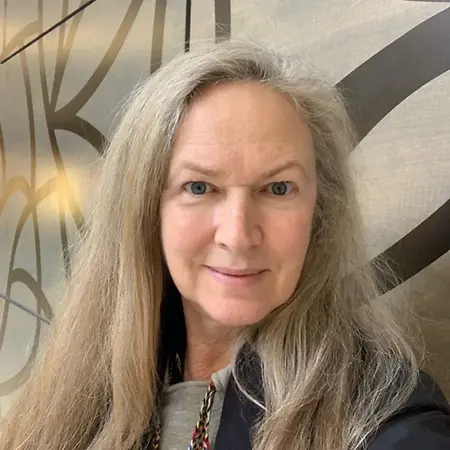
Her Story
About Marsha
Dr. Marsha Tufft is an accomplished aerospace engineer, STEM educator, and award-winning author whose career has been dedicated to advancing both technical innovation and human potential. Over the course of more than 35 years with GE Aerospace, she held leadership roles spanning aerospace engineering, durability engineering, life management programs, and technical education management, contributing to major aircraft engine programs including the GE90, GEnx, and GE9X. Her work focused not only on engineering systems and processes, but also on how technical knowledge is taught, learned, and applied. As Manager of Technical Education Programs, she partnered with educators from Columbia Teachers College to train instructors in evidence-based educational methods and improve engineering education programs across the organization. Throughout her career, she observed that one of the greatest barriers to success in STEM was not a lack of ability, but a lack of confidence in math and problem-solving skills — a realization that would later shape her mission in retirement. Her academic achievements include a Ph.D. in Materials Engineering from University of Dayton, a master’s degree in Aerospace Engineering from University of Cincinnati, and a bachelor’s degree in Mechanical Engineering from Purdue University, along with her Professional Engineer license in Ohio.
After retiring from GE in 2016, Dr. Tufft continued her work at the intersection of STEM education, creativity, and storytelling through Putney Designs, LLC. Drawing from decades of engineering experience and a lifelong belief that learning happens best through experimentation, she developed educational programs and stories designed to help students build resilience, curiosity, and what she describes as the “choice muscle” — the confidence to make decisions, learn from mistakes, and grow through challenges. Her volunteer work with the Girl Scouts of Western Ohio and the Greater Cincinnati STEM Collaborative has introduced thousands of students to engineering concepts through hands-on learning experiences, including STEM summer camps and “Think Like an Engineer” activities. Dr. Tufft strongly advocates for creative hobbies such as sewing, woodworking, art, and bicycle repair as powerful tools for developing spatial reasoning and practical problem-solving skills, believing that engineering success is built not only through formulas and theory, but through learning how to think critically and create fearlessly. Her own path reflects that philosophy; after struggling academically at one point during college, she rediscovered the joy of learning and later completed her Ph.D. in her mid-30s, proving that there is never a single path into engineering or innovation.
Dr. Tufft is also the creator of the award-winning Putney Hicks Inventor Adventures series, a collection of STEM-focused middle-grade novels that combine engineering concepts, invention, and real-world problem-solving with engaging storytelling. Inspired by her belief that “stories change attitudes, but learning by doing builds confidence,” the series encourages young readers to see failure as a natural and necessary part of discovery. Alongside the books, she developed companion STEM experiment guides and later authored the nonfiction work Choose, Fail, Grow, which reflects on decades of observing how people learn across engineering, education, and even behavioral science. Her innovative mindset has extended beyond aerospace and publishing into environmental conservation, including the development of a sea turtle nest screen device on Hilton Head Island that helps protect hatchlings from dangerous light pollution. Her books and educational programs have received multiple awards, while her professional honors include the GE Aviation Outstanding Retiree Award, the GE Volunteers Award, the Girl Scouts Appreciation Pin, and numerous engineering excellence recognitions. Whether through engineering systems, educational initiatives, conservation projects, or storytelling, Dr. Tufft remains committed to helping others recognize that they are capable of solving problems they once believed were beyond their reach.
Her Interview
Ten minutes with Marsha
01What do you attribute your success to?
I attribute my success to grit, perseverance, and a lifelong commitment to learning and teaching. Hands-on hobbies have also played an important role, as they strengthen problem-solving skills and reinforce the value of experimenting, failing, and trying again. I have consistently taken advantage of opportunities to grow both as a learner and as an educator which has shaped my ability to translate complex ideas into practical understanding for others.
02What’s the best career advice you’ve ever received?
The best career advice I have received has come from a few key influences throughout my life and career. Marco and Fowler from Columbia Teachers College reinforced the importance of strong instructional methods and how engineers and educators can work together to make complex concepts truly learnable. Ted Fowler, with whom I reconnected after retirement, reminded me of the value of lifelong learning and continuing to apply engineering thinking beyond traditional career boundaries. My mother also had a lasting impact, consistently emphasizing the importance of math and reinforcing that confidence in it opens doors to nearly every technical opportunity.
03What advice would you give to young women entering your industry?
I would encourage young women entering this field to stay curious and actively seek out hands-on experiences and hobbies that build confidence in problem-solving. It is important to protect time for creative exploration and not be afraid to try different paths into engineering, as there are many valid educational and career routes. Developing resilience and grit will help navigate challenges along the way, and building a positive relationship with math by connecting it to real-world applications can make it feel more accessible and meaningful.
04What are the biggest challenges or opportunities in your field right now?
One of the biggest challenges in my field today is the widespread lack of math confidence among students, along with a limited understanding of engineering among both educators and parents, which can unintentionally discourage early interest in STEM. At the same time, I see significant opportunity in addressing these gaps through storytelling, stronger support and development for instructors, and hands-on, experiential learning that helps students connect abstract concepts to real-world applications. By making STEM more engaging and relevant, we can build motivation, strengthen confidence, and expand access to engineering pathways for more learners.
05What values are most important to you in your work and personal life?
In both my professional and personal life, I value curiosity, perseverance, creative problem-solving, and the ability to learn and grow through failure. I am deeply committed to making STEM education accessible, engaging, and meaningful for children, with a particular focus on encouraging and empowering girls to explore their potential in science and engineering.
Join Influential Women and start making an impact. Register now.