Her Story
About Marvina
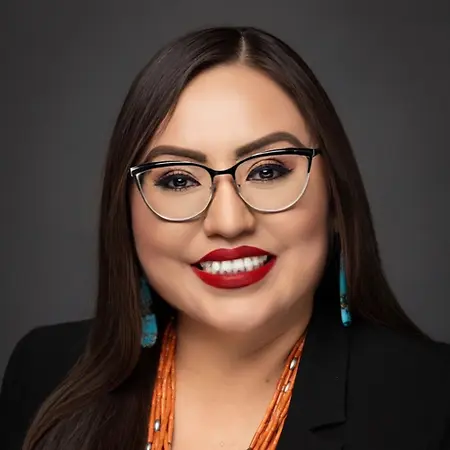
Marvina Pete is a Vice President and Senior Business Account Officer at First Southwest Bank, a community development financial institution dedicated to expanding access to capital and financial services in underserved communities. With more than 20 years of experience in banking, she leads the development of the bank’s business deposit program, supporting businesses, nonprofits, and foundations across multiple locations in rural Colorado. In her role, she is building the business banking segment from the ground up—establishing service standards, developing product offerings, negotiating third-party partnerships, and creating the internal infrastructure needed to deliver competitive, mission-aligned solutions. Her work blends strategy and execution, with a strong focus on operational excellence, staff development, and long-term community impact.
Marvina’s career reflects a deep commitment to both financial empowerment and community advocacy. Prior to joining First Southwest Bank, she spent many years at Wells Fargo, where she built a strong foundation in banking, leadership, and client service. Today, she brings that expertise into a CDFI environment, where her work directly supports economic development in Indigenous and rural communities. Beyond her corporate role, she actively serves in leadership positions across several nonprofit and community organizations, advocating for small businesses, youth development, and access to opportunity. Her approach is rooted in collaboration, accountability, and a genuine passion for helping others succeed.
Outside of her professional life, Marvina is deeply grounded in family and community. She lives on the Navajo reservation in New Mexico, commuting long distances while also helping manage her family’s open-range ranch, where they care for horses, cattle, sheep, and other livestock. A devoted wife of 15 years and mother of five, she values time spent with her family and embraces a full, purpose-driven life. She is an avid reader, enjoys podcasts and audiobooks, and expresses her creativity through photography and a small business managing social media. Marvina’s journey is a testament to resilience, balance, and the power of aligning career, culture, and community to create meaningful impact.
Her Interview
Ten minutes with Marvina
01What do you attribute your success to?
Honestly, I've had a lot of really great leaders, and I keep a lot of contact with them. I think support is everything - support from all realms. It could be support from your direct employees who you work with, your supporting manager, your peer group and friends, and support from family. My boss here, the Chief Operating Officer, is very hands-off and trusts me to do what I need to do, which has been a breath of fresh air I didn't know I needed. I also attribute my success to the exceptional training and development I received at Wells Fargo, where leaders really took time to develop me and teach me how to have difficult conversations, provide accountability, and care for my team. Those leaders taught me that accountability is caring, and they showed me how to lean into uncomfortable conversations because they come from a place of caring. The support I've received throughout my career, combined with the strong foundation my family gave me about accepting correction and accountability, has been instrumental in my success.
02What’s the best career advice you’ve ever received?
I received this advice when I was a brand new teller at Wells Fargo, just 2 days into the job. An executive leader named Kathy King walked right up to me and introduced herself, asked me how long I'd been with the company and what I wanted for my career. The fact that this executive was taking time to talk to a brand new teller who still had no idea what she was doing was very impactful and told me the type of culture and environment I was in. The advice she gave me was to be an advocate for change. She communicated that I would see many things change in my career and life - leadership change, staff change, products change, regulations change, market conditions change. Everything is constantly moving and adapting, and if I was ever going to get ahead, she strongly encouraged me to be an advocate for change. Because when you're an advocate for change, you're not affected by it, and you're able to pivot very quickly from hearing the news into executing your next steps for a different outcome. It coaches flexibility and adaptability. She told me I would find, as I expanded in my career, that I would run into people who fight change, and oftentimes them fighting the change or fighting something brand new didn't always work in their favor. She said this would be true not only in the workplace but in life too. That advice has taken me very far, and I've revisited it and shared it with people I love and care about multiple times because it's such a great message. You can always count on things changing, and if you're too busy mourning or too busy upset about what was, you can no longer get to what's in front of you.
03What advice would you give to young women entering your industry?
I would say, of course, embrace change is always a good one, but I think another go-to for me is get comfortable being uncomfortable. Challenge yourself to be uncomfortable, because at the very root of that feeling, the very root of that uncertainty - those knots in your stomach, the lump in your throat, all of those things that are happening in your body when you're doing something you've never done before that you don't know how to do - there's a certain amount of anxiety and nervousness tied to that. But the reality of that reaction and that feeling is that's you growing. That is you stretching yourself and learning something new. Not only embrace the changes, but also be okay not knowing everything. Be okay to accept the challenge of a new product, a new service, or a new process rolling out, and be the first one to say, I figured this out. You might be really scared, really nervous, you don't know what the outcomes are, you know you might embarrass yourself, you might not do it right, and you might make some mistakes, but that's okay. Because odds are, everybody else who's not willing to make those sacrifices and make those decisions and jump into knee-deep water, they're thinking the same thing. But the overall outcome of embracing that change or embracing that process is going to be delayed for that person. The quicker you're able to figure something out - and I'm always a fan of, you know you understand it and you know how to do it when you have the capability of teaching it. Challenge yourself to feel that every day. The moment you start getting comfortable and things become routine or expected, that also means you're not growing anymore and you're not striving anymore, and you're kind of in this circle of doing the same things. You have to ask yourself, are you doing those same things because that's where you find comfort? And if you continue doing that, are you really going to get the career outcome you're striving for? Are you really going to accomplish those goals you set for yourself if you allow yourself to be comfortable every day?
04What are the biggest challenges or opportunities in your field right now?
I think it's knowing that some of the individuals I work with don't always have the same experience I do. We have some leaders who have been here - this is the only bank they've ever worked for. When I brought up segmentation, like business segmentation, I had to explain what segmentation was. I had other leaders who worked for larger banks and they were vibing with me, they followed the conversation. So there's a lot of needs and a lot of creation around maybe some of the higher-tiered mechanisms that need to be created for an institution, and we're not quite there here. I think that is also because you have to create a lot of awareness and explain and elaborate - this is why this is important, and this is why we need to do it. You have to explain the why a little more, whereas if you have somebody who has a similar experience and the same knowledge as you do, you transition very quickly into execution. I've run into that on several different topics, but we're getting there. I think as long as we have leaders who are willing to learn and leaders who are willing to ask questions and speak up, there's a lot of value in being able to speak up and say, hey, I don't know what you're talking about, or could you back up and explain that to me? It takes some bravery and some vulnerability to say I don't know what you mean, can you please explain it to me? If they're not communicating it, then you're going into execution mode and they're not in tune with you.
05What values are most important to you in your work and personal life?
I'm really big on transparency. I think being transparent is more like a front-end active activity, whereas honesty is a result of maybe you trying to get away with something. If I take the last cookie from the cookie jar and I don't tell anybody, nobody's going to know. But if somebody asks, then I'll be honest and say yeah, I took the last cookie. But being transparent, I'm like, I just took the cookie from the last cookie jar, so I don't know who's replacing it or who's making more, but there's no cookies in there now. I really value transparency, and I think transparency does many things - it discloses positive intent, it discloses the initial intentions of any conversation, and transparency allows people to react and respond. Another value that's critical to me is accountability. I learned early on from my parents that correction comes from a place of love - that only if somebody cares for you and loves you, they will say hey, you're messing up. The way accountability and correction was taught to me growing up was that anybody older than you has the ability to correct you, and you should not be upset about getting corrected because it is coming from a place of love and caring. You really have to care for someone to have that type of conversation with them. I had a leader who shared that accountability is caring, and it's true because those conversations are tough and uncomfortable, but they're not impossible to have. I think oftentimes people lean away or don't want to have those conversations, but getting comfortable being uncomfortable is really how those conversations move to forward momentum. I've learned to lean into difficult conversations because they come from a place of caring, and I've been appreciative of that lesson throughout my career.
Join Influential Women and start making an impact. Register now.