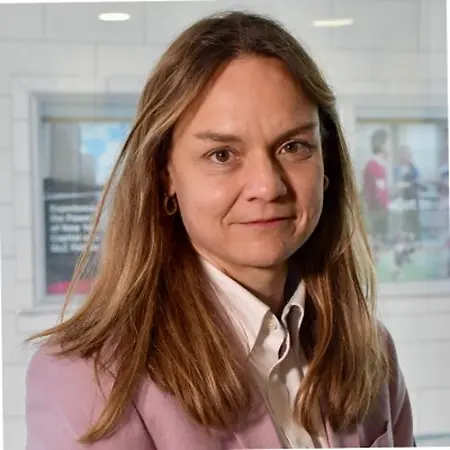
Her Story
About Mary
I wanted to pursue law from an early age, but life took a different path and I worked in colleges for 10 years. I actually got into a PhD program in the cultural foundations of education, but I thought about it and realized I wanted to be able to do academic research and writing, but also practice and represent clients from disadvantaged backgrounds who might not have access to justice otherwise. That's always been my driving force. The law degree pulled everything together - it gave me the opportunity to teach, write, and think, but also to truly make a difference in a practical way by representing clients and helping them get their best shot in court and honestly, in the system. If I had gotten the PhD in higher ed, I couldn't do anything like that. I could evaluate things and write programs, but I couldn't go in and say this violates the person's rights. So it's taking theory into practice. I've been with the court system for 6 and a half years in different positions, and my area of law is guardianship. My main work involves legal administration, supervision, and program development. I'm most proud of helping create the New York Youth Law Academy for 41 high school students at the University of Rochester - it's a free program for basically inner-city kids in Rochester, New York. I also taught constitutional law at SUNY Brockport and legal research and writing at Albany Law School, and I absolutely love teaching and mentoring students. I'm also writing articles now. Additionally, I go to the landlord-tenant pro bono court twice a month on Thursday nights to represent clients who are about to get evicted and can't afford representation.
Her Interview
Ten minutes with Mary
01What do you attribute your success to?
I've had some truly incredible mentors along the way who have valiantly given me their time, thinking, energy, and heart for free. They've really guided me and helped me to find where I fit and what's possible. And I also have some of the best friends in the world.
02What’s the best career advice you’ve ever received?
Let them tell you no.
03What advice would you give to young women entering your industry?
I think, to the extent possible, to toggle between now and 5 years from now, which is not easy, but I think remembering that the landscape, especially with respect to technology and AI, is and likely will be significantly different in the future. So those entering law school right now are going to be getting an experience that could very well may be outdated technologically in 3 years. That said, the ability to think about a problem critically, humanly, is still invaluable.
04What are the biggest challenges or opportunities in your field right now?
I think there is a way to utilize technology to provide access to justice and to the court system in a way that pro se litigants have never had before. I think there's also the opportunity for those in the field to create intelligent AI that can also enhance the work of legal practitioners in a way that previous computer systems haven't been able to. On the AI front, I think there's so many opportunities to help those without representation or access to justice and to the systems. I think there's a lot of work that can be done there. The other piece to it, though, is using AI responsibly and being able to not just trust whatever the outcome is. You still need to have a critical perspective on what AI is producing, and there's a series of cases out there now that discuss exactly this, where people just went in ChatGPT, and ChatGPT hallucinated, and then the attorneys never checked the cases. That's almost like human error, but it's also system error too right now. So there's so many ways that AI can improve the system, but it requires some significant oversight and critical analysis from technicians and lawyers. Without that kind of perspective or approach, it could be deadly, almost.
05What values are most important to you in your work and personal life?
Absolute integrity, far and above. Human dignity - dignity of all humans. And ethical social fairness. I'd say dignity and integrity, dignity of people and institutions.
Join Influential Women and start making an impact. Register now.