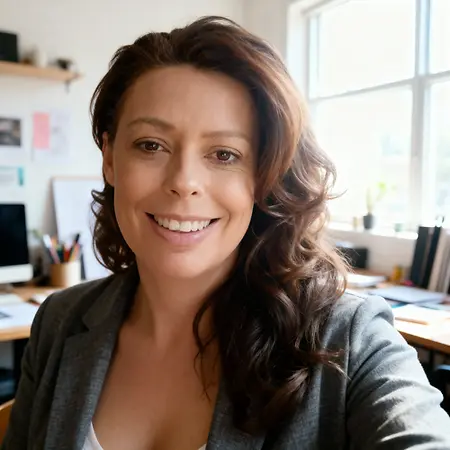
Her Story
About Mary
Mary Stanley is the Founder and Company Owner of Supportive Minds, a trauma-informed organization dedicated to autism, nervous system regulation, and neurodiversity support. A veteran, wife, and mother, Mary’s professional work is deeply informed by her personal journey raising children with autism, including a minimally-speaking child with high support needs.
After facing limited and rigid therapy options, Mary committed herself to understanding brain wiring, sensory processing, and nervous system regulation. Through extensive research and collaboration with international experts, she implemented brain-based regulation strategies focused on strengthening neural pathways and supporting emotional safety.
Over time, her son demonstrated significant improvements in communication, emotional regulation, and social engagement. He progressed from experiencing frequent distress and limited expressive language to developing stronger verbal skills, increased resilience in public settings, and improved self-regulation. While autism remains part of his identity, his ability to navigate daily life with greater confidence and connection has expanded dramatically.
These measurable changes reinforced Mary’s belief that development is dynamic and that nervous system-informed approaches can create meaningful growth. The methods she refined within her own family now guide her work through Supportive Minds, where she equips parents and professionals with practical tools to reduce meltdowns, prevent burnout, and build sustainable regulation skills.
Mary believes improvement is not about “fixing” a child—it is about unlocking capacity, building safety in the nervous system, and creating environments where growth becomes possible.
Her Interview
Ten minutes with Mary
01What do you attribute your success to?
I attribute my success to helping people see a kid as a kid first.
When I have the opportunity to talk about what I do and help others understand children as individuals—not diagnoses—that’s what success means to me. Success is when a law gets passed or a regulation changes in a way that protects and supports these kids. Success is when a child who once couldn’t speak finds their voice. It’s about creating real, tangible change in children’s lives.
It’s also about reminding families that their children deserve to be children. They deserve to play in the dirt, be creative, explore, and have a childhood—not spend 40 hours a week in therapy trying to fit a mold.
My success comes from refusing to accept the status quo. When professionals told me I was wrong for approaching autism as a brain and nervous system issue rather than strictly a psychological problem, I chose to keep researching, learning, and trusting what I was seeing in real life. I stopped trying to follow scripts and narratives that weren’t aligned with what I knew was possible.
The moment I began speaking authentically—without filtering my perspective to make it more comfortable for others—that’s when people started listening. That’s when families started finding hope.
For me, success isn’t about recognition. It’s about children being seen, families feeling empowered, and systems shifting so kids can grow up as kids first.
02What’s the best career advice you’ve ever received?
The best career advice I've ever received is to be myself and don't follow the status quo. When I first started, I couldn't speak effectively because I was trying to read scripts and follow the narrative that others expected of me. I was doing my own thing from day one, which wasn't the status quo, and people were trying to get me to make videos and follow their format. When I tried to do that, I sounded like I couldn't even talk. But once I just stopped trying to fit their mold and just talked authentically as myself, that's what brought people in. Being true to myself and my approach, even when it went against traditional methods, has been the key to my impact.
03What advice would you give to young women entering your industry?
The advice I would give to young women entering this field is this: trust your mind, trust your instincts, and don’t shrink to fit into someone else’s framework.
You will encounter systems, titles, and professionals who speak with authority. Respect expertise—but don’t silence your own critical thinking. If something doesn’t align with what you’re seeing in real life, ask questions. Research. Stay curious.
Focus on solutions, not just the problem itself. It’s easy to become consumed by what’s broken—by diagnoses, deficits, policies, and limitations. But real leadership comes from asking, “What can we build? What can we change? What can we improve?” Don’t become the problem by fighting endlessly against it. Become the solution by creating something better.
Do not feel pressured to follow the status quo simply because it’s established. Innovation rarely comes from comfort. If I had accepted what I was told without challenging it, I would not have seen the progress I’ve witnessed in my own home or in the families I serve.
Build resilience. This work is emotional. It requires boundaries, balance, and the courage to stand firm when your perspective isn’t popular.
Most importantly, lead with dignity. See the child before the diagnosis. See the person before the problem. If you stay anchored in that principle, your work will matter.
You don’t need to be louder than everyone else in the room. You need to be clear, steady, solution-oriented, and authentic.
That’s what builds lasting impact.
04What are the biggest challenges or opportunities in your field right now?
Challenges include outdated therapies that don't help parents learn, frozen or delayed state funding in Minnesota that disrupts services, stigma toward parents and a concerning suicide risk among neurodivergent youth. Opportunities lie in adopting brain-based approaches and changing school practices and regulations so children receive education and appropriate services concurrently.
05What values are most important to you in your work and personal life?
The most important value to me is putting my kids first - that's stated clearly in all my paperwork when I work with clients. If my son or my kids are having an issue or a health issue, I will reschedule clients, because family comes first. I value helping people understand that asking for help is not a sign of weakness, but actually a sign of strength. I believe strongly in giving children with autism the chance to actually be children - to play, get dirty, be creative, and have a childhood rather than spending all their time in therapy. I value meeting people in the middle rather than forcing them to mask who they are or avoid situations entirely. It's about teaching practical coping strategies and understanding that everyone experiences discomfort in life, so we need to learn how to deal with it constructively. I'm passionate about making sure these kids are seen as kids first, not just as diagnoses, and ensuring they get the education and opportunities they deserve.
Join Influential Women and start making an impact. Register now.