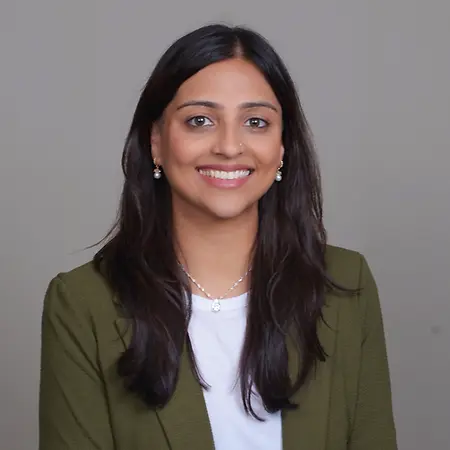
Her Story
About Maryam
Maryam Siddiqui, M.S., LPC-S is the Associate Clinical Director at Evolve Psychiatry and a Ph.D. candidate in Counselor Education and Supervision at Sam Houston State University. With nearly a decade of clinical leadership and direct practice, Maryam has built her career around advancing evidence-based behavioral healthcare, with specialized expertise in supporting children and adolescents navigating complex emotional, psychiatric, and trauma-related challenges.
Maryam earned her Master of Science in Clinical Mental Health Counseling from The Johns Hopkins University, completing advanced clinical training through the Department of Psychiatry and Behavioral Sciences at Johns Hopkins Hospital. She later served as a Behavioral Health Clinician at Texas Children’s Hospital, where she was instrumental in launching an Intensive Outpatient Program (IOP) for youth, authoring CBT- and DBT-informed treatment curricula, and strengthening clinical safety frameworks. Her background also includes impactful clinical work at Baylor College of Medicine on a SAMHSA grant, providing multidisciplinary care for youth with severe emotional disturbances.
In her current executive role at Evolve Psychiatry, Maryam leads the therapy department—spearheading clinical program development, establishing operational standards, and supervising a team of mental health professionals while maintaining active direct client care. Her scholar-practitioner approach integrates executive strategy, rigorous quantitative research, clinical supervision, and trauma-informed practice. Guided by a core commitment to connection, advocacy, and continuous quality improvement, Maryam is dedicated to shaping innovative models of care, providing supervision, and mentoring the next generation of mental health professionals.
Her Interview
Ten minutes with Maryam
01What do you attribute your success to?
I attribute my success to three interconnected pillars: foundational family values, a strong partnership, and the grounding experience of motherhood.
- Roots & Upbringing: My parents instilled in my brothers and me a relentless work ethic, a passion for learning, and a responsibility to give back to our community—shaping my initial drive to achieve.
- A Supportive Partnership: Having an unwavering, supportive husband provides the stability and encouragement needed to balance executive clinical leadership, research, and doctoral work.
- The Perspective of Motherhood: Being a mother to our toddler has brought an entirely new depth to my grit and determination. Parenthood sharpens my focus, reinforces my purpose, and serves as a daily reminder of why creating high-impact work matters.
02What’s the best career advice you’ve ever received?
The best career advice I ever received came from Dr. Michael Clark at Johns Hopkins: approach clinical practice through a blended lens of science and creativity. Textbooks, research, and evidence-based protocols provide the vital scientific foundation, but every client arrives with a deeply nuanced human story. Real therapeutic impact happens at the intersection of empirical rigor and creative flexibility—knowing how to take scientific frameworks and artfully adapt them to fit the unique realities of the individual in front of you.
03What advice would you give to young women entering your industry?
Anchor yourself in empirical rigor, but never lose sight of your intuition and humanity. Behavioral healthcare and higher education demand high standards of science and leadership, but our greatest impact comes from building authentic connection and driving systemic change. My advice to young women entering clinical leadership and counselor education is threefold:
- Own Your Expertise: You do not need to choose between being deeply compassionate and academically rigorous—the strength of our field lies in mastering both.
- Build Bridges, Not Just Models: Seek out mentors, invest in strong professional networks, and actively create pathways for other women to step into leadership.
- Embrace Agility: Treat every challenge as a dataset. When things don't go according to plan, pivot with curiosity rather than self-doubt.
04What are the biggest challenges or opportunities in your field right now?
Right now, our industry is facing a critical inflection point. The biggest hurdles continue to be access disparities in rural and under-resourced areas, structural stigma, and high clinician burnout driven by resource limitations. The promising news is that we are seeing unprecedented opportunities to modernize care. Integrating mental health services into primary care settings allows for earlier detection and intervention. Concurrently, by combining data-driven clinical frameworks with dedicated policy advocacy, we have the opportunity to reshape mental health infrastructure and expand high-quality, trauma-informed care to communities that need it most.
05What values are most important to you in your work and personal life?
Connection and lifelong learning serve as the compass for everything I do, both professionally and personally. True leadership and meaningful therapy both begin with empathetic, authentic relationships—valuing the unique narrative every individual brings and remaining intentionally open to diverse perspectives. Alongside connection, I view lifelong learning as an ongoing commitment to growth. Whether through quantitative research, clinical supervision, or personal reflection, staying curious about the world and the people around me ensures that I am constantly evolving as a leader, clinician, and advocate."
Join Influential Women and start making an impact. Register now.