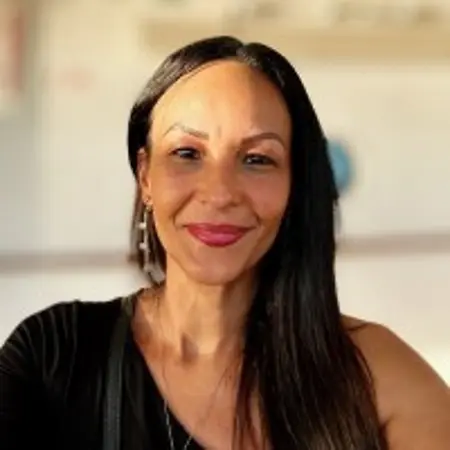
Her Story
About Mayra
Mayra Vega, RDMS OB-GYN, RVT, Ultrasound Technologist at Akumin®, is a skilled and dedicated Ultrasound Technologist with clinical expertise in obstetric, gynecologic, and vascular imaging. Based in Fort Lauderdale, Florida, she currently serves at HCA Florida Westside Hospital, where she supports high-quality patient care through accurate diagnostic imaging, technical precision, and a strong commitment to clinical excellence. She also brings additional experience from leading healthcare organizations, including Akumin and Roshal Health, where she has worked in diverse outpatient, hospital, and mobile imaging settings.
Mayra transitioned into ultrasound technology after beginning her career in health insurance sales and customer service with UnitedHealthcare. While she has always had a strong interest in healthcare and science, she sought a more hands-on role where she could directly impact patient care. That decision led her into sonography, a field she finds both fulfilling and meaningful. She is especially passionate about the patient experience, recognizing the importance of empathy and emotional support when working with individuals facing complex conditions such as pelvic cancer or undergoing treatments like chemotherapy and radiation. For her, ultrasound is not only about imaging but also about providing comfort, compassion, and human connection during vulnerable moments.
Throughout her career, Mayra has continued to grow through hands-on experience and advanced training. One of her most significant achievements was completing a travel assignment at Beth Israel Deaconess Medical Center in Boston early in her career, where she gained exposure to high-acuity cases in one of the nation’s leading transplant centers. She has also traveled across Florida, including assignments in Orlando, Gainesville, Ocala, and Tallahassee, working with diverse patient populations and expanding her clinical skill set. She holds an Associate of Science in Diagnostic Medical Sonography from Southeastern College, along with RDMS (OB-GYN) and RVT credentials from ARDMS. Her work reflects resilience, adaptability, and a deep commitment to both the science and humanity of ultrasound imaging.
Her Interview
Ten minutes with Mayra
01What do you attribute your success to?
I attribute my success to being responsible and trying to learn more about what I do, educating myself all the time. In radiology and ultrasound, they come up with different technologies all the time, so you've got to be on top of what's out there and try to learn a little bit more about what you're doing and everything that's new about your career. That way you don't fall behind and you continue to succeed and do your best. You have to use new technologies and knowledge to improve your skills in what you do.
02What’s the best career advice you’ve ever received?
The best career advice I’ve ever received is to never give up. I’ve learned that success is rarely immediate or linear, and that setbacks, challenges, and moments of uncertainty are a natural part of any professional journey. Staying consistent, remaining committed to my goals, and continuing to move forward even when progress feels slow has been essential to my growth. This mindset has helped me build resilience, learn from challenges, and maintain focus on long-term success.
03What advice would you give to young women entering your industry?
I would say that working hard, putting in all the effort, and being consistent and disciplined is key to succeeding in this industry. When I was going to school for ultrasound, it wasn't an easy career. It was very tedious because I was working full-time and had to go to school at night. I had to discipline myself. You don't have to be a genius to be good at something, you just have to be disciplined, put in the effort, and know that you can do it. Believe in yourself, that's the most important thing, no matter what others say. Effort, discipline, and passion are essential. If you really like to do something and you fail, because we're going to fail sometimes, you've got to get up and continue if that's what you really want to do. A lot of successful people have failed before in athletics, literature, business, everything you can think of. That doesn't mean if you fail one time or two times that you can't still get up and do it if you keep trying.
04What are the biggest challenges or opportunities in your field right now?
Sometimes working with old equipment or equipment that's not that great is a challenge, so you have to work extra hard or put in double the effort to get good results. I would also say sometimes compensation is not that great. It is still a very well-paid career, but I think sometimes we put a lot of ourselves into it because it's not an easy job. It's not like a desk job where you sit behind a desk for 8 or 9 hours. You've got to think a lot. It's physical because you have to deal with patients, run around to different places, help the patient get on the bed, and do all of that, especially at the hospital. It's a very tiring position. When you get home, you just want to relax. But like I said, if you like what you're doing, it doesn't matter what you come against, you can always go forward and do it.
05What values are most important to you in your work and personal life?
Treating people with respect, empathy, and trying to understand what they feel and how they're feeling is most important to me, especially when it comes to patients with pelvic cancer or people in really bad conditions. I think empathy is one of the biggest and most important characteristics that a person should have in this field. Any type of healthcare worker needs to have that because you at least have to understand the patient. Sometimes patients don't feel very well or are feeling down, and they talk to you about it. So you've got to be a shoulder to cry on too, because it's not just going there, scanning the patient, and that's it. Even though sometimes it feels like it, especially in an outpatient center, you still get people that have gone through cancer, radiation, and chemotherapy. I think it's important that you understand and talk to your patient, understand a little bit of their background, and especially their medical history.
Join Influential Women and start making an impact. Register now.