Her Story
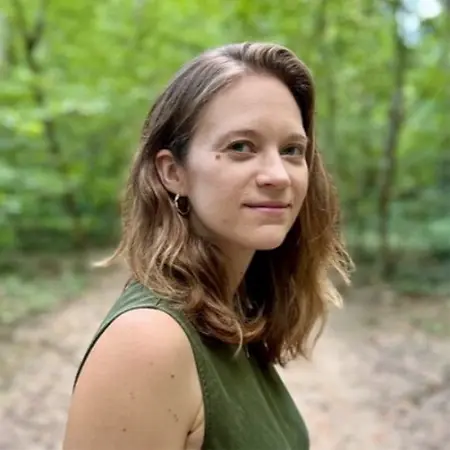
About Meagan
I work primarily in heritage language education, focusing on speakers who come from multilingual homes, usually immigrant homes. My main work involves building curricula for heritage speakers and helping them feel confident and motivated to learn their heritage languages while supporting their multicultural, multilingual identity development. As Director of Multilingual Education at the University of Rochester, I work extensively with master's students training to teach any language - whether English as a second language, Spanish, Arabic, Mandarin, German, or others. I teach them how to build curricula and lesson plans, classroom management, and teaching methods for K-12 settings. I also work with PhD and EdD students on the research side, conducting classroom-based and community-based research on language learning in ethical and valid ways. My work has taken me around the world - as a Global Fulbright Scholar, I spent two months each in Argentina, Greece, and Austria working with teachers and researchers on community-based language learning and critical language pedagogy, bringing the real world into the classroom. These collaborations continue today, two years later, as I work with educators internationally on curriculum design and teaching methods. My background uniquely positions me for this work - I started as a bilingual science teacher in New York City with degrees in chemistry and chemistry education, teaching students who didn't speak English and struggling to translate materials and connect with students speaking Mandarin, Arabic, Japanese, and other languages. This challenge led me to pursue a master's in applied linguistics in Spain and eventually a PhD at Georgetown University in Spanish Applied Linguistics, allowing me to now collaborate across science education and language education departments.
Her Interview
Ten minutes with Meagan
01What do you attribute your success to?
I attribute my success to a combination of factors. Part of it is luck - being in the right place at the right time. But a huge part has been building social connections with people. You can be the smartest person in the world and not know how to talk to people, and they're not going to want to listen to you, help you, or collaborate with you. I genuinely enjoy talking to people and listening to their experiences, and I think that has made it so that I've had a lot of help in my career, a lot of support, and a lot of people willing to stick out their neck for me. Without that, I think it's really hard to build anything. And of course, there's been a lot of hard work - many long hours of studying, researching, adapting schedules, and adapting to other people. But yeah, a lot of help along the way, and some luck.
02What’s the best career advice you’ve ever received?
The best career advice I ever received was when I was a teenager, just starting college: if it doesn't feel right, it probably isn't. I think that's so true. When people say they don't know how they feel about a career or they're not really vibing with it, you usually do have a gut feeling. We try to overanalyze things today and do our pros and cons lists, and those things help, but nine times out of ten, when you look back, people know when something wasn't for them and when they were passionate about something. So when something feels right, you know to look into it more, and when something doesn't feel right, just notice that. That's how I've found the people I want to work with and collaborate with - you get a certain feeling, it lands differently on your system, on your nervous system. With social media now, it's so hard to tune in to what we really feel and think because we've got so many people telling us what to think and how to feel. So being aware of just how you're feeling about something - that's the best advice I ever got, and it's served me well so far.
03What advice would you give to young women entering your industry?
Stand up for yourself, even when it feels uncomfortable. Especially as women in education, we're meant to be caring, keep others in mind, and step in - this is what we expect of women as a society. If you're in education, you're probably even more expected to be kind, understanding, go with the flow, and be a team member. But sometimes that is on the backs of women. Just because you're in a field that thinks a lot about well-being and taking care of others doesn't mean you can't stand up for yourself, and you really have to sometimes. It is uncomfortable, but you need to demand the respect and value that you put into what you're doing. This doesn't come naturally to a lot of people, especially women in education. We're in education because we want to take care of others - if you're a teacher in any way, you're used to taking care of others' needs. So standing up for your own needs is really uncomfortable. But that's not how the systems work - they work by getting as much out of you as they can a lot of the time, so you really do need to speak up sometimes. It's still very uncomfortable for me, but I'm willing to do it because it just needs to be done. I've had other strong women mentor me along the way on how to ask for things, how to put your foot down, and how to not take on more than you can. I'm still learning.
04What are the biggest challenges or opportunities in your field right now?
One of the biggest challenges is that we have a mass exodus from education - a huge problem with educator retention at both the K-12 level and the university level. Lots of professors are leaving and going into industry or consulting. Why? Because teaching is hard, but we've also invested less and less in education, especially in the U.S. We have a society that doesn't have a lot of faith in educators, with expressions like 'those who can't do, teach' - we look at teachers like they're not trained professionals. Teachers have had enough of not being able to afford to live in the place they teach, commuting an hour or two hours to their schools, working with very limited resources. Nobody goes into education to make money, but you should be able to have a comfortable life and a family without scrambling, hustling, and working two or three jobs. This becomes a difficult conversation when my students training to be teachers come in with challenges and doubts, and I have to say, yeah, that's how it's been for decades - is it going to get better? We're working on it, but we need the politics to change. We have tons of people who would love to be teachers, who are passionate about education and working with kids, but they're saying this isn't worth it. If we don't have people who want to go into teaching, and people are leaving when they do go into teaching, who's left to teach our kids? There's such a level of uncertainty right now in most educational settings - not knowing where resources are coming from, not having time to plan. The general economy hurts too - parents need to spend more hours at work, so kids need to be in extracurriculars more, but that requires teachers to spend more time with students when they're already not having time or pay for what they're doing. It's a whole cycle, and the challenge is where do you start? Keeping morale up is really challenging because everybody in education is pulled in ten different directions. Often it's not that we don't know how to fix things or couldn't know if we had the time to discuss it - it's that we don't have the time and resources to really dive in and dedicate to it.
05What values are most important to you in your work and personal life?
Respecting people and their time is a huge value for me, and something I really prioritize, especially in education where teachers and educators are overworked, underpaid, and asked for more and more all the time with less and less flexibility. At the university level, we're asked to wear so many different hats, and at the K-12 level, teachers are doing even more. My work depends on me working with schools, teachers, and their students, so I try to really be aware of people's time and to value people. You need to value people and their time, and really value different experiences that are maybe non-traditional than what we've been told are worth something. I would say most people who work in a school of education would agree that people's well-being comes above any project or project outcomes. People's happiness, people flourishing, people being able to regulate their system - all of that comes above any work tasks. Sometimes that means sitting down and chatting with people, and we didn't do the test we were going to do today, but that's what this teacher or student really needed today, and that's okay. That's what education is, also. We need systems that value humans.
Join Influential Women and start making an impact. Register now.