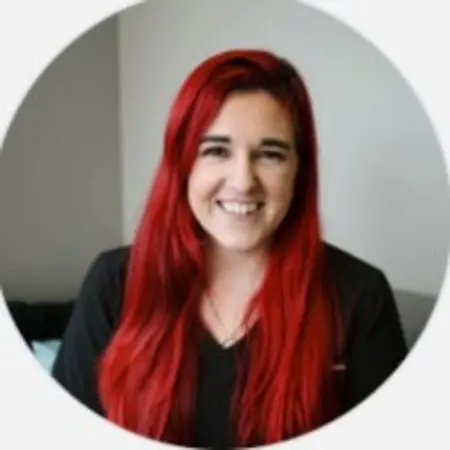
Her Story
About Megan
Megan Collins, DAT, LAT, ATC, has been a certified athletic trainer for 10 years, with a career spanning collegiate athletics, orthopedic clinics, wellness centers, and high schools. Currently, she serves as the head athletic trainer at a Minneapolis high school, where she manages afternoon administrative tasks, provides treatment and rehab for student-athletes, and offers medical coverage during practices and home events. Megan’s career reflects her dedication to athletics and her commitment to supporting athletes across a variety of settings.
Her clinical philosophy centers on the "three E's": experience, education, and empowerment. She prioritizes listening to each patient’s experiences, educating them about their bodies and treatment options, and empowering them to make informed healthcare decisions. Megan is committed to continuous learning, staying up to date with practical skills like dry needling, cupping, and kinesio taping, and networking to bring the best care to her athletes.
Megan earned a Doctorate in Athletic Training from Indiana State University, a Master’s in Exercise Science from Concordia University-St. Paul, and a Bachelor’s degree in a related field. She is an active member of the National Athletic Trainers Association and the Minnesota Athletic Trainers Association and contributes to dissertation boards and national programs like AT’s Care. Her dedication to athlete health, rehabilitation, and education has earned her recognition as one of the 2026 Influential Women in Minneapolis, Minnesota.
Her Interview
Ten minutes with Megan
01What do you attribute your success to?
I would say the support of the people around me, as well as my dedication to working hard. I always had people cheering me on. In the darkest parts, and the hardest parts, and the blood, sweat, and tears, I had people that were helping me get back up, and supporting me, and saying, you got this. I actually met my husband after my first semester in my doctorate, so we had met and started dating and got married all within that program, so he really is the reason that I pushed and was able to push through that and really get through it. I'm dedicated to learning and picking myself up when I fall, and learning from mistakes, instead of just making them over and over again. So, I think it's a combination of all of those things that's helped me to continue this journey when I wanted to give up, or to excel and get to the top of what I can do.
02What’s the best career advice you’ve ever received?
The best career advice I’ve received is to always network and ask questions—there’s so much to learn from those with more experience and stepping outside your comfort zone often leads to guidance, opportunities, and insights you wouldn’t have found otherwise.
03What advice would you give to young women entering your industry?
I would advise young women entering sports medicine and athletic training to network proactively, ask questions, seek out mentors, persist through bias or setbacks, and use every opportunity to demonstrate that greater representation is possible.
04What are the biggest challenges or opportunities in your field right now?
The biggest challenge I face is being a young female in what is still a male-dominated world, even though athletic training as a field is actually more female-dominated with about a 56-44 split. While things are getting better, I still get different comments of sexualization, or men saying this or that, and men get treated differently than I do, even when I have more education and accolades than a male counterpart may have. Sometimes just having my voice heard has been a challenge. I also have bright red hair, piercings, and tattoos, so how I look and present myself sometimes makes people not want to listen. It's almost like I've had to work extra hard to really get my foot in the door to the higher accolade-type positions. As for opportunities, I'm involved with my master's degree institution on their kinesiology dissertation board, and they've given me a speaking opportunity coming up next month to speak to students about where do we go from here and what we do with our career if we don't want to be in academia. There are always opportunities to be involved, whether it's with our national and statewide athletic trainers associations, opportunities to lobby with politicians, serve on boards, and be part of teams. I'm also involved with AT's Care through NATA, where we support athletic trainers who've gone through critical incidents. There are so many opportunities to give back and be involved with the profession as a whole.
05What values are most important to you in your work and personal life?
In work especially, and this goes for everything, it's just listening to people. I'm in a field of healthcare, and especially right now, I work with high schoolers, and so many people dismiss them. It's about listening to the person and hearing what they are saying in front of you. My clinical philosophy centers on three values, the three E's, which is experience, education, and empowerment. I want to hear about your experience - what's your experience with this? Was it a positive one? Was it a negative one? And what's my experience with it? Because then I can bring that expertise into our conversation. Then, can I educate them? It's my job as a healthcare provider to educate, and I want to teach you something. I want you to walk away feeling like you understand your body better than when you walked in. And that ties into the third, which is I want to empower you. I want to empower people to help make their own healthcare decisions, and feel empowered to know what's going on, and what to expect, and what we're doing. So it's not just me saying, this is what you have, this is what we're doing, and good luck. I want to make sure that people are involved in that. That overflows into personal life as well - listening to people, talking to them, and really just hearing what they have to say, because a lot of times they have different experiences or different things that can be really impactful, and you just see them as a person when you actually listen to them.
Join Influential Women and start making an impact. Register now.