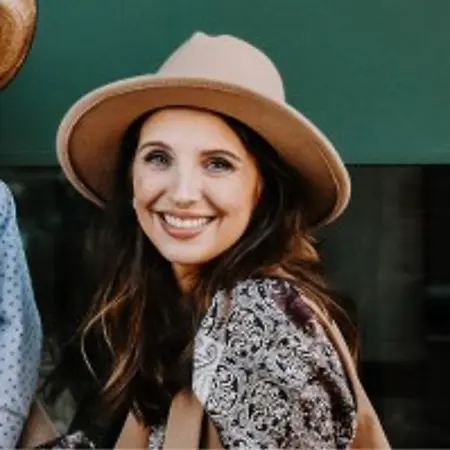
Her Story
About Megan
Megan Garrett is a nonprofit and community development professional specializing in strategic planning, grant administration, fundraising, and cross-sector collaboration. She currently serves as Director of Strategic Partnerships with Habitat for Humanity of Springfield, Missouri, where she leads development strategy, cultivates major donor relationships, and builds mission-aligned partnerships that strengthen organizational capacity and community impact. Her work is grounded in a people-centered, data-informed approach that focuses on turning collaboration into measurable, sustainable outcomes.
Megan began her nonprofit career immediately after graduating in 2018 from College of the Ozarks with a bachelor’s degree in Family Studies and Social Services with a geriatric emphasis. She initially envisioned a long-term career in senior services and began working with SeniorAge Area Agency on Aging, where she provided case management and supported senior day center operations. One of the most defining experiences of her early career was rapidly transitioning an entire community-based senior program to a fully remote model within 24 hours at the onset of COVID-19, a challenge made even more complex in a rural setting with limited access to technology. After several years in senior services and a brief transition into the corporate sector, she realized her strongest alignment remained in mission-driven work and returned to the nonprofit field.
She went on to serve as Grants Administrator with Harmony House Family Violence Prevention Center, where she helped strengthen and expand the organization’s grants infrastructure in partnership with the development team. She later joined Community Partnership of the Ozarks as Director of Community Collaboratives, leading cross-sector stakeholder groups focused on advocacy and community-based problem solving. Across each role, Megan has developed a reputation for building and rebuilding programs, particularly in environments that require structure, strategy, and sustainable systems development. In her current role, she continues to apply that strength by guiding development operations and shaping partnerships that align donor vision with community need, viewing nonprofit work as a bridge where philanthropic investment is translated into real, tangible community impact.
Her Interview
Ten minutes with Megan
01What do you attribute your success to?
I don't think there's any one particular achievement that defines my success - to me, it's really about the culmination of my ability to adapt to every circumstance and do every day to the best of my ability, no matter what I'm working through. I've had to adapt through a pandemic, adapt coming out of a pandemic, help a nonprofit build their grants program through all of that, and navigate the continually shifting federal funding landscape and donor landscape. My most notable professional achievement has been this ability to adapt through multiple circumstances. I've also found that one of my biggest strengths has been coming into situations that either need to be built or rebuilt in a new way and taking on that challenge of rebuilding a program or building out a program from the beginning. Whether it was shifting an entire community-based senior citizen program fully remote in about 24 hours during COVID in a fairly rural community where technology is a struggle, or building out grants administration programs, I've learned to embrace change and challenge as opportunities for growth.
02What’s the best career advice you’ve ever received?
The best career advice I’ve ever received is that I can adapt and overcome any situation that arises. Over time, I’ve learned that challenges, unexpected changes, and difficult circumstances are an inevitable part of any professional journey, but they are also opportunities to grow and strengthen both my skills and my perspective. This mindset has helped me stay focused and solution-oriented, especially in fast-paced or high-pressure environments, and has reinforced my confidence in my ability to navigate uncertainty, problem-solve effectively, and continue moving forward regardless of the obstacles I face.
03What advice would you give to young women entering your industry?
My advice to young women entering this field is to remember that your work has the power to meaningfully help others and strengthen your community, and that responsibility is both important and deeply rewarding. The nonprofit and community development sector can be demanding, but it is also incredibly impactful, and success comes from staying committed to the mission while continuing to build your skills in communication, collaboration, and strategic thinking. Don’t underestimate the value of persistence, relationship-building, and learning how to navigate challenges with patience and creativity. Most importantly, trust that your perspective matters—your ideas, your voice, and your commitment to service can directly shape programs, partnerships, and outcomes that improve lives.
04What are the biggest challenges or opportunities in your field right now?
One of the biggest challenges in this field is balancing growing community needs with limited resources, while also navigating a funding environment that increasingly demands clear, measurable impact and long-term sustainability. At the same time, there is a strong opportunity to build deeper cross-sector partnerships and improve how organizations collaborate to address complex issues more effectively.
In my current role, which I’ve only recently stepped into, I’m still learning the full scope of these dynamics, but it’s already clear there is meaningful opportunity to strengthen donor and partner relationships and help build more streamlined, intentional systems that better align resources with community impact.
05What values are most important to you in your work and personal life?
Working in nonprofits has always been about the mission for me - nothing that you do is for the love of yourself, it's for the love of the mission, and that's the most important piece. Throughout my career, I've been drawn to work that touches my heart personally. I loved working in geriatrics because I had been a CNA since I was young and worked my way through college on the night shift of a nursing home in memory care. Working for the women's shelter spoke to the challenges I had overcome in my childhood and early adult life, coming out of a family dynamic that included some domestic violence, so that was truly touching to me on a personal level. Now at Habitat for Humanity, I get to combine my passion with my husband for buying houses and remodeling them with my professional work, which is so rewarding. Outside of work, it's really important to my husband and me to give our children a really robust and well-rounded education outside of academics. Most of my free time is spent with my husband and two small children, and when I'm not with them, I'm helping the community through my work and board service.
Join Influential Women and start making an impact. Register now.