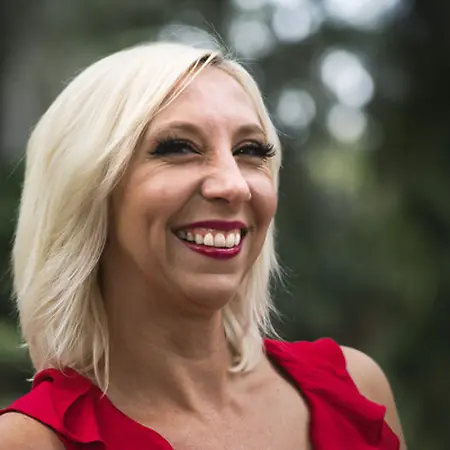
Her Story
About Megan
I've been working in nonprofit arts since 2006, and my entire career has been about seeing the field from multiple vantage points. I'm a professional performing musician who studied opera at the Peabody Conservatory, and I've always worked in arts administration alongside my performing and recording path. These multiple pillars reinforce each other because I see the field from being the person on stage performing and from behind the scenes doing the administrative work. Earlier in my career, I reviewed performances from a music journalism and criticism perspective. I also have a coaching business where I help performers and composers understand the business elements of their creative careers, because so many get training in their craft but then realize they're not sure how to build a sustainable business without burning out. I'm passionate about proving we don't have to be starving artists. Since 2018, I've been executive director of The Live Music Project, an arts service organization that does classical music advocacy and builds technology to support the field. We created a national and international concert calendar and Spontaneous Free Tickets, a program that's distributed over $80,000 worth of free tickets to first-time listeners while gathering feedback for arts organizations. We're about to launch the platform version nationally. I also do marketing and PR work freelance for other arts organizations, research creative placemaking and how we experience and maintain our identities through the places where we live and work, and I'm a faculty member at Peabody teaching professional studies like entrepreneurship, branding, marketing, and grant writing. I perform regularly in a duo with my significant other.
Her Interview
Ten minutes with Megan
01What’s the best career advice you’ve ever received?
One of my most important mentors was a professor at Peabody who I've stayed in touch with over the years. They were so helpful when I was a wide-eyed grad student wanting to do all the things. They helped me understand what is achievable on your own and what's achievable when you team up with people - that feeling that you don't always have to be the only one, you don't have to do everything all by yourself. Sometimes it's really valuable to work in a team or work inside something, get everything you can learn out of that situation, and then break out on your own. That's part of entrepreneurial spirit - recognizing when you're being called to be a leader and do all the parts yourself or strike out on your own, and when it makes more sense to be on a team, even if it's not the team you put together. They would always say 'Megan, have you thought about...' and my ears would just perk up every single time because it was always this great idea that would probably change my life. That person who just lovingly lays out some steps on your own plan for you - I'm so grateful to them for that. They taught me to realize it doesn't always have to be that all-or-nothing kind of thing. There's value in being the point person and there's value in being in a collective. And when someone ahead of you in their career says 'have you ever thought about,' you listen to that, take it in.
02What advice would you give to young women entering your industry?
Curiosity is a superpower - I say that all the time and I feel that deep to my core. Just put yourself out there and try things. Get curious about what does it look like from this perspective, what does it look like from a different vantage point, what does your field look like from every single seat in the house. It really makes you indispensable to your company, your organization, your field, or just to the work that you're doing, whatever your big goals are, because you took the time to look at it from all these different perspectives, and that is so incredibly valuable. I say this to my students all the time - I want them to just try things, to put themselves out there, to take an internship, to do a job for a little while, to look at it from a different perspective, and not feel like everything needs to be overly curated immediately. Self-explore.
03What are the biggest challenges or opportunities in your field right now?
I see a lot of challenges with our current funding landscape at the federal level and the uncertainty that's happening there. We're seeing challenges that aren't going to have quick fixes. When you look at a grant that's $20,000 less than it was in the past, that's somebody's entire job that's getting cut, and that has so many knock-on effects in our communities. We're always going to want more resources to do the work we do in nonprofits, but we're in a situation right now that is even more challenging in some ways than the pandemic was, because the pandemic was going to end at a certain point. These funding challenges will not change substantially in quite a long time and they're going to have a long tail. After what we all persevered and pushed through to get through the pandemic, to then have this same type of uncertainty and feeling like the rug is being pulled out once again - I look at every day and go, okay, how do we manage this, how do we continue to persevere when this could all just get pulled. Because of that uncertainty, we also experience it on the philanthropy side where donors themselves aren't feeling like they have the ability to step up and support. They're feeling even more closed right now, saying I'm not sure if this is the right time for me to be supporting or contributing in a larger way. You end up seeing that ripple effect happen where the signal of shrinking funding on one side communicates to donors that they should also tighten up their pocketbook strings. They're not thinking we need to show up and help weather this storm, they're thinking maybe we should back off too.
Join Influential Women and start making an impact. Register now.