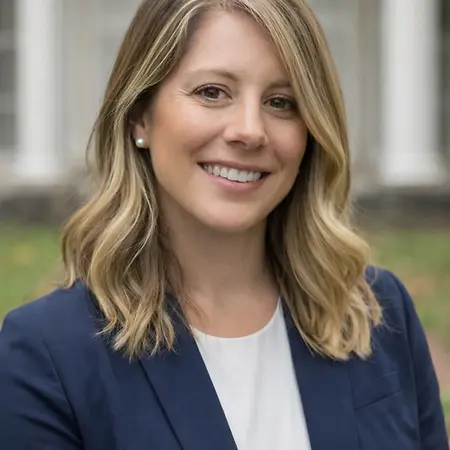
Her Story
About Megan
I started working in healthcare around 2010, and I've been in the field for about 15 years now. I'm brand new in my current role as Director of Care Acceleration, which is part of our AI and digital ventures arm of the ministry for Bon Secours Mercy Health. Prior to this, I was driving and leading patient experience work since 2018, most recently as a Regional Director for Patient Experience. As I was working with teams and integrating different technology that was patient and team-facing, I identified some of the different operational friction points we were experiencing from a change management perspective. I reached out to learn more about our AI and digital ventures arm because it was such a growing space, and my role was really built just from a conversation to learn more about the problems we were solving in the ministry and how we could approach it differently and put some more structure around it to continue to scale the work we're doing faster. My job in healthcare leadership has always been about relationship building, understanding the needs of our teams, aligning it with the goals of our health system, and making it easier to do our work. My typical day is interacting with our leaders across the organizations to do that. I'm really proud of the progress we've made in patient experience metrics and culture change. When I first joined Bon Secours, we had a lot of opportunity in our patient experience metrics. We were in the 20th percentile, and now we're in the 70th in the areas I was supporting. That came from building trust with teams, creating a culture of feedback and coaching, and developing ownership that these teams have taken. My first job after getting certified was to work with our physicians on best documentation practices to support reimbursement. I always joke that if I can do that with our physician leaders, I can pretty much accomplish anything in life. That really propelled me into patient experience, and team member education is something I'm very passionate about. It's incorporated into every role - how do we make something really complex and difficult to understand digestible and relatable to our teams so we can actually do something with it.
Her Interview
Ten minutes with Megan
01What advice would you give to young women entering your industry?
The advice I usually give to young adults that I'm mentoring, or maybe they're interning with me, is one of the best pieces of advice I got early in my career: fill a void. If you see a problem, don't just be the person to address the problem, but find a way to fix it. It doesn't mean you necessarily have to own it forever, but if you see kind of white space or blank space, fill that void, and it will serve you long-term. I can think about so many different aspects in my career where I can look back and say that was because I stepped up to do something that no one wanted to do, and it was a pivotal point for me. During COVID, working in healthcare as a non-clinical person, it would have been very easy to eliminate me as a non-revenue generating, non-essential worker, but I had our team fill voids and helped support all the volunteer efforts and other ways that we could support the team, supporting family visitation to patients, which was limited at the time. We found ways to fill a void and brought tremendous benefit during a time when it wasn't clearly defined for us. Another example would be with different technology rollouts - I've done it because no one else wanted to do it, and I probably begrudgingly, internally did it, but it was actually something that set me apart from other people and helped propel me in my career. It would have been a missed opportunity had I not filled that void.
02What are the biggest challenges or opportunities in your field right now?
I think we're in such an interesting point right now as it relates to just our society and technology. Everything is kind of branded with AI - I joked the other day, I was 45 minutes into a meeting, and I didn't say AI, and how amazing was that? But the question is, how can we thoughtfully use technology to make our lives easier, while also keeping, especially from a healthcare lens, things patient-centered? That's obviously something that's very important to me - keeping things patient-centered and team-centered and doing good work in the process and leveraging technology where we can in really cool and unique ways. That's a goal for me in my new role.
03What values are most important to you in your work and personal life?
I want to do good work and help people where I can. I want to make a difference, and make some money along the way. It's interesting - as females, we're very hesitant to talk about finances, and even from a business background or mindset, you're almost scared about that, but we all want nice things and to be able to provide for our family. I'll never forget my first job out of college when I was asked how motivated I was by materialistic things, and I was hesitant to say I like nice things and I'm incentivized by money. It was actually a really big learning lesson to me very early on in my career to not be scared to say things like that - that I'm motivated to win in different ways. I'm very active and model that for my kids. I love that my son recognizes how important an active, healthy lifestyle is. Family time is huge - I love my husband, he's absolutely wonderful, and we love going to the beach and the river, really anything that involves the water. Wherever God is calling me to go is very important to me.
Join Influential Women and start making an impact. Register now.