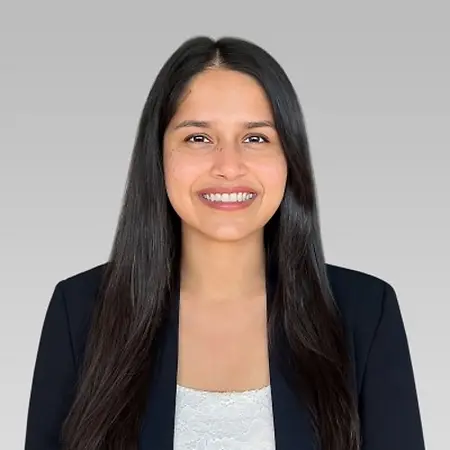
Her Story
About Meghana
I work in the cell and gene therapy space, where my focus is upstream process development - the foundational work that determines whether a promising therapy can be manufactured reliably enough to reach the patients who need it most. Being part of a team that moved a program from the lab into the clinic recently is something I am genuinely proud of.
But the science is only part of the picture. As a Massachusetts Advisory Council member of Tomorrow’s Women Today, I get to work alongside remarkable women leaders who are shaping what the present and future looks like across industries. As an Associate Board member of Boston Cares, I help support one of Boston’s most impactful volunteer organizations and the communities it serves. And as a Young Alumni Advisory Board member at Northeastern University, I stay connected to the institution that gave me the foundation for this path - one I built through co-ops, research experiences, and community leadership alongside my coursework.
What will keep me in this field is the vision of medicine that works for everyone - effective, accessible, and centered on the patient. People fighting serious illness shouldn’t also have to fight the system. They deserve to spend their time and energy on the things and people they love.
Her Interview
Ten minutes with Meghana
01What do you attribute your success to?
Honestly, community - in every form it has taken in my life. The values I bring to my work were shaped long before I entered a lab. My parents showed me from a very young age what it looks like to pursue something meaningful with full commitment, to maintain your integrity along the way, and to always be looking around and asking who you can lift up alongside you. That foundation has guided every decision I've made since. Those values naturally drew me toward experiences that deepened them. At Northeastern, I wasn't just a student - I was a Graduate Resident Director and Teaching Assistant, while also doing co-op rotations at places like Brigham and Women's Hospital and a mental health unit at Arbour Hospital. Each of those environments taught me things the classroom couldn't: how to listen carefully, how to show up with patience and empathy, and how to lead from wherever you are standing. I am also genuinely grateful for the community I have built over time. My husband, my sister, my close friends, and extended family cheer for me in a way that makes even small wins feel significant. That kind of support is something I never take for granted. When I ask myself what has brought me to where I am, the answer is always the same: the people around me. I have been very lucky, and I try never to forget that.
02What’s the best career advice you’ve ever received?
The best advice I ever received was also the most relieving: you don't have to know where you're going to start moving. Early on, I put a lot of pressure on myself to have a clear, linear plan. What I've learned through co-ops in research labs, mental health clinics and hospitals, through residential life and teaching and eventually biotech - is that your path reveals itself through doing, not through planning. Every experience I said yes to, even the ones that seemed unrelated, added something I didn't know I would need later. So my advice is to stay curious, stay open, and trust that a life built on genuine engagement will take you somewhere meaningful even if it doesn't look like anyone else's path.
03What advice would you give to young women entering your industry?
I want to start by saying something I genuinely mean: it is not easy. And I think we do young people a disservice when we skip over that part. Entering a field that is rigorous, fast moving, and still finding its way toward being truly inclusive can feel isolating in ways that are hard to name out loud. There are moments where you wonder if the self-doubt you feel is just yours, or if it's something in the room. Often, it's both. And that's important to know, because when you understand that the environment plays a role, you stop spending all your energy questioning yourself and start spending it on the work which is where it belongs. What I want every young woman entering this space to know is that the instinct to question whether you belong is almost universal, and it almost never reflects reality. The people I have admired most in my career - brilliant, accomplished, generous scientists and leaders - have quietly admitted the same thing to me. You are not behind. You are not the exception who slipped through. You are here because you earned it. So here is my practical advice, from someone still figuring it out herself: find your people early. Find the colleagues who celebrate your questions instead of dismissing them. Find mentors who open doors and then stay in the room with you. Find communities like Tomorrow's Women Today that remind you that your growth and someone else's are not in competition. And when you find those people, hold onto them and become that person for someone else as soon as you can. The science needs you. Not a quieter, smaller, more apologetic version of you. All of you.
04What are the biggest challenges or opportunities in your field right now?
In cell and gene therapy, the most exciting opportunity and the most pressing challenge are actually the same thing: bringing these treatments to scale. The science has advanced at a pace that still amazes me. Therapies that seemed like a distant possibility a decade ago are now reaching clinical trials. But manufacturing them consistently, safely, and affordably remains one of the field's biggest hurdles. It determines whether a breakthrough therapy stays in the lab or actually reaches the people who need it. The field is making real progress on this through better bioreactor technologies, smarter automation, and improved process analytics among other things. Every step forward on reproducibility and cost is a step toward treatments that more patients can actually access, not just those fortunate enough to be close to a major research center or able to afford the current cost of care. It always comes back to the same thing: who are we building this for, and are we making sure they can actually reach it?
05What values are most important to you in your work and personal life?
At the core, three things matter most to me: showing up with purpose, showing up for people, and never stop growing. Purpose means keeping patients at the center - not as an abstract idea, but as a real, living reminder of why the work matters. Every time I feel the weight of a difficult problem, I think about the person on the other side of it, and that recalibrates everything. Showing up for people means exactly that - in the lab, in the community, and in the relationships that have shaped who I am. I believe deeply that we rise together or not much at all. That belief drives my work with Boston Cares, my involvement with Tomorrow's Women Today, and the way I try to show up as a colleague and a friend. And growth - staying curious, staying humble, being genuinely willing to learn from anyone is what keeps all of it alive. I never want to be the person who thinks they have arrived. The most exciting things in this field, and in life, are still ahead.
Join Influential Women and start making an impact. Register now.