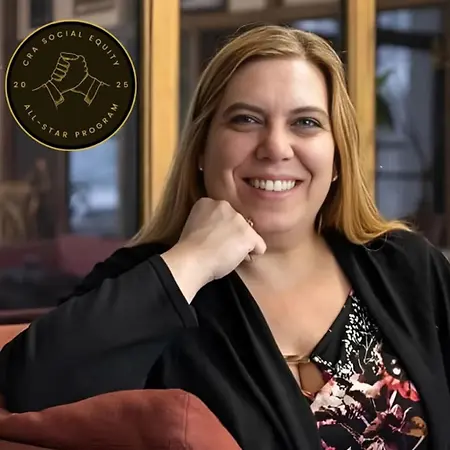
Influential Woman · Cannabis
Melissa Marie Jekel
CEO, Social Equity Solutions
Grand Rapids, MI 49504
The most impactful skill I taught myself was navigating broken systems: interpreting policies, finding gaps, and solving problems in real time to make systems work better for the people they serve.
Melissa Marie Jekel · In Her Own Words
Her Story
About Melissa
Melissa Jekel is the Founder & CEO of Social Equity Solutions and Director of Data and Research for the Great Lakes Expungement Network. Based in Grand Rapids, Michigan, she works at the intersection of cannabis, policy, and justice reform to expand access to opportunity and build community-centered systems that create measurable impact.
Melissa has led initiatives across both the private and nonprofit sectors, advancing social equity programming, community reinvestment strategies, and expungement access statewide. She has experience advancing state and federal legislative initiatives, conducting regulatory equity research, and co-authoring a statewide Social Equity Program evaluation for the Michigan Cannabis Regulatory Agency. She has also contributed to advocacy efforts supporting the passage of the Right to Try Act and the Steve Gleason Enduring Voices Act.
Her expertise spans policy research design, stakeholder engagement, municipal policy implementation, and translating community impact data into actionable reform strategies—bridging policy, industry, and community to ensure equity is not just a concept, but a measurable outcome.
Grounded in accountability, compassion, and integrity, Melissa’s work is driven by a commitment to lasting impact—building solutions that not only serve individuals today, but strengthen communities for the future.
Her Interview
Ten minutes with Melissa
01What do you attribute your success to?
I care too much—and that’s both my greatest strength and my greatest challenge. I’ve always had a deep desire to help people. It’s something that runs in my family, but it’s also something that’s been shaped by my own experiences.
What really drives me now is the work I’m doing in honor of my father. He was a homicide victim in Grand Rapids in June of 2022, and he struggled with substance use disorder. After he passed, I was told, “this is what happens when people live that kind of life.” But that never sat right with me—because my dad’s life had value. He helped people. He supported others in getting clean and finding recovery.
Going through that loss changed everything for me. It exposed how fragmented our systems are and how difficult it can be for people to actually access help. Too often, people show up looking for support—at resource fairs, at programs—and leave without getting what they need. And when that happens enough times, trust is lost.
That’s what drives my work today. I’m focused on building systems and spaces where people don’t fall through the cracks—where resources are not only available, but trusted, accessible, and designed with real people in mind. For me, this work is about legacy. It’s about making sure people like my dad are seen, valued, and supported in ways that truly matter.
02What’s the best career advice you’ve ever received?
The best career advice I ever received actually came from my middle school classmate, Javier. I was in 7th or 8th grade, really frustrated, and on the verge of tears. I don’t remember exactly what led up to it, but I remember how overwhelmed I felt. He looked at me and said, “Missy, don’t cry—because they’ll know they’re getting to you.”
That moment stuck with me. At the time, it was about getting through a tough situation, but as I’ve grown, I’ve realized it’s really about composure and control. There are always going to be moments where you feel frustrated, overwhelmed, or pushed to your limit—but how you respond matters.
I’ve carried that with me into my career. It’s not about suppressing emotion—it’s about staying grounded, not letting others dictate your reactions, and moving through challenges with strength and intention.
03What advice would you give to young women entering your industry?
My biggest advice is to stay consistent and stay driven. This industry can be challenging, and there are a lot of narratives out there—especially for women—but your experience is shaped by how you show up.
When I entered the cannabis space, I heard a lot about negative experiences women might face. That wasn’t my reality. I focused on my work, stayed professional, and built results—I sold a lot of cannabis products without compromising who I was. That doesn’t mean challenges don’t exist—the glass ceiling is still very real—but you don’t have to let other people define your path.
You have to stay grounded in your “why.” For me, it’s always been about the impact—especially on the medical side. I’ve seen firsthand how cannabis can help people manage symptoms, improve quality of life, and support conditions like ALS. That purpose is what keeps me going, even when things get difficult.
If you’re passionate about this work, keep showing up. Stay focused, stay consistent, and don’t let other people’s assumptions or limitations dictate what’s possible for you.
04What are the biggest challenges or opportunities in your field right now?
One of the biggest challenges right now is the lack of understanding around cannabis—both in terms of its medical benefits and how the industry actually operates. There’s still a lot of stigma, and in many cases, the people regulating cannabis don’t fully understand the product, the business model, or the impact it can have on people’s lives.
In Michigan, regulatory gaps create real issues. For example, if the Michigan Cannabis Regulatory Agency is investigating a license and that business closes, the investigation often closes with it. That creates opportunities for bad actors to re-enter the market under a different name, which undermines accountability across the industry.
At the same time, stigma continues to limit opportunity. There are still organizations that won’t accept cannabis-related funding, even when it could directly benefit the communities they serve. That inconsistency—where some groups will partner and others won’t—slows down meaningful progress.
That said, the opportunity is just as big as the challenge. As education improves and policies evolve, there’s real potential to build a more transparent, responsible industry—one that not only creates economic opportunity but also supports public health and community reinvestment in a meaningful way.
05What values are most important to you in your work and personal life?
Honesty, integrity, and compassion are the values that guide both my work and my life. I’ve always been someone who leads with honesty—sometimes to a fault. I joke that I fell from Honest Abe’s apple tree, but it’s true. I’ve never felt the need to hide who I am or how I show up.
I remember being about 10 years old in Traverse City when we had fireworks that weren’t exactly legal at the time. When the police showed up and asked if we had more, everyone else said no—but I told the truth. That’s just who I’ve always been.
Over time, I’ve realized that honesty alone isn’t enough—compassion matters just as much. I used to think the world needed more love, but someone once told me it actually needs more compassion, and that stuck with me. People don’t always act out of kindness, even when they think they’re acting out of love.
If we approached each other with more compassion—treating people the way we’d want to be treated—I think we’d see real change. That’s the mindset I bring into everything I do: lead with integrity, act with compassion, and never lose sight of what’s right.
Join Influential Women and start making an impact. Register now.