Her Story
About Melissa
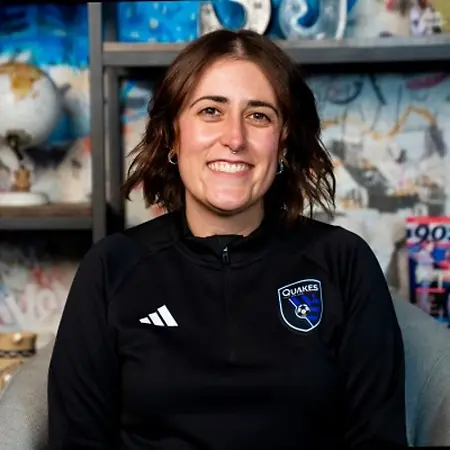
Melissa Sousa, MSW, ASW, is the Manager of Player Engagement for Quakes II and the Academy at the San Jose Earthquakes. Originally pursuing a career in clinical social work, Melissa earned her Master of Social Work from California State University, Monterey Bay, but realized hospital-based work wasn’t her passion. Having previously worked part-time in sports during the summers, she sought opportunities to combine her social work expertise with her love for athletics. When this newly created role at the San Jose Earthquakes became available, Melissa embraced the opportunity to build the position from the ground up, shaping player engagement and wellness programs that didn’t previously exist at the club. Over the past four years, Melissa has developed and led programs addressing players’ mental health, academic development, and personal growth. She conducts individual meetings with players across all levels, manages educational pathways and NCAA compliance, and oversees holistic programming. Since October 2026, her role has expanded to include workshops, reflections, and group sessions focused on off-field development—allowing her to apply her social work training more directly in the sports context. Melissa’s work exemplifies a commitment to holistic player care, ensuring athletes thrive both on and off the pitch. Melissa’s dedication and innovation have been recognized globally. In 2024, she unexpectedly received the Academy Player Care Rest of World Award from The Player Care Group, an honor she initially nominated herself for “just for fun.” Beyond her club work, Melissa has contributed to research and community programs, including projects on inclusivity in sports recreation, and has held internships and leadership roles with organizations such as Montage Health, Interim, Inc., and the Giants Community Fund. Her skills in communication, leadership, program development, and data analysis position her as a trusted advocate for athlete wellness and development.
Her Interview
Ten minutes with Melissa
01What do you attribute your success to?
I attribute my success to pushing very hard in a male-dominated field and working to prove I deserve to be at the table. People often ask me why I don't just go work for a women's team where it would be easier, but I always say, why would I do that? I could go there and I know I can do it there, but can I do it here and still prove that I can go to the same extent that my male counterparts can? A lot of us women in this field, we push very hard and work insane hours - probably work 2 or 3 times as hard as the men - so that we can still prove we deserve this job. A lot of it is just trying to make sure I can keep myself at the table with everybody and get the same recognition as others. So a lot of it is just fueled by wanting to have the same respect.
02What’s the best career advice you’ve ever received?
The best advice I've ever received is from reading an interview with Rachel Balkovec, the first full-time female manager in the history of affiliated baseball at the Major or Minor league levels. In one of her interviews, she made a comment that has always stuck with me. She said "I've been nervous my whole life, in a good way. Because I'm pushing myself. If you're not nervous about what you're doing, then you're just comfortable." It's a good point - if I'm not nervous over what I'm pushing for, then I know I'm probably not going as hard as I could. But if I'm comfortable, then I know I'm being lazy. So it always reminds me that if I'm feeling too comfortable, then I'm not pushing my boundaries, and I'm not pushing to get better and do better. I always try to live by that - you push as hard as you can.
03What advice would you give to young women entering your industry?
Networking is one of the most important things. There are so many of us that want to help others get into sports. A lot of people have reached out to me, and I'm always trying to help them find jobs or connect them with others, because I struggled to find where I wanted to be because I didn't have someone guiding me. I always tell people I meet, if you need help, or if you're applying for a job and I have a connection there, let me know - I'll reach out to people I know. It's the same thing I've told college students - you have professors, you have those speaking on panels to you, use your networking resources, because a lot of the job market has turned into knowing somebody to get the job. Find people in fields of your interest and reach out. Most people are willing to talk about their jobs, you just have to reach out - if someone messages me, I'm not going to say no.
04What are the biggest challenges or opportunities in your field right now?
The biggest challenges right now is what has been going on the last few years in our world. Our players are impacted just as everyone else with the changes of our world and economy. We've seen stress levels rise for our players when it comes to off the field matters. Some of our players are not making the millions of dollars that fans or the general public believe they are making, and some are trying to use that money to not only take care of themselves and their family, but also their parents or grandparents, relatives who rely on them. I've also seen an uptick in mental health due to the added level of stressors outside their control. I also work with younger players, and with the surge of the internet and AI, it's created more issues. I had a 20-year-old tell me that the internet told them depression wasn't real. As a psychologist and social worker, I'm battling what is being poorly displayed on the internet and AI. At the end of the day, we're all busy doing what we can to find people access to resources and providing support because we're all being impacted directly and indirectly whether we realize it or not.
05What values are most important to you in your work and personal life?
Empathy is very important to me. Especially with what I do as a living. I think a lot of people only see players as pros, making money, signing deals, but forgetting that they're also still people and deal with everyday problems like anyone else. It was easy for me coming into this job already having an empathetic mindset. Coming in and hearing all of their stories and giving them the space to have them talk about what's going on in their lives has been so important. A lot of them haven't had that kind of support before. I'm also trying to do that in my personal life too - I have friends and family, where I remind myself I may not know what's going on, but I need to give them the same type of empathy and care that I would at work. My parents have always told, treat others as you would want to be treated, and you have to remember that where you are in life mentally or physically, is not the same for someone else. Family is also very important to me - I spend so much time at my job that I kind of call them my second family. Some of these players come from difficult home lives, so they just need someone to treat them as if they're family. I've had players come over and we've done dinner together, I've also gone to one of their graduations. Sometimes they need more than just "cool, great training, see you next week."
Join Influential Women and start making an impact. Register now.