Her Story
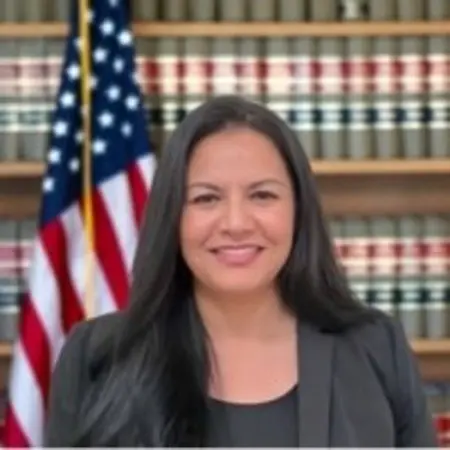
About Mia
Mia Espinoza is a seasoned federal probation officer with over 26 years of experience in community corrections, currently serving the Central District of California. She supervises cases across Santa Barbara and San Luis Obispo counties while being attached to the Ventura office. In her role, Mia balances fieldwork—including unannounced home visits, drug testing, and court appearances—with meticulous documentation, all while carrying a firearm and maintaining rigorous training in defensive tactics and scenario-based exercises. She also supervises specialized populations, including sex offenders, ensuring compliance with court-ordered monitoring and attending containment meetings with therapists.
Mia’s professional philosophy centers on individualized supervision and the belief that people can change. She emphasizes listening, respect, dignity, and providing opportunities for growth while ensuring that responses to noncompliance are proportionate and fair. Her commitment to precise documentation and advocacy for supervisees’ rights reflects a deep understanding of the complexities of federal probation work, balancing enforcement with rehabilitation.
Her career began at Santa Barbara County’s mental health department after graduating from the University of California, Santa Barbara, and she later joined federal probation, where she has spent nearly 19 years. Mia’s extensive experience, combined with her dedication to mentorship and hands-on supervision, has made her a respected figure in community corrections. Her work demonstrates a rare blend of field expertise, procedural rigor, and a human-centered approach to public safety.
Her Interview
Ten minutes with Mia
01What do you attribute your success to?
I love what I do. It is a lot, I'm not gonna lie, not gonna sugarcoat it. It is a lot. But I really love what I do. I think because I'm able to do so many different things in this job, in this line of work, it's not a mundane job. I just got assigned 3 new cases this morning, and a part of me is so curious to open up these files and read about these people, and see what their history includes, and then I literally am like, okay, he's gonna be my caseload, he's gonna be my offender in 2 years when he gets out of prison, or in 6 months, or whatever the sentence was. I would attribute my success to my childhood experiences, right, growing up with the siblings, and then the family that I grew up in, and the neighborhood that I grew up in. And just really wanting to make a difference in whether it's just one or two lives, I think I make a difference in many more lives than that. I have people on my caseload who - I have one guy who sends me a Christmas card every year. He sent me a Christmas card for the last 16 years. The first one was like, you will never know the impact you had on my life. I've supervised people from all walks of life. I had a guy in my caseload years ago who was an Aryan brother, skinhead - I'm a female, Latina, law enforcement, like, I am the triple threat enemy for them - and the first time I met him, he wouldn't even look at me. And by the time he was getting off my caseload, he was in tears. And he said, I would take a bullet for you, I would jump in front of a bus for you. It's just that I really think that people do deserve a second chance. And I really hope I want everyone's situation on my caseload to be better when you get off of my caseload than it was when you came to my caseload. And I would like to say that the majority of my cases do end up in better situations and making better choices once they're getting off my caseload than when I got them.
02What’s the best career advice you’ve ever received?
The best career advice I ever received came from a friend of mine who grew up in a similar situation, who was a little bit older than me. He basically said, look, we don't pick our family. We pick our friends, and you were born into the family you were born into, and don't feel bad about it. Don't apologize. The reason your brothers and sisters made those choices was independent to you, separate from you. I was younger, they were older. So, basically just don't feel bad about where you came from. Don't be ashamed about where you came from, because it made you who you are. And that has always really stuck with me. He retired, and we're still friends. He was a mentor for me, for sure. It's complicated in this career because it's very political. He basically said, don't be ashamed of that. Like, not that I was ashamed, it was just difficult to talk about, because we're very judgmental in this business. We make judgment calls every day. And I do field work alone for the most part. So we're having to confront noncompliance, sometimes me and my offender who's on my caseload, and he may have a friend or a spouse, and it could be, like, you know, people are very protective of their loved one. And it can be a little dicey. We put ourselves in danger every day. Every time I knock on someone's door, I don't know who's there, I don't know what's in the home. It's really a blind, a cold knock every time you go to someone's house, because most of the time, they don't know I'm knocking. They don't know I'm coming. It's unannounced, so you just never know.
03What advice would you give to young women entering your industry?
The advice I would give is that you're going to be - it's just like in society - oh, it's because you're a woman, you're a female. You're not physically as strong. But we have a more nurturing side. And that can be used almost as a strength, right? Like, almost like a superpower, in a way. You are physically not going to be stronger than the men that you work with, physically. And you're not going to be stronger than a lot of the males that you supervise. But the most important tool we have, as officers in general, is not our firearm, it's not our ballistics vest, it's not your pepper spray, it's not your handcuffs. It's your words, it's your ability to communicate. And that's true with our offenders and with people you work with and those who you work for. The other thing I would give advice to females is something I wish somebody would have told me. Before you accept that position, understand that there are only a few times in your career where you can negotiate your salary. And I don't think women are empowered by that. Men have no problem asking for more money, or saying, what does the average starting salary - what is the most that someone has started at? What is the lowest? So you can gauge where you're at. I wish somebody would have told me that. But when I started this career, I started at the bottom and had to peck my way up in the salary chain. So I would give advice that when you're being hired, that's really the most - probably one of the only times you'll be able to negotiate your salary and do so. You're your own best advocate at that time. There are gonna be cases you supervise - I'm thinking of men - they're not going to want to take orders from you because you're a female. Especially men in business - CEOs of companies, business owners, people who commit fraud, whether it's stealing from the state, or the federal government, or credit card fraud. They will not - you're gonna have to really be assertive, because you don't carry the - your voice, your authority doesn't carry the same weight as a man's to that person. And you're going to need to be assertive and say, look, my authority is the same as my partner's authority, who happens to be a male. But men are sometimes more receptive to a man because they don't want to be bossed around by a woman. I've been in the field with my partner or my supervisor, and I'm talking to my offender, and he's responding to my partner or my supervisor. But I'm the officer, you're on my caseload, but it's because that person has an issue with the fact that a woman has a badge, and a gun, and is telling me what to do, and I'm not going to take orders from her. And I would just tell somebody who's looking to get into this field, get ready, because there are going to be things you're going to have to encounter, and things that you are going to deal with that men never have to deal with. You might be passed over on a promotion. You're gonna be like, was it because I'm a female? This is because I was too assertive? It's really kind of another tightrope you walk. It's like, you want to be tough, but not too tough. But you can't be too soft, either. You've got to find that sweet spot. I would also say, be very mindful of your social media. Social media can be great, but it can really harm a person's reputation. Be mindful of that. And know your audience. If you're gossiping or bad-mouthing someone, you might think the person you're talking to is someone you can confide in, or gossip with, but they might turn around and tell the person you're talking about. Or if you're saying a joke that's not necessarily appropriate, that can come back to haunt you.
04What are the biggest challenges or opportunities in your field right now?
For me, and I'm speaking specifically because of where I supervise - I supervise the Central District of California, which covers 7 counties. There are 250-some-odd federal probation officers in our Central District of California. The officers who supervise Santa Barbara and San Luis Obispo County, there are only two. Everyone else is in Ventura County and South. They're more populated. What's difficult for me, what I'm finding difficult because of where I live and where I supervise are promotional opportunities. Because the nearest office for me to promote to is Ventura. But because, as a supervisor, you have to be in the office, I would have to drive 100 miles every day to the office as a supervisor. I've been asked, but I can't - that - no marriage would survive that. That would be a 12-hour day, 5 days a week. So, promotions, depending - because it's logistically for me, I'm not gonna move. I'm not gonna sell my home. My home's almost paid off. We've lived here for 25 years. We are happy here. Our kids were born and raised in this home. We're not leaving. And logistically, unless you're prepared to move, promotional opportunities have been limited for me because of where I live, and because of my roots. My roots are deep here. And I'm not going to give up the flexibility that I have, because I'm a fully mobile officer. I work from home when I'm in the office. Yesterday, I was in Los Angeles. I left my house at 8 in the morning, I got home at 8 o'clock at night. I had training. My training was from 12:30 to 3:30. And it with traffic, it took me four and a half hours to get home. That is a lot of time that you're not being - we're salary, so we are not hourly here. So I give away a lot of hours, a lot of time from your life, and you don't get that back. So for me, it's been logistically, promotions have not - I'm eligible, I can do it, but I'm not gonna move. You've gotta weigh your professional success with your personal happiness, and what is more important to you? For me, it's my personal happiness. My family, my children. My spouse, who has supported me unconditionally in this field. And so, you just kind of have to be okay with that. Now, if I lived in Los Angeles, totally different. I would have - I'd probably be at least a supervisor, if not higher, by now. But I'm not willing to give up this life, this quiet, slower-paced part of the state. Los Angeles is not for me. I'm a Santa Barbara girl. I'm not a big city person. And I have to be okay with that. I would just say, if you're the kind of person who's willing to move every couple of years, more power to you. I'm rooted here. And those roots are deep. You really have to just know what is your professional - are your professional accolades more important to you? And not everybody in my field has a family. Some of them aren't even married because of the job and because they want to promote, or they want to transfer, and you want to be able to move, and it's hard when you have kids or a spouse who's got a job in that area.
05What values are most important to you in your work and personal life?
I would say, in my work, I try to supervise my caseload in a way that these people are human. We're all fallible. I tell everyone all the time, I make mistakes every day. But you've got to learn from those mistakes. And I think what I value is people can change. And I've seen it, I've witnessed it, and not everybody is ready to change. So I think giving people the opportunity to make those changes when they're ready, and I hope that they're ready when they're on my caseload. Listening to them, not talking down to them. And really, just letting them speak, and just letting them be heard, I think that's very important, and I think a lot of that came from the way my brothers and sisters' parole and probation officers treated them and treated my parents. It was a very 'my way or the highway.' And for me, as a probation officer, I really say, these are your conditions. And these are your options. And there really is an easier way to do things, and there's a harder way to do things. I like easy. I prefer easy. But some people are very combative. I cannot approach every case the same because the way I interact with someone on my caseload really - they set the tone in a way. Because I'm trying to - we're reading each other, like, we're reading each other's body language, we're listening to each other's words, we're sizing each other up. Just listening to the person, understanding, looking at the big picture. This crime didn't happen - someone didn't just pick you out of a crowd and say, you're gonna go rob a bank. You made a decision to get involved in something, and you knew the risk you were taking, and you got caught. And I'm in your life because of a choice, or because of a string of choices you made. And then values, things that I value in my life are - family is a huge value for me. Because my family was very broken, as far as brothers and sisters who were in and out of trouble. My children were not exposed to that life at all. They do know their aunts and their uncles, but they definitely know that there's a difference between the way they grew up and the way I grew up. And being present in the moment, I think, is huge. And the older I get, the more important that is for me. We're all so connected to our phones and wanting to capture every moment and save photos and videos, and I'm learning that really just being there and really just taking it in like we used to when I was a kid, before cell phones - that, to me, is meaningful, and instead of having to go through my phone to remember these moments, I really want to feel them. That, I think, is an important value for me. And yeah, just trying to be a good person, and treat people with respect and kindness. And really the golden rule - do unto others as you would have done unto you. And I think of that with my brothers and sisters, because they dealt with some really, really heavy, cold, domineering - I witnessed that as a little kid, and the way they spoke to my parents, and the way they spoke to my siblings, I've never been that officer, ever. Because I remembered how degrading and demoralizing and humiliating it was for them, and even my parents. My parents have never been in trouble. Never been arrested. And they had kids. We grew up in a poor neighborhood. We grew up around gangs and drugs, and that's where my brothers and sisters gravitated towards. But, because of the choices they made, I went the other way. I was like, I don't want to get in trouble, I don't want to cause this pain for my parents, so I knew doing well in school, being a good kid, being a good person, and following the rules was my ticket out of that cycle.
Join Influential Women and start making an impact. Register now.