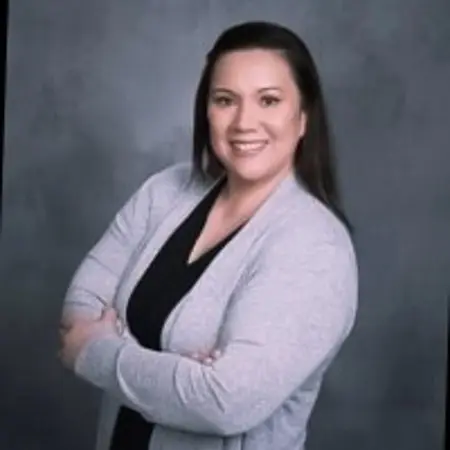
Her Story
About Michelle
Michelle Gladstone-Wade is a distinguished leader in the field of tribal economic development, currently serving as the Director of Economic Development for the Affiliated Tribes of Northwest Indians Economic Development Corporation (ATNI-EDC). In this role, she focuses on advancing regional economic initiatives for ATNI Member Tribes, providing policy and data analysis, supporting lending programs, and fostering strategic partnerships that promote sustainable growth. Her work is deeply informed by her cultural teachings and commitment to tribal sovereignty, emphasizing collaboration, listening, and respect for tribal governance in all aspects of her professional practice. Michelle’s career began in higher education as an AmeriCorps member at Northwest Indian College, where she explored her identity as a tribal person while contributing to the education of Native students. She later taught in the Tribal Governance and Business Management bachelor’s program, successfully guiding it to financial sustainability and igniting her passion for tribal economics, community development, and Indigenous-based research. Following this, she earned an MBA and a Master of Science in Leadership, which enabled her to bring a combination of academic rigor and practical expertise to her work with tribal communities. Transitioning to public service, Michelle founded the first Office of Tribal Relations at the Washington State Department of Commerce, establishing frameworks for government-to-government consultation and leading the agency’s first MOU with tribes. Her work transformed the department’s relationships with tribal communities and served as a model for cultural competency and strategic collaboration. Today, at ATNI EDC, she continues to connect tribal and non-tribal partners, advancing economic prosperity for member tribes while centering tribal values, sovereignty, and long-term community impact.
Her Interview
Ten minutes with Michelle
01What do you attribute your success to?
I attribute my success to those who came before me and lessons taught to me by the women in my life. My mother and my Aunt who have always been there for me in the best and the worst of times. Family is so important and those connections find you when you need them most. During my time at Northwest Indian College we discovered that my department chair is my Aunt! Having the support of my family was absolutely foundational in pushing me to go further and do more and bring more home to our people. What's the point of all this work, academic success, professional success, breaking of glass ceilings, if I'm going to gatekeep and not reach back and uplift the generations coming up behind me? I began my education in a small rural town and blazed a path to Dartmouth College. My time at Dartmouth taught me that I don't have to be in the box they put me in - I am allowed to explore my own interests and be true to who I am. My first job after graduation was an AmeriCorps placement at Northwest Indian College. Being an AmeriCorps member was both personally and professionally life-changing, I was able to explore my own identity as a tribal person and learn what it means to serve a tribal community. I found that's where I belong and that as a a professional my job is to use my gifts and skills to support my community.
02What’s the best career advice you’ve ever received?
The most impactful piece of advice I received was from my father, who is formerly an elected leader in our tribal community. He shared with me that when you walk into these rooms where you are the token Indian, or you are the one woman at a table full of men, the best thing to do is to listen. Something I've experienced as a tribal woman in a male-dominated space - specifically in non-tribal spaces, there's always something to be said, there's always something that fills the space. If you simply sit back and listen, actively listen, you're able to figure out the playing field and how the players influence one another. Knowing and understanding the playing field has become a strength to help survive and begin to thrive in esoteric non-tribal workspaces. This advice has been endlessly useful and it has helped me in more ways than I'm able to articulate.
03What advice would you give to young women entering your industry?
When a young woman asks me for advice about entering this field, I always start with what father taught me. Always listen before you speak. When you walk into these rooms where you are the token Indian, or you are the one female a table of men, the best thing to do is to listen first. A a tribal woman in a male-dominated space of economic development and elected leadership, specifically with our non-tribal counterparts, there's always something to be said and someone is always filling the space. If you sit back and listen, actively observe, you're able to figure out the dynamics and how the space operates. This has become strength to help survive and establish a presence in these esoteric workspaces. I also firmly believe, what's the point of all this work, academic success, professional success, breaking of glass ceilings, if I'm not going to share what I have learned with the generation coming up behind me? I love to work beside people and share my knowledge, experiences, and stories even if I don't call it formal mentorship.
04What are the biggest challenges or opportunities in your field right now?
The biggest challenge in my field is navigating the tension between tribal and non-tribal spaces and systems. The non-tribal bureaucratic systems do not always understand tribal sovereignty which can jeopardize growing partnerships. The greatest opportunity lies in developing responsive funding and contracting mechanisms, strengthening the tribal workforce through education programs, and forging meaningful agreements and partnerships that prioritize tribal goals.
05What values are most important to you in your work and personal life?
The values most important to me center around giving back to my community and serving Indian Country - that's what I have been called to do as a professional. I believe strongly sharing knowledge and lessoned learned with the generation coming up behind me, because what's the point of academic success, professional success, and breaking of glass ceilings if I'm not going to share it? I value leveling power dynamics and being vulnerable enough to say 'I don't know lets find out together' because that bit of vulnerability really helps to establish relationship and trust. Family time is very important to me and being able to watch my children spend time with their grandparents brings immense joy. Our natural world around us is also crucial - we won't survive without our world, so teaching and learning about how to be more gentle in our environment is something important to me. I hope to share these lessons with my children so we can do our part to ensure our community is safe and healthy place for all of us, whether it's the cats, the plants, or the people.
Join Influential Women and start making an impact. Register now.