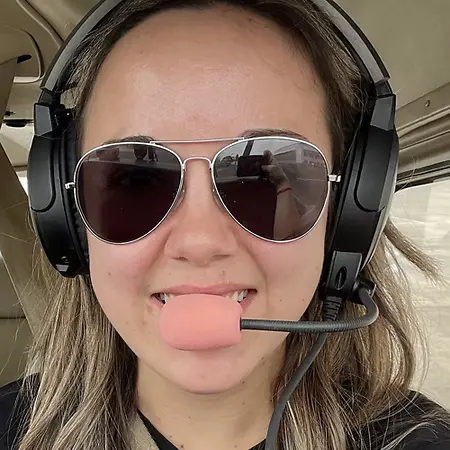
Her Story
About Michelle
I started my career in the arts, attending the Vancouver School of Arts and Academics for middle school and high school, which shaped how I think about the world by combining arts and academics. I went on to earn two bachelor's degrees from the University of Hawaii in theater and communications/multimedia, then worked professionally in film, starting as a production assistant and working my way up to production manager and producer for notable clients. After going through a divorce and some life changes, including becoming a mother, I discovered aviation in 2019 when a friend who had been an airplane mechanic in the military suggested I consider becoming a pilot. After eight months of research and talking to pilots, I took my first discovery flight, and my instructor told me I was a natural. I've been hooked ever since. I now serve as chapter chair of Hawaii's chapter of the 99s, where I've held various board positions since 2019, including two years as vice chair and four years as chapter chair. I also created and serve as executive director of the Hawaii Aviation Expo, which is in its third year and has grown to include sponsors like Hawaiian Airlines, Alaska Airlines, the FAA, NOAA, and the Air Traffic Controllers Union. I'm passionate about creating networking opportunities and connecting people to resources in Hawaii's unique aviation community, and I help women navigate the scholarship application process to make flight training more accessible. I'm currently pursuing my own flight training and have earned my commercial pilot's license, while also working a full-time job and raising my daughter and two stepchildren.
Her Interview
Ten minutes with Michelle
01What do you attribute your success to?
I think part of the reason I've been able to find success is because I can marry both sides of my brain. I come from the arts, but I have the ability to think and communicate like an artist while also thinking and communicating in the logistics, the numbers, and the admin side of things. Because I can marry both sides, I think that's where it's helped me find success. I also believe in making a choice not to let fear prevail. There are so many opportunities for fear in aviation, like flying solo across the ocean or pursuing something with such high financial stakes, but it's just a choice you make. You can let fear take over, or you can push through. I also think it's important to always be learning. The moment you think you've figured something out, there's risk. I pursue everything with the mindset that I can always learn more, and there's always room for improvement. That way, you don't take feedback as a negative thing - you see it as an opportunity.
02What’s the best career advice you’ve ever received?
The best career advice I received was from the film industry, and the phrase was 'You want to make sure you get invited to the party.' What that means is, if we're being realistic about the way the world works, it's not always the most qualified person that gets hired. It's not always about seniority or merit, though merit should be first and foremost. An element to remember is that you want to be the kind of person that people want around. You need to operate with merit and be capable of doing the job, but you also need to present yourself and operate with others in a way that makes them want you around. Learning that social aspect of the career world is difficult because it comes with trial and error. As a woman who is confident, direct, and not afraid of authority, it's taken a lot of work to learn how to manage that social side of things to make sure you're not compromising your values or yourself, but you're also making sure you get invited to the party. I would also add to always be learning. The moment you think you've figured something out, there's risk. Always pursue whatever you're doing with the mindset that you can always learn more and there's always room for improvement. That way you don't take feedback as a negative thing - you see it as an opportunity instead of somebody attacking you.
03What advice would you give to young women entering your industry?
My main advice for anyone pursuing aviation is to surround yourself with other people who can support you, who are further along on the same journey so they can be a resource to you. I also think it's important to have folks in your life that are behind you on the journey, so that you can continue to pass on what you've learned and be an encouragement to them. That's why I'm so passionate about the support groups, resources, and networking that I'm trying to foster and keep alive, because anytime you're going about something that's hard and you try to do it by yourself, it's gonna be even harder. It's largely a self-led journey to pursue aviation, so having that community is crucial. The other advice I have is, if you're gonna do it, go all in. Go for it. Don't half-ass it. And believe in yourself. This journey is not easy, and there's a lot of tests, regulations, and opportunities for fear, but you have to find a way to believe in yourself and push through. Remember, especially in this male-dominated industry, women are worthy to be there. We are capable of doing this job for the simple reason that we are capable of doing the job, and it has nothing to do with gender.
04What are the biggest challenges or opportunities in your field right now?
I think the biggest challenge in aviation right now is that it's not really available to just anyone to make a career. It's really only available to people who are financially wealthy. The cost of flight training is astronomical, and it's been exponential even just since before COVID. I look at my flight training costs in 2019 before COVID hit versus now, and it's exponentially gone up in cost. That's the barrier - the financial barrier to have a career in aviation, which is a career that pays well. We all know that pilots make a lot of money, and I just wish that there was a way to make it more accessible to people of all socioeconomic backgrounds, and the reality is it's just not right now. That's a challenge of the industry for folks who are interested in it, and young kids who may look up and be like, oh, I want to fly planes, but what if their family doesn't have money, and what if they aren't in a situation where they're near flight schools? Another challenge is the disconnect between what pilots in training are experiencing versus what the airlines are saying. If you talk to us who are in flight training working on getting our ratings and licenses and hours, we're all saying it's completely oversaturated, we can't get into flight schools, there's no jobs to be had, nobody's hiring. People who have been at their minimums for years aren't getting hired. But then I've had conversations with managers of talent acquisition at legacy airlines, and they talk about a pilot shortage. There's this weird mismatch of experience. The industry is like a roller coaster - they'll snatch up a bunch of people, and then hiring's kind of at a freeze for a few years, and then it goes like that.
05What values are most important to you in your work and personal life?
When it comes to work, safety is the really important value that you need to prioritize as a pilot. Because of the risks and because things are constantly changing, there are so many factors - you have the plane itself, the people aboard the plane, weather, the airport environments. There are so many factors where there could be possible risks that you have to prioritize safety and make sure that's the highest priority. Number two is always doing the best that I can do and making the smartest choices based on all the information that I have. They talk a lot about external pressures and not letting external pressures affect your decision-making when it comes to piloting, so just making sure that I'm prioritizing the right decision for all parties involved. The most important thing is making sure everybody gets home. Personally, I value having a can-do attitude but also being realistic at the same time. When you come across a potential hiccup or issue, having a can-do attitude like, what's the solution here, how do we move forward, but also being realistic in the sense that safety is the number one priority, so if it's not safe to move forward, then we won't. I value that process of evaluating and having a can-do attitude. The human element of everything is important to me, remembering all the humans that you're interacting with. I know that someday when I fly passengers, their lives are literally gonna be in my hands, and the people I'm working with on board, the crew - the human element of that matters to me. I want to be somebody that people have respect for and trust that I'm gonna make smart choices, that I'm capable, and treating people with kindness, that everyone matters.
Join Influential Women and start making an impact. Register now.