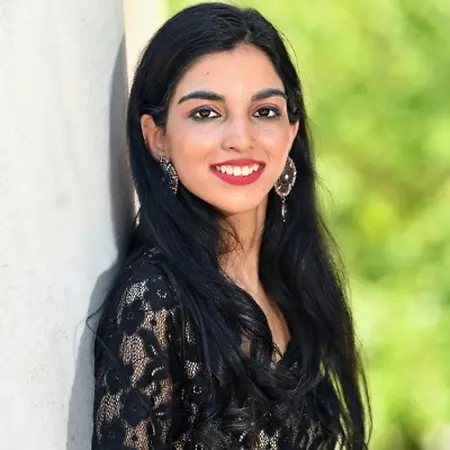
Her Story
About Mifrah
My education was not traditional. I started off in the biological sciences because I used to work in hospitals and hospices, and I wanted to help develop therapeutics and cures for my patients. I was really fascinated with cell mutations and how it leads to disease, what factors lead to cell mutations, like environmental factors and genetics. I got the opportunity to learn how to do gene editing through CRISPR-Cas9 in the lab setting. When I was learning that, I became really interested in the ethics behind it, because around that time, the Haijengu case came to surface in China and around the world, and it was really interesting to think how this could affect people long-term if we did not have laws and regulations in place. I went into a master's in biotech at Johns Hopkins, and I was doing pancreatic cancer research at MIT, but then I slowly transitioned to bioethics at Harvard, and then I became more and more interested in AI and how that could be used for the healthcare field. I've been teaching ever since I was a master's candidate at Harvard Medical School. I taught undergraduate students under the mentorship of a professor, and then I was brought on to teach graduate students at the Extension and summer schools. Eventually, I became a co-instructor, so I helped design a course on evolution and precision medicine. Now I look at AI governance, health law, and bioethics. It's something that found me. When you forget you're working, and you're doing something that you feel is helping others and really making that difference, and you're enjoying it and having a good time while doing it, I feel like it's where I belong.
Her Interview
Ten minutes with Mifrah
01What do you attribute your success to?
I honestly attribute it to my faith in God, knowing that there was always hope. There's a quote in the Quran that says that we do not burden someone more than they can bear, and with every hardship, there's relief. So even when things are bleak, that if you're steadfast and you work hard, it will get better. I also believe that you should never let success go to your head, and never let failure go to your heart. I started off as a biological scientist, and experiments don't always turn out the way we hope they do, and it's so discouraging, but it's just about trying again and having that belief that you will succeed, and that leads to success eventually.
02What’s the best career advice you’ve ever received?
I think two things. Never let success go to your head, and never let failure go to your heart. I started off as a biological scientist, and experiments don't always turn out the way we hope they do, and it's so discouraging, but it's just about trying again and having that belief that you will succeed, and that leads to success eventually.
03What advice would you give to young women entering your industry?
I would say that your belief in yourself needs to be stronger than any other noise you hear from anyone else. As a minority woman, I'm kind of petite, I was told time and again that, you know, you're from this background, or you're from this town, or you didn't grow up with the right connections, so how can you aim so high? I just... it got to the point, sometimes I felt the only person who believed in me was myself, or a handful of mentors. That's all you need, it's one person to believe in you, even if it's yourself. That's what encourages you to go forward, despite that.
04What are the biggest challenges or opportunities in your field right now?
In my field, some of the challenges are that I work in AI governance, so a lot of times, there's a question of liability and informed consent. Since AI systems are constantly evolving, the idea of consent is necessary, just because it's becoming incorporated in everyday life. And there is an issue with what consent is. In some cases, it's as simple as a signature on a document. In other cultures and religions, it's understanding the whole process and understanding what could go wrong, different procedures, different outcomes, that kind of thing. It's not a universal standard, it's different in the US, from the UK to Muslim-majority countries, and it's something that needs to be developed in a way that benefits everyone, but it's easier said than done. AI is so rapidly becoming incorporated in everyday life. At first, it was very small, but now it's part of medicine, law, criminal justice, environmental things, and the laws are not caught up to properly incorporate it in everyday life.
05What values are most important to you in your work and personal life?
I think, honestly, compassion is one that I see both in work and in my personal life, whether it's dealing with a family member or dealing with a student who's struggling. It's always good to think of things from their point of view, and try to help them in any way you can. When I'm teaching, it's okay if the student's struggling, what can I do to make the material better for them, or really help them with their careers? With family, it's okay, we both are connected, and we have this blood bond, how do we fix any type of issue? And that role comes up over and over again, whether it's student, family member, patient, that kind of thing.
Join Influential Women and start making an impact. Register now.