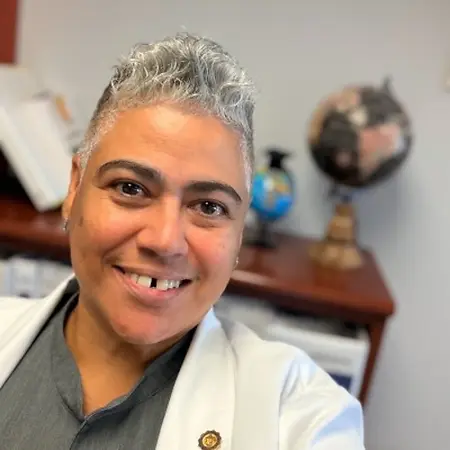
A powerful testament to finding purpose beyond conventional timelines. This narrative celebrates perseverance, faith, and the transformative journey of becoming an occupational therapist and educator while inspiring others to embrace their unique paths.
Her Story
About Migdalia
Migdalia “Mikki” Gonzalez is a dedicated occupational therapy educator and clinician known for her human‑centered approach to care, education, and leadership. Most recently, she served as an OTA Program Professor and Academic Clinical Fieldwork Coordinator at Keiser University in Fort Lauderdale, Florida. In this role, she collaborated closely with clinical partners, supported students through the complexities of fieldwork education, and helped cultivate a learning environment grounded in practical skill development, accountability, and compassionate, patient‑centered care.
Mikki’s journey into occupational therapy is both unconventional and deeply meaningful. A lifelong caregiver at heart, she discovered the profession later in life and, at age 44, made the bold decision to return to school after successful careers in corporate America and the maritime industry. While attending Keiser University, she balanced full‑time employment with full‑time studies in the university’s accelerated one‑course‑at‑a‑time format. As the eldest student in her cohort, she persevered through significant personal and financial challenges—at one point sleeping on an inflatable mattress during clinical rotations—demonstrating resilience, determination, and an unwavering commitment to her goals.
After earning her associate’s degree, Mikki began her clinical career as a traveling Certified Occupational Therapy Assistant, working across diverse settings in Texas and California. Her clinical experience spans skilled nursing facilities, outpatient clinics, home health, and acute care settings, where she treated a wide range of conditions and developed a strong ability to adapt to new environments and work with interdisciplinary teams. She later returned to Keiser University to complete both her bachelor’s and master’s degrees through the MSOT Bridge program.
Following graduation, Mikki resumed travel therapy before being invited back by former professors to join the faculty. In academia, she brought real‑world clinical insight into the classroom, mentoring future practitioners and emphasizing the importance of adaptability, empathy, and professional integrity. As she prepares to transition from academia, she looks forward to returning to clinical practice—potentially as a traveling clinician or working internationally—continuing her commitment to supporting independence, dignity, and quality of life across the lifespan.
Guided by her personal philosophy, “I only have patience for my patients,” Mikki believes deeply in leading with humanity, truth, and example. She often reminds others that “we are all small angels of God, spreading our wings for one patient at a time.” Through every role she holds, she remains steadfast in her mission to make a meaningful difference—one human connection at a time.
Her Interview
Ten minutes with Migdalia
01What do you attribute your success to?
I attribute my success to perseverance, resilience, and a deep commitment to others. I was required to grow up early, becoming independent at 15, and at 21, my life changed again when I adopted my newborn nephew. Although this meant placing my personal goals—such as joining the Air Force or pursuing law enforcement—on hold, raising him through significant challenges became the most demanding and formative experience of my life. It strengthened my ability to prioritize, remain steady under pressure, and lead with compassion.
These experiences taught me that our circumstances do not define our outcomes. We may come from similar beginnings, but we choose how we move forward. In healthcare, fear and difficulty are inevitable, but I believe we must choose to rise and remain grounded in humanity. I approach my work with clarity, empathy, and purpose, understanding that every patient encounter matters. My philosophy is simple: success is measured by impact. If I can make a meaningful difference for even one patient each day, then I am fulfilling my purpose.
02What’s the best career advice you’ve ever received?
The best career advice Migdalia has ever received is to lead with integrity, stay grounded in purpose, and always see the person before the diagnosis. Throughout her journey in occupational therapy, she has drawn from her life experiences, the patients she has served, and the professional OT community that surrounds her. She learned early on that while clinical competence is essential, meaningful impact comes from empathy, consistency, and presence.
This guidance shapes how Migdalia approaches both practice and leadership in occupational therapy. She believes effective occupational therapists empower individuals through connection, advocacy, and purposeful engagement—meeting patients where they are and helping them move forward. By prioritizing humanity and occupation-centered care, she defines success not by titles but by the lives she positively influences each day.
03What advice would you give to young women entering your industry?
I tell young women that there is no single, correct path into a meaningful career. Not all of us move from high school to college to profession in a straight line—and that does not make us behind or unqualified. My own journey was nontraditional. I had to become independent at 15, and I didn’t enter this profession until I was 44. What I want young women to understand is this: timing does not define capability. If you are willing to commit, grow, and act, it can be done.
Many women begin their careers without financial advantages, strong support systems, or clear roadmaps. That reality is not a limitation—it’s context. Passion alone is never enough; action is what moves you forward. If you want a seat at the table, you have to be willing to step into discomfort, do the work, and bring your passion to life through consistency and accountability.
At the same time, I encourage women to remain balanced and grounded in purpose. Success is not just about money or titles. In healthcare and occupational therapy, especially, our work is rooted in meaning, service, and humanity. We have a responsibility not only to ourselves, but to those coming behind us—to challenge the status quo and move the profession forward with integrity.
My philosophy is simple: live fully and intentionally. Tomorrow is not guaranteed, and you take nothing with you except the impact you made. I choose to live each day with purpose, resilience, and presence—because that is what a meaningful life and career are built on.
04What are the biggest challenges or opportunities in your field right now?
One of the most significant challenges in occupational therapy today is compensation and the profession's value within traditional reimbursement models. Heavy reliance on systems like Medicare has limited how occupational therapy services are perceived and, at times, how confidently clinicians see their own worth and scope.
Yet, within this challenge lies an extraordinary opportunity. Occupational therapy has one of the broadest and most adaptable scopes in healthcare. When practitioners look beyond conventional settings, innovative pathways emerge. I've seen this firsthand—whether through Aging‑in‑Place initiatives, community‑based roles, housing design, or partnerships with industries focused on lifespan accessibility. Occupational therapists are uniquely equipped to help people live safely and independently, especially as the population ages, and demand for this expertise is rapidly growing.
There are also global opportunities, as occupational therapy continues to expand internationally. Most importantly, the profession has an opportunity to reclaim its narrative. We are not limited to tasks or checklists—we are grounded in humanity, function, and meaningful engagement across the lifespan. By articulating our value more clearly and embracing nontraditional spaces, occupational therapy can redefine its role, broaden its impact, and continue to lead change in the delivery of care.
05What values are most important to you in your work and personal life?
The value that guides both my work and personal life is being human first. Genuine connection is at the heart of everything I do. You cannot truly reach people unless you connect with them mentally and emotionally—rapport, trust, and presence matter. The interpersonal skills we once naturally cultivated—listening, empathy, and bedside manner—remain essential, and preserving them is critical to the future of healthcare and leadership.
I place great importance on truly listening and creating space for people to be heard. Fear often stems from confusion or lack of understanding, and when fear takes hold, it can manifest as resistance or withdrawal. Education, patience, and compassion are powerful tools, and I believe strongly in empowering people through knowledge while leading with empathy.
Integrity and leading by example are also central to who I am. I value truth, accountability, and action, and I am not interested in complacency or maintaining the status quo. At my core, I believe our purpose is to create meaningful impact. I often say we are all small angels of God, spreading our wings for at least one person each day. As long as you can positively impact one human being, your work has meaning. My personal motto reflects how I live: I am going to die living. Tomorrow is never guaranteed, so I choose to live—and lead—with intention, authenticity, and humanity.
Her Content Hub
Articles by Migdalia
Influence Rooted in Resilience: Redefining Leadership Through Service and Second Chances
Finding Purpose Beyond the Conventional Path: A Journey of Faith, Resilience, and Meaningful Impact
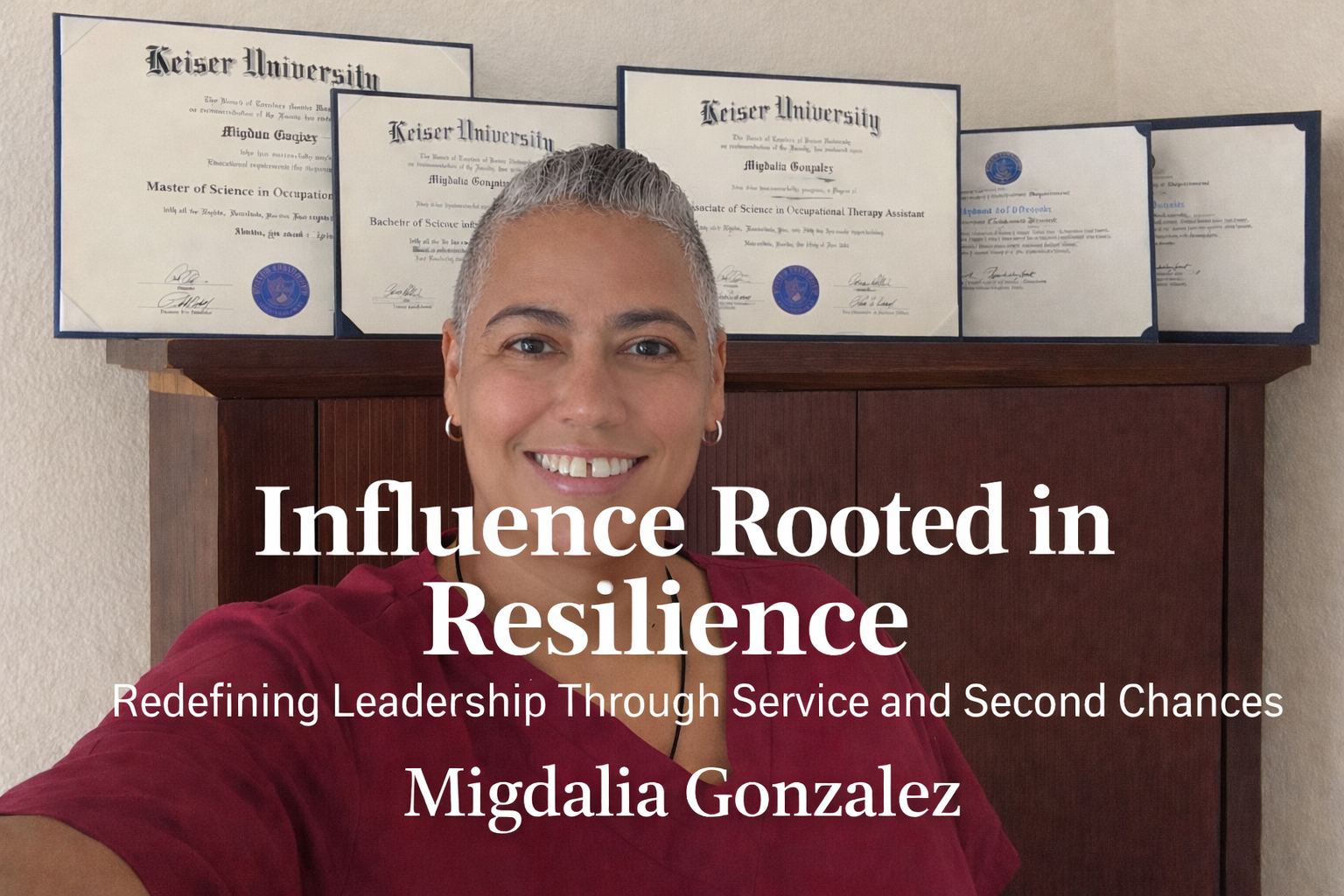
Influence is often measured by titles, timelines, or the speed of success. My experience has taught me something very different. True influence is built on perseverance, humility, and faith—especially when the path ahead feels uncertain.
I did not follow a conventional path into healthcare or academia. After years in corporate America and the maritime industry, I discovered occupational therapy later in life. At 44, I returned to school as the oldest student in my cohort, balancing full-time work with full-time studies, guided by conviction, prayer, and determination.
There were times when the obstacles felt overwhelming—including completing clinical rotations while living on an inflatable mattress. Yet even in those seasons, my faith reminded me that difficulty does not equal defeat. Those challenges strengthened my resilience and clarified my purpose.
Influence is not reserved for the earliest starters or the loudest voices—it belongs to those willing to persist, to grow, and to lift others along the way.
Occupational therapy aligns naturally with who I have always been—a lifelong caregiver at heart and a professional committed to restoring independence and purpose. As an occupational therapist, I help individuals regain the skills and confidence needed for everyday life, supporting dignity, participation, and meaningful independence during some of life’s most challenging moments.
That journey eventually led me back to the classroom—this time as an educator. Serving as an OTA Program Professor and Academic Clinical Fieldwork Coordinator enabled me to guide students through pivotal professional milestones and reinforced my belief that leadership is grounded in service, accountability, and advocacy.
As I prepare for the next chapter of my career, my purpose remains the same. With faith leading the way, I aim to serve with integrity, lead with compassion, and make a meaningful impact wherever I am planted.
To women who feel their timeline does not align with the norm, know this—it is never too late to realign with your purpose. Your experience is not a limitation; it is your advantage.
I move forward with faith always ahead of me, trusting that purpose is revealed one faithful step at a time.
Join Influential Women and start making an impact. Register now.