Her Story
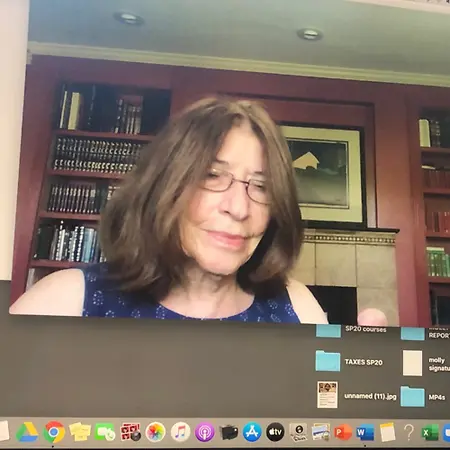
About Molly
I am a professor of classics with 60 years of experience in teaching, research, and mentoring. My work revolves around the study and teaching of classical literature, particularly Latin, which I believe is the most important thing anyone can study in college because it trains you how to think and how to learn. My typical day involves studying and learning in front of a desk, teaching classes, mentoring students, serving on various university committees, and conducting research. Some days are devoted entirely to teaching, while others focus on research - I am my own boss in this regard. Throughout my career, I have been passionate about communicating with the great minds of antiquity through their texts, as most of my mentors have been books and the dead people who wrote them. I read constantly and have learned how to do research from books rather than from human mentors in labs. Beyond my academic work, I am also a poet who reads and writes. I have witnessed profound changes in higher education over my six decades in the field, from the shift toward commercialization and corporate business models to the challenges of COVID-19 and the astronomical rise in tuition costs. Despite these challenges, I have loved every minute of my work and have dedicated myself to helping students understand why they should study the humanities, even as universities increasingly prioritize STEM fields and applied sciences over classical studies.
Her Interview
Ten minutes with Molly
01What advice would you give to young women entering your industry?
I would say, do only what you love. Ten years ago, I would have told you not to pursue a PhD in the humanities because it's too hard to get jobs - schools are hiring more temporary people instead of tenure-track positions, and you can't make a living wage until you climb up the ladder and become a full professor. The whole face of education has changed, and it's especially tough in the humanities where schools keep closing classics departments. But now I've changed my tune because of AI. AI is really going to put a dent in job opportunities for people in the STEM fields - those technical jobs that used to be a pathway to good careers are being undermined, and people are getting fired by companies like Microsoft. The people who majored in humanities will be able to create a future because they've learned things that have no use, and as my favorite poet says, the most useful things are the things that have no use. I think the best path to take is to major in the humanities, and in particular the classics, and especially Latin, because it trains you how to think and how to learn. I would not major in the STEM field now unless I loved it. And loving it is why you should major in what I majored in - because I loved it. Your best bet is to study whatever you love, because if you're trying to get an education that will send you straight into a job market where they're all looking for you, forget about it, it's not going to be like that.
02What are the biggest challenges or opportunities in your field right now?
The biggest challenge is the commercialization of education. Universities have been slowly transforming over the past 40 years, picking up steam, and they are now much more like corporations than they were when I was in college. The university is run on a business model rather than what used to be the academic model. Administration became more important than it ever used to be, and I got into this because I had no boss and I was nobody's boss - I was my own boss, and that's the way academia used to be. It's not like that anymore. COVID was a big challenge because students were trying to do everything on Zoom and online, and they didn't like it, and the professors mostly didn't like it. It was another step in the direction of commercialization and changed things for the not for the better. Another challenge is that education became so incredibly expensive. Very few people have the luxury now of going to college and paying all the money that college costs without thinking of it in many ways as a trade school. Liberal arts colleges never used to be trade schools - you went before you learned your trade, but it prepared you for any trade. Now there's a big push for studying only the applied sciences, engineering, and schools spend money on that, but I'm in humanities, and humanities is the last thing that schools are thinking of supporting now. They keep closing classics departments. So the whole face of education has changed, and in my opinion, not for the better. However, I think AI presents an opportunity because all those technical jobs are the ones that are being undermined, and it's going to be the people who majored in humanities who will be able to have the ability to create a future.
Join Influential Women and start making an impact. Register now.