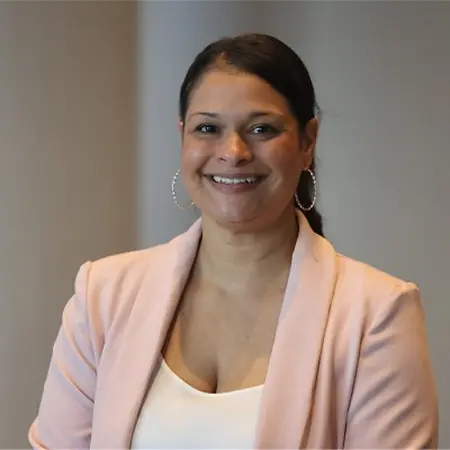
Her Story
About Monique
I'm a first-generation college student who went to a large public institution and was quite lost, as many first-gen students are. I changed my major a bunch of times and really couldn't figure out what to do. Then I went to my career center at my undergrad and met one of my mentors - still my mentor to this day. She was a career coach and worked with me and was able to help me declare a major, get an on-campus job, and really start to feel like I belonged in that space. That experience inspired me to pursue this field. I took four years off between undergrad and grad school, then went back to get my master's in education and counseling because I really wanted to be a high school counselor, but I loved the career piece of it. After my master's program, I worked for the state of Connecticut in their labor department doing re-employment services - this was in 2010, the height of unemployment prior to COVID. I was working with people who were losing their jobs, trying to get them back in the job market. Then I saw there was a job at UConn, which is my alma mater, and I ended up applying because I really wanted to work with 16 to 24 year olds - that was my range of people that I loved working with. I started working at UConn doing academic support and student services work, then moved into the Career Center there, and I've been in career for the majority of my higher ed career.
Her Interview
Ten minutes with Monique
01What do you attribute your success to?
God, first and foremost - never-ending grace. Definitely my husband - he was the one that pushed me to go and get my doctorate. If it wasn't for him and his support, I wouldn't have made it through. He has his PhD, so it was really great for me to have someone who had already been through this in my corner. My kids - constant motivation. I have five kids. My son is 21, and I actually had him when I was an undergrad at UConn, so he was a big motivator to finish and finish my degree because I didn't want to be a statistic and not finish. Then I have a 7, 6, 3, and 1 year old, and my three girls are really big motivations because I want them to be raised by a strong woman and be strong women. My family, of course - my parents and my sister have always been in my corner. But it's also for every brown or black girl that was told like you can't do it, or you're not good enough, or you can never be this, like you can't have it all. I feel like it's for them too, to say like you are good enough, you can do this. Like it's not gonna be easy, but it's not impossible. That was always really important to me, to be that person, that example - like you know, she's here and in this role, like I can do that too.
02What’s the best career advice you’ve ever received?
The best career advice I received was actually pretty recently from a mentor. She said, and this was when I was transitioning or thinking about transitioning jobs, make sure that you run towards something and you're not running away from something. I thought that was really powerful because I think oftentimes we go into the next phase because we're trying to get away from something, and then we end up recreating the same thing again in a new space because it wasn't actually what we wanted to do, we just needed to get out of where we were. I get that value of getting out, especially if it's toxic, but you want to make sure that you're not running towards something that's creating a vicious cycle.
03What advice would you give to young women entering your industry?
I would tell them what I tell my daughters now - you're good enough, you belong here, you have a voice, you can make an impact. Just know your worth and know your power and use it wisely. Don't be afraid to fail and take risks. Mistakes are seldom fatal. I think people are just so scared to make them because it feels like it's the end of the world, and it's not. It doesn't have to be.
04What are the biggest challenges or opportunities in your field right now?
Higher ed is under a lot of challenges right now. Things that are happening in the world and the growing question of if folks need a degree or not, the rise of AI and people being scared about how that's going to impact the job market - those are all challenges. I feel like in some ways higher ed's fighting for its life right now to survive, with the enrollment cliff and people aren't sending their kids to school, they're not having as many kids anymore because of the economy. Higher Ed really needs to reinvent themselves and get out of this is how we've always done things. Career Services has to do the same - it's not just about offering students career appointments or career fairs. Our students are wanting something different, they want more of that personalized experience. This challenge exists for both higher ed and employers - to appeal to this new generation of learners and workers and be able to pivot and adapt so that you retain them because they have so many options. Nobody's staying at their own company for 30 years anymore. People aren't staying - they're moving out every 3 to 5 years. COVID really awakened people that life is short and we can do more things from home. People are less likely to buy into oh well you have to be in the office, you have to do it this way. We have all this technology, AI and other things - we can work smarter, not harder, and still meet our goals and expectations.
05What values are most important to you in your work and personal life?
Integrity, compassion - there's a restorative part to my work. Oftentimes I'm brought in to build something that didn't work or needs fixing, so I'm really big on restoration. Inclusion and diversity are important to me. And I'd say love - I don't think that we talk about love enough when we talk about work. What I mean by that is oftentimes it's all about the ROI or the benchmark or the metric, how are we doing this, but it's like how are we caring for one another, how are we loving each other, how are we showing up for one another. So yeah, love is definitely one of my values.
Join Influential Women and start making an impact. Register now.