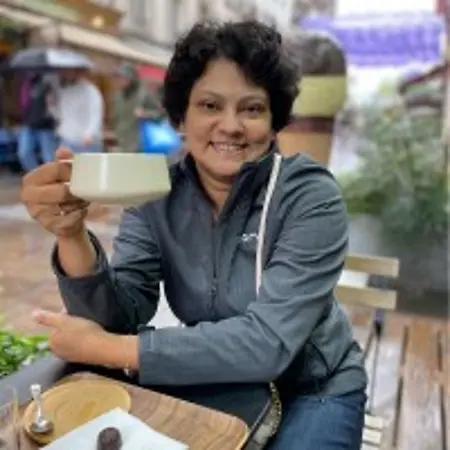
Her Story
About Mousumi
Mousumi Roy is a technology leader and RF systems architect with a career spanning over 17 years in wireless, microwave, and millimeter-wave engineering. Her journey into engineering began in a Himalayan town in India, where she grew up without female engineer role models and developed an early fascination with space and astronomy. Inspired to contribute to space exploration, she pursued electronics and communication engineering, earning both her Master’s degree with distinction and a PhD from the University of Manchester. Her academic research primarily focused on various aspects of low-noise cryogenic radio-astronomy receiver development as well as other next-generation receiver solutions. These experiences helped her transform her childhood curiosity into a lifelong technical career.
Professionally, Mousumi has built a versatile expertise across RF system design, for complex wireless technologies, including cellular systems, IoT, UWB, phased arrays, radar, and satellite-adjacent applications. Her work has spanned both industry and research environments, including roles at NVIDIA, Qorvo, and postdoctoral research at the University of Manchester for Rolls Royce. Over time, she transitioned into technology leadership. At Qorvo, she led the UWB systems architecture team, focusing on UWB radio architecture, standards and algorithm development. Her work reflects a strong systems-thinking approach, connecting concepts across diverse domains to drive high-performance engineering solutions.
Alongside her industry career, Mousumi remains closely engaged with academia and professional communities. She is currently a volunteer researcher at Arizona State University and a senior IEEE member, contributing to the Microwave Theory and Technology Society through participation in technical and administrative committees. Passionate about mentorship and STEM outreach, she is committed to supporting the next generation of engineers, particularly young professionals and women entering the field. Guided by a philosophy of continuous growth, stepping outside comfort zones, and maintaining technical excellence, she continues to balance leadership, research, and service in a career dedicated to advancing technology and inspiring others.
Her Interview
Ten minutes with Mousumi
01What do you attribute your success to?
I attribute much of my growth to a mindset of continuous learning, personal discipline, a strong sense of ownership and accountability, and, most importantly, a willingness to step outside my comfort zone. At the same time, I recognize that my journey has been shaped by the mentors who guided me, the teams I worked with, the opportunities I received, the support of my family, and the environments that helped me grow.
One experience that has stayed with me was an internal growth-mindset assessment, where I scored very highly. More than the score itself, it reinforced something I strongly believe: people grow through consistent effort, learning, and the way they choose to see themselves. This belief has shaped both my career and my leadership style. As a leader and mentor, I have encouraged people to take on ambitious goals, move beyond self-imposed limits, and see challenges as opportunities for development.
My career journey has also taught me both resilience and humility. I come from a Himalayan town with limited access to resources and career guidance, but I was fortunate to grow up in a family that valued education, openness, and respect for different perspectives. I did encounter moments where societal expectations could have narrowed my sense of possibility, but I chose to keep learning, take ownership of my path, and move beyond those limits to build an international career. Over time, I have learned to listen with humility, consider different viewpoints, and make thoughtful decisions with confidence and accountability. I have also worked successfully across generations, and I particularly enjoy engaging with young people, whose curiosity and fresh perspectives reinforce my commitment to staying open-minded, inclusive, and free from preconceived biases.
I also believe in focusing on solutions rather than becoming overwhelmed by problems. Whether I am working on a technical challenge, leading a technical team, mentoring young professionals, supporting STEM initiatives, or helping someone grow, I try to bring full attention, discipline, and positive energy to whatever I do. I do not take on responsibilities as a burden; I engage with them because I believe I can contribute. That attitude - to learn, stretch, help, and keep moving forward - has been central to my personal and professional growth.
02What’s the best career advice you’ve ever received?
During difficult phases of life, my close friends and family have often reminded me: “Whenever you find yourself doubting how far you can go, remember how far you have come.” That advice has been deeply empowering for me because it shifts my focus from fear and uncertainty to resilience, gratitude, and the progress I have already made.
The other important lesson I have learned and incorporated in my personal and professional life is to focus on things that I can influence, while developing the resilience to live with uncertainty and outcomes I cannot control.
03What advice would you give to young women entering your industry?
Having mentored both young women and young men, my first advice to anyone entering this industry is to become comfortable with being uncomfortable. Growth often begins in unfamiliar situations - when you take on a challenge, enter a room where you may feel underrepresented, or attempt something before you feel fully ready. Over time, those uncomfortable moments build confidence, resilience, and a stronger sense of what you are capable of accomplishing.
The second advice is not to let other people’s doubts define your choices. Assume good intent, listen respectfully, and take feedback seriously, but do not treat every caution or criticism as the truth about your potential. Instead, focus on what you can learn, what you can influence, and how you can become part of the solution. This matters for all young people. At an early age, a single discouraging message can become an invisible boundary. A teenage girl may hear, “Engineering is not for girls,” or “You are not ready.” A teenage boy may hear, “Showing empathy is weakness.” Different messages, but the effect can be similar: they can narrow confidence and limit ambition before a young person has even had the chance to discover what they are capable of.
My message would be simple: do not wait until you feel completely ready. Learn, ask questions, take up space, seek mentors, and keep moving forward. Confidence is not something you always start with; often, it is something you build by doing.
04What are the biggest challenges or opportunities in your field right now?
The technology landscape is changing at an unprecedented pace, and that creates both challenges and opportunities for engineering. Fields such as AI, quantum technologies, semiconductors, advanced wireless and satellite connectivity, clean energy, biomedical engineering, and robotics, to name only a few, are no longer abstract technical area - they directly affect how people live, communicate, receive healthcare, access energy, and stay safe.
To solve these problems, we need engineers who can keep learning, adapt across disciplines, and use tools like AI responsibly while still relying on strong fundamentals and sound engineering judgment. I see AI as a powerful enabler in this transformation. If used well, it can accelerate design, improve system-level analysis, support validation, and help engineers make better decisions. However, it must be combined with domain expertise, ethics, and critical thinking. The real opportunity is to use these new tools to build better technologies while also creating an engineering culture where people continue to learn, adapt, and contribute throughout their careers.
Many of these challenges require engineering talent at a scale we do not yet have, which means the engineering community must do more to build the next generation of talent. In my view, one of the biggest challenges and opportunities in the field is developing a more future-ready technology workforce. This is one of the primary driving factors behind the IEEE MTT-S global online one-to-one mentor–mentee initiative that I am co-leading this year. Because the program is online, it is accessible to any MTT-S member from anywhere in the world, helping remove geographic barriers to mentorship and professional guidance. For me, this initiative is a way to give back to the engineering community by helping young engineers build confidence, gain direction, and see a broader range of possibilities for their future.
05What values are most important to you in your work and personal life?
The values most important to me in my work and personal life are integrity, ownership, curiosity, continuous learning, and a commitment to to stay solution-oriented in the face of challenges.
Join Influential Women and start making an impact. Register now.