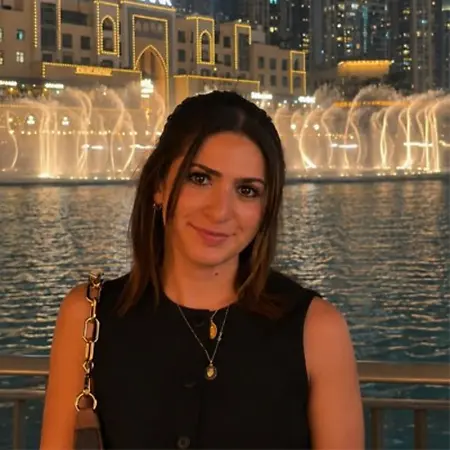
Her Story
About Nadia
Nadia Altaher is a dedicated professional in the field of international health. She began studying global health in 2020 and earned her bachelor's degree in community health with a concentration in global health from George Mason University in 2023. Following her undergraduate studies, she worked as a project specialist for approximately one and a half years before pursuing her master's degree in international health with a concentration in health systems at Johns Hopkins University, which she completed in May 2026. During her master's program, she served as a health program analyst intern for nine months at the United Nations Relief and Works Agency headquarters in Amman, Jordan, where she supported projects including updating child health technical instructions, developing maternal health dashboards, creating training surveys, and analyzing quantitative data on child nutrition. She also holds certificates in humanitarian health and public health economics obtained through her master's program and was a member of Student Justice for Palestine. Nadia attributes her success to her advisors, mentors, and professors at George Mason University and Johns Hopkins University, and she values relationship building, respect for diversity, cultural immersion, and commitment to consistency in her work.
Her Interview
Ten minutes with Nadia
01What do you attribute your success to?
I honestly could not be here without all of the advisors and mentors that have gotten me here. There are professors that I have looked up to during my time at Johns Hopkins, at George Mason, even at Underwood and at CAF. I've definitely felt a lot more motivated and inspired by the people that I've worked with and the people that have taught me. So I attribute a lot of my success to them, and I honestly would not be here without all of the people that have come into my life thus far.
02What’s the best career advice you’ve ever received?
Don't let what the system has already placed in front of you be the only solution. It's hard to think now out of the box in ways that we can implement different ways of delivering certain services or programs just because there's already a system in place. One of the career advice that I received from my professor in global health policy, he said just because there is a certain system, a national governance system in place does not mean that that has to be the only solution. It's definitely a lot harder to find your own solution and develop a new system or a new way of delivering global health services and programs but just because it isn't there doesn't mean it can't be developed.
03What advice would you give to young women entering your industry?
Don't be demotivated in this line of work just because there's a lot at play, there's a lot of interdisciplinary or intersectional teams and systems happening all at once. You feel like you can't really make a change or that one person isn't impactful. But it is, like in small ways it is. Sometimes waking up and showing up regardless and greeting your neighbors and people that you're working with kindly, it all leads to a certain change, a certain direction where you can make more impactful change. Don't be discouraged by not seeing the impact or not feeling like you're making the impact you want to make yet. It will happen with time and small impacts are just as important as big ones.
04What are the biggest challenges or opportunities in your field right now?
There's a lot of external factors that come into play, one being the challenges of funding sustainability and funding shortages especially at the UN as a whole. There isn't really something sustainable that it can use to keep the projects and programs that they have going. So it's kind of unfortunate that a lot of the necessary programs are reliant on government and donor funding. Another one would be trying to make sure that the work is becoming more localized. The work needs to become more localized to people that are working on the ground granting them the power and the decision-making policies needed instead of people working in headquarters in Geneva or DC or New York. Grant more autonomy and more decision-making privileges to people that are working on the field because they know most about the context and programs that they're working in.
05What values are most important to you in your work and personal life?
Relationship building, having respect for other people and their diversity and their cultures just the way they think differently. Immersing yourself in whatever culture or location that you're moved to, really immersing yourself, getting to know the people, getting to know everything about where you are not just coming in and doing your work and then leaving but really trying to immerse yourself and become one with the people you're working with. Commitment to consistency. Being committed to routine, committed to doing something even though you don't want to do it but knowing that it's going to lead you in a direction that's for the best.
Join Influential Women and start making an impact. Register now.