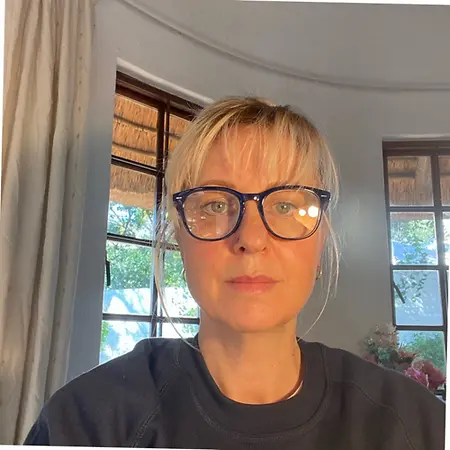
Her Story
About Natasha
I have been in the hospice and palliative care field for 25 years, working both in clinical and non-clinical capacities. Palliative care is when somebody has been diagnosed with a life-limiting condition and there is no curative treatment, so we start treating symptoms and pain because that's the only thing we can do. My past 2 years were spent in a managerial role at the Hospice Association of the Witwatersrand, or Greendale Hospice, which are the oldest and largest hospice in Africa. In that role, I managed day-to-day operations and specifically focused on end-of-life care and wound management. Before entering hospice care, I spent 25 years in corporate working in aviation insurance. It was during COVID, after losing my brother and sitting in hard lockdown for 6 weeks, that I wanted to be part of the solution. I didn't want to just sit in the house and complain. I started looking at healthcare and somehow came across hospice, and the more I looked at it, the more it told me, because it is actually humanitarian aid. I enrolled in a year-long certification in caregiving that aligns to certified nursing assistant in hospice and palliation in 2021, and during that year I worked in the hospice that I studied at. I've just relocated to the US about 6 weeks ago after my career in South Africa.
Her Interview
Ten minutes with Natasha
01What do you attribute your success to?
I attribute my success to the School of Hard Knocks. When you do what you have to do every single day to survive, you do those things, but you do get to a point in life where you can do something because you want to do it, because it fulfills you. I've got an attitude of being the eternal optimist. I look for a rainbow in every single storm. I never give up. I make do with what I have, and that's the one thing that hospice has taught me tremendously, especially when you are caring for somebody whose economic background is incredibly challenged. You make do with what you have, and you try and create as much comfort as you can with what you have.
02What’s the best career advice you’ve ever received?
I would credit a gentleman, Zane Bulbulia, who is the Director of Disability in the Premier's office in South Africa. Zane himself is disabled and in a wheelchair, and he's not just a work colleague but also a close friend. What really stood out to me and always taught me is that when we visit various institutions, hospices, children's homes, things like that, Zane never goes in. He does not go and meet the children, because his view is that the children are not on for display. They are human beings with feelings and emotions, just like I am, just like you are. These children see all these feet come through the children's home to gawk at them and look at them. That is quite a profound lesson that he had taught me, that I implement myself.
03What advice would you give to young women entering your industry?
To young women in this industry, you've got to choose this industry. Don't just fall into it. You'll find that a lot of people that work in hospice are older, and maybe it's because they have gone through life. You have to choose the industry, and you need to understand and go delve into what it means to be, the difference between sympathy, empathy, and compassion. Hospice is not just end-of-life care. I want to make this quite pointedly. The scope of hospice is actually very large, and it goes hand-in-hand with medicine and social welfare and social services. You build a village around you, where you reach out to other people when you need resources, whatever that resource might be, when you need food, when you need personal care products, or you need a spiritual advisor, whomever that may be, you may need a priest, you may need to reunify family members, things like that.
04What are the biggest challenges or opportunities in your field right now?
The opportunities are huge, because people don't choose it. People are scared of hospice and palliation, and what does it mean to work in death? People are very afraid of it, because we don't treat death as a natural process. Death is natural as much as life is natural. It's part of the circle, part of it. So the opportunity to work in hospice care is tremendous. It's very big. The biggest challenge is our own perception of hospice, palliation, and death. The fact that we don't speak about these subjects. That is the biggest obstacle, because if we don't speak about it, we don't have information about it.
05What values are most important to you in your work and personal life?
The first thing is compassion. You need to understand the difference between sympathy, empathy, and compassion, because there's a difference between the three of them. To work in the field of palliation and hospice, you choose that. Nobody enters medicine to sit at somebody's deathbed. People enter medicine to cure, to find cures for things, to help. They don't enter medicine to sit at somebody's deathbed. So you need to understand the difference between those three things, and I think compassion is probably the first pillar, the first thing. The second thing is altruism. You are doing something for someone else, and not expecting a single thing in return.
Join Influential Women and start making an impact. Register now.