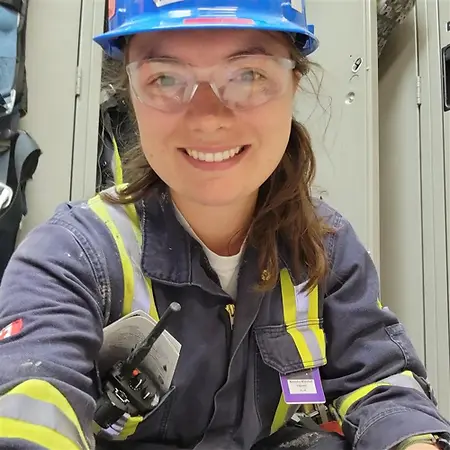
Her Story
About Natasha
Natasha Marshall is a mining engineer with over a decade of experience and currently works as a Principal Mine Engineer at Red Dog Mine in Alaska, part of Teck Resources. Over the years, she’s built a strong foundation across both underground and open-pit operations, working in mining regions around the world and gaining experience that spans technical planning, operations, and project delivery.
Her career has taken her through hands-on roles underground early on, where she was involved in short-range and daily production planning, ventilation, and ground control. That time in the field shaped how she approaches engineering today—practical, grounded, and closely connected to how work actually happens on site. As her career progressed, she moved into leadership roles supporting mine planning, scheduling optimisation, and major development and construction projects across a range of mining methods, including longhole open stoping, sublevel retreat, and large-scale open pits.
Natasha is known for leading multidisciplinary teams and bringing together planners, engineers, surveyors, and operations teams to deliver integrated mine plans safely and effectively. She has worked with several major mining companies, including Teck Resources, Rio Tinto, and Lundin Mining, contributing to projects across the U.S., Canada, Chile, and the U.K.
She holds a Bachelor’s degree in Mining Engineering from the Camborne School of Mines at the University of Exeter and is currently completing an MBA at the University of Alaska Fairbanks. Outside of her day-to-day role, Natasha is passionate about mentorship, leadership development, and giving back to her community. She has participated in the Women’s Leadership Program at Yale School of Management and has volunteered her time in areas ranging from youth theatre productions to the Canadian Ski Patrol.
Fluent in English and professionally proficient in Spanish, Natasha is recognized not only for her technical capability, but for her collaborative leadership style and her commitment to building strong teams in a demanding and ever changing industry.
Her Interview
Ten minutes with Natasha
01What do you attribute your success to?
A lot of my success comes from the experiences and lessons I’ve picked up over my 10+ years in mining. I’ve been fortunate to step into leadership roles that pushed me outside my comfort zone, challenged how I think, and taught me how to lead with integrity while delivering results in complex, real-world environments. I think back to the roles I have learnt the most from and guess what?they were not the roles that came naturally or easy to me, I had to embrace my weakness and find a way to make it work as a strength, whether that be my previously non existent Spanish capabilities or having to get stuck in helping tow a pick-up stuck in the snow on a waste dump.
Just as important to me has been mentoring and supporting young engineers as they find their footing. Helping people build confidence, strengthen their technical skills, and understand their value within the profession has been incredibly rewarding. Watching others grow has made our teams stronger—and it’s been a big part of what continues to motivate and shape my own career.
02What’s the best career advice you’ve ever received?
Early in my career, after leaving the first mine I worked at in Chile, I moved to Canada. I stepped into a role very similar to my previous one, and it didn’t take long to get up to speed with the new operation. At the time, I was still young, with less than five years of experience, and I felt I had so much more to learn.
Then, an opportunity for an operations supervisor role came up. Transitioning from a technical role into operations wasn’t something I had ever considered. My mentor, however, encouraged me to apply. I was nervous, I felt completely out of my element as an engineer, used to working on designs rather than coordinating people and plans. I doubted my skills and worried I might be treated differently because of my background.
One piece of advice stuck with me: “If you can do 30% of what the role requires, you can grow and learn the remaining 70%. If you take on something you’re 100% ready for, you’re not challenging yourself to grow.”
That perspective changed everything. Since then, my career has pivoted from technical to operational and back again, and the experience of working directly with operators on the ground made me a far better problem solver and leader. It taught me that stepping out of your comfort zone isn’t just about taking risks, it’s about gaining skills, perspective, and confidence that you can carry forward for your entire career.
03What advice would you give to young women entering your industry?
The first thing I’d say is: confidence comes from competence. Take the time to learn the basics, get out in the field as much as you can, ask questions, and really understand how the operation works from start to finish. That grounding builds credibility and more importantly, it gives you the confidence to speak up and contribute. Yes you are going to say stuff that makes you cringe in a meeting and think how did I get here? Is everyone going to hold it against me? Then you realize that absolutely nobody else is thinking about what you just said, in fact the only person still lingering on the moment is you.
I’d also tell you not to feel like you have to fit a certain mould. Mining needs different perspectives, especially as things get more complex. You don’t need to have everything figured out on day one. Your perspective still matters, and often it’s the questions you ask that lead to better decisions and better outcomes. The times when you form part of an unorthodox team trying to find a solution for a problem you didn't even know existed last week but now seems to be the central focus of everyone on the mine, are the times when your perspective matters the most.
Something I learned along the way is how important it is to have both mentors and sponsors. Mentors help you learn and grow; sponsors are the people who speak up for you and put your name forward when opportunities come up. Be intentional about building those relationships, and don’t underestimate how valuable a strong peer network can be.
I’d also encourage you to say yes to opportunities — even the ones that feel uncomfortable. Some of the most valuable experiences in my career came from roles I didn’t feel completely ready for at the time. Growth almost never happens inside your comfort zone.
And finally, remember that leadership isn’t about a title. It’s about how you show up, the choices you make, and how you support the people around you. If you stay curious, grounded, and open to learning, there’s a long, rewarding career in this industry — and a real chance to help shape it for the better.
04What are the biggest challenges or opportunities in your field right now?
From my perspective, the mining industry is at a really interesting turning point. Demand for critical minerals is growing quickly, but at the same time mining is getting more complex. We’re working with deeper orebodies, tighter margins, and higher expectations around safety, sustainability, and community engagement, all of which raise the bar on how well we need to execute.
One of the biggest challenges I see is making sure we actually have the people, skills, and systems in place to keep up with that complexity. Talent is a huge part of the conversation. We’re dealing with an aging workforce while also asking teams to work in more digital, integrated, and data-driven ways. The graduates coming out of school now have digital skills that make me feel old, like when my parents need help to set up a Bluetooth speaker. That means we need leaders who are comfortable moving between technical work, operations, and people leadership.
I also think diversity plays a big role in where the industry needs to go. Mining has traditionally drawn from a pretty narrow group of people, and that’s no longer enough for the challenges ahead. Bringing in different perspectives leads to better questions, better decisions, and stronger outcomes, especially in high-risk, fast-moving operational environments.
There’s also a real opportunity in how we plan and operate. Better integrated planning, stronger alignment between engineering and operations, and smarter use of data can unlock a lot of value, not just in productivity and our commitments to investors, but in reducing risk and improving safety for generations to come. For me, the future of mining belongs to companies and leaders who are willing to lean into complexity, invest in people, and focus on how work actually gets done on the ground. That’s how we build safer, more resilient operations and set the industry up for long-term success.
05What values are most important to you in your work and personal life?
The values that guide me, both at work and outside of it, are integrity, accountability, respect, and balance.
Integrity is the foundation. In mining, our decisions affect real people, so doing the right thing matters, even when it’s hard and you are out on a limb by yourself. Accountability goes hand in hand with that. I believe in owning decisions, learning from what works (and what doesn’t), and standing behind your team at all times.
Respect is huge and relies so much on teamwork and leading with influence. The best outcomes come when people feel heard and valued, and when different perspectives are genuinely considered rather than promoted as “diversity or inclusion”
And finally, balance matters. This is a demanding industry, and I’ve learned the hard way that looking after yourself isn’t optional if you want to perform well over the long term. Having a life outside of work keeps me grounded, sane and helps me show up better as a leader.
Join Influential Women and start making an impact. Register now.