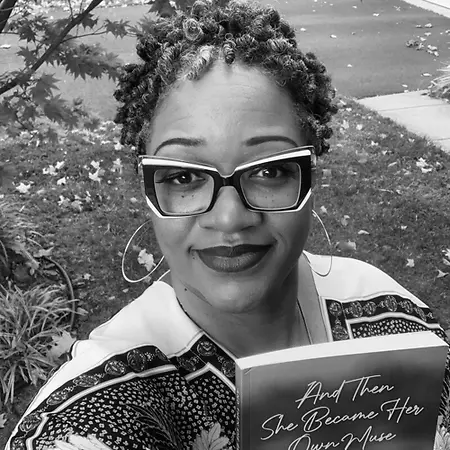
A powerful essay on reclaiming truth and practicing rest as resistance. Nichelle Sankey explores how Black women navigate professional spaces, confront projection, and refuse to diminish their lived experience for others' comfort.
“
After being publicly let go, I rebuilt by aligning my work with my values and launching my own consulting firm. My glass is never empty. It's endlessly refillable.
Nichelle Butler Sankey · In Her Own Words
Her Story
About Nichelle
Nichelle Butler Sankey is a principal consultant, strategist, and operator who helps mission‑driven organizations build the systems, structures, and executive capacity required for sustainable growth. As the founder of jnsankey Consulting, she partners with associations, nonprofits, and scientific organizations to modernize AMS/CRM environments, strengthen operational infrastructure, and create decision‑making frameworks that support clarity, alignment, and long‑term strategy.
With a background spanning complex system transitions, stakeholder engagement, and organizational development, Nichelle is known for transforming ambiguity into structured, actionable pathways. Her work centers on operational excellence, data governance, and executive team facilitation — helping leaders navigate growth, reduce friction, and make informed, future‑focused decisions.
Nichelle brings a principal‑led, high‑touch approach to every engagement, balancing strategic insight with practical execution. She is frequently sought out for her ability to guide organizations through AMS/CRM transitions, operational redesign, and the shift from grassroots operations to sophisticated, scalable structures.
She speaks on topics related to mission‑driven leadership, organizational capacity, and sustainable leadership practices.
Her Interview
Ten minutes with Nichelle
01What do you attribute your success to?
I attribute my success to starting my own business and getting that first contract on my own. I quietly build and I'm always the kind of person who measures twice and cuts once, so I've been very deliberate about what I do. I don't always accept every opportunity that's offered to me. I'm deliberate in understanding what I bring to an organization and just being solicited for that expertise. That's probably one of the things I'm most proud of. I did really well with learning things I didn't know. For example, I didn't know much about Salesforce and digital transformation at first, but I immersed myself in learning about Salesforce and worked with the more technical team that I was heading up to understand it so that we could make the best recommendation for the client. I'm always learning and staying immersed in my field, currently studying for my PMP certification, immersing myself in Salesforce services, and even building my own AI agent for my clients to utilize in their business based on what I know works in the process of an implementation.
02What’s the best career advice you’ve ever received?
Some of the best career guidance I’ve ever received came from two women who shaped my early professional life at the association management company where I worked. The president saw my strengths long before I fully recognized them in myself, and she named them with a clarity that stayed with me. My supervisor, in a very different way, pushed me relentlessly. She held me to a high standard and kept raising the bar, often without extending much grace.
With time — and healing — I came to understand that she was leading through her own pain. When we eventually had an honest conversation, she apologized for not knowing what I was carrying personally. That moment reframed the entire experience for me.
What I gained from that organization has stayed with me throughout my career. I learned how deeply women can pour into one another. I learned that my glass isn’t half full or half empty — it’s refillable. I learned how to engage clients with confidence, how to escalate issues appropriately, and how to lead without performing strength I didn’t feel.
And I witnessed something powerful: when staff were disrespected — even by physicians — leadership intervened. They made it clear that staff were partners, not subordinates. That culture of collaboration shaped my own leadership philosophy and continues to influence how I build client partnerships, how I set boundaries, and how I show up as a principal consultant today.
Much of what I practice in my business is a direct extension of what I learned there — the standards, the integrity, the advocacy, and the belief that excellence and humanity can coexist.
03What advice would you give to young women entering your industry?
One of the most important lessons I’ve learned — and one I encourage others to embrace — is the power of knowing your niche. People often shy away from narrowing their focus, but understanding your strengths, your gaps, and where you create the most value is essential. From there, build partnerships that complement you. Some of my most meaningful collaborations have come through simple exchanges of expertise, where I offer strategic insight, website structure, or validation of someone’s positioning, and they offer what they do best in return. When you’re too close to your own work, you can’t always see the full picture. Trusted partners help you widen the lens.
Relationships matter. Not in the transactional “what can you do for me” sense, but in the collective “how can we build something stronger together.” Keep those relationships warm. Check in on your strong friends. Stay connected even when you don’t need a favor or a reference. And when someone models the kind of integrity or excellence you want to see in the world, be the person who recommends them without hesitation. Even if a past situation wasn’t ideal, if someone is a solid colleague, honor that. It costs nothing to pour from a refillable cup.
Stay immersed in your field. Pursue certifications when they strengthen your craft. Keep learning. Benchmark your work against what you see done well. Study the missteps — yours and others’ — and let them refine you, not define you.
Above all, be loyal to yourself. That loyalty will guide your decisions, your boundaries, and the way you show up in the world.
04What values are most important to you in your work and personal life?
The values that guide me — healing, accountability, and honoring yourself — were shaped in profound ways after my sister passed unexpectedly from pancreatic cancer just a week after her diagnosis. That loss pushed me into a deep depression, and writing became the way I found my way back to myself. From that season came my book, And Then She Became Her Own Muse, a collection of musings on personal accountability, self‑honoring, boundaries, truth‑telling, and the lifelong work of healing.
My healing journey taught me to see people clearly, without illusion or embellishment. It taught me that healing is not a destination — it’s a practice. Triggers still come, and when they do, I pause and ask: What is this trying to teach me? Why is this pattern repeating? Writing has always been my way of processing, so moving from grief into reflection felt natural. Through that process, I learned to hold myself accountable, to set boundaries, and to speak up even when my voice shook. For years, I struggled to find the balance between being “too much” and being a doormat. Growth helped me understand that I never had to be either.
My mother used to tell us, “Let me be sad. I’ll be okay — I just need this moment.” I carry that with me. When I’m overwhelmed, I allow myself to feel it fully, then regroup. I teach my children the same: you’re allowed to feel everything — anger, sadness, disappointment. What matters is what you do with those feelings.
I don’t believe in scarcity. I believe there is enough for everyone to have what they need. I don’t compete with other women; I want them to understand that what’s meant for them will not miss them. My hope is that women see themselves as whole, capable, and deserving — and that they honor their own healing as fiercely as they honor their ambitions.
Her Content Hub
Articles by Nichelle
On Rest, Reclamation, and the Cost of Making Other People Comfortable with Your Truth
When a Black woman speaks her truth, some will call it confrontation—and that's their work to do, not yours.

By: Nichelle Sankey
Strategic Consultant and Principal, JNSankey Consulting
The Inbox Message Nobody Talks About
There's a moment many women know, unfortunately—the moment when a public win gets met with a private correction.
My article went live, picked up by Influential Women, and I celebrated and shared it across my timeline. A good day. A proud day. A “look at God” day.
And then came the inbox message.
Not hateful. Not overtly hostile. A lengthy message wrapped in that familiar tone women learn to decode early: concern disguised as guidance, guidance disguised as critique, critique disguised as care.
She told me she was happy for me. She said she was happy that I had found my calling.
She told me she read my article.
She said she “almost stopped reading” when she reached one particular sentence.
And in that moment, I felt the old sting—not because her words hurt, but because they were so predictable. Because I’ve lived this dynamic before. Because every time a woman centers her truth, someone else’s unresolved story comes knocking.
This time, though, I didn’t shrink.
I didn’t contort.
I didn’t apologize for the truth that is still shaping me.
I simply responded—and kept moving.
What the Published Article Actually Said
The irony is that the article wasn’t controversial. It wasn’t exclusionary. It wasn’t even pointed. It was a leadership piece about rest for women—the cost of constant endurance, the toll of overfunctioning, and the way women in leadership are conditioned to carry more than is sustainable.
I wrote about an issue that current data supports.
I wrote about lived experience.
I wrote about the cultural patterns that shape how women lead and how they burn out.
And yes—I wrote one sentence naming the specific conditioning of Black women. One sentence. One truth. One lived reality.
That was the sentence she couldn’t get past—the one that narrowed her lens for the rest of the article.
Not the importance of rest as a leadership strategy.
Not the organizational implications when that rest is absent.
Not the universal call for women to reclaim rest as power.
Not the personal anecdotes of reclaiming power at home.
Just the part that made her uncomfortable.
But specificity is not exclusion.
Naming my experience does not erase anyone else’s.
And telling the truth about Black women’s labor is not an attack—it’s an acknowledgment.
The “What About” Reflex
There’s a reflex that activates the moment a Black woman speaks plainly about her experience. A reflex that redirects, reframes, and recenters. A reflex that says:
“What about all women?”
“What about other groups?”
“What about me?”
It’s a pattern as old as every boardroom where I’ve been the only one.
As familiar as every meeting where my clarity was treated as confrontation.
As predictable as every moment when naming my truth was interpreted as an accusation.
The “what about” reflex doesn’t expand the conversation—it shuts it down.
It doesn’t create inclusion—it erases specificity.
It doesn’t build bridges—it reinforces silence.
And the irony?
The women who deploy it often believe they’re being fair, balanced, or protective of unity. But unity built on erasure is not unity. It is quiet harm.
Her opening line—happy I’d found my calling—was its own familiar trope: the compliment that buys permission for what comes next.
The Response — Rest as a Lived Practice
There’s a kind of composure people mistake for softness.
They don’t realize it’s discipline.
They don’t realize it’s restraint.
They don’t realize it’s the result of years spent learning when to speak and when to let silence do the work.
When I responded to her message, I wasn’t performing grace—I was practicing rest.
Not the spa-day kind.
Not the “take a nap and drink water” kind.
The kind that says:
I refuse to contort myself to make you comfortable.
Because the truth is, my response wasn’t for her.
It was for me.
It was for the woman I used to be—the one who would have overexplained, softened her truth, or apologized for being specific.
It was for the woman who used to carry the emotional weight of other people’s discomfort.
This time, I held my ground without raising my voice.
I didn’t match her energy.
I didn’t shrink.
I didn’t let her pull me back into an old version of myself—the version she was certain would have had me capitulate to her, like I did when we worked together.
That is rest as a leadership strategy.
That is rest as reclamation.
That is rest as resistance.
And it’s a practice—one I’m committed to continuing as I navigate leadership spaces where I am seated at the table as a subject matter expert.
The Mirror Moment
Here’s the moment that shifted everything for me: reading her response to my published article.
I am not responsible for what you see when you look in the mirror.
I am responsible for my words.
I am responsible for my integrity.
I am responsible for my truth.
But I am not responsible for the story someone else tells themselves when my lived experience makes them uncomfortable with their own truth.
Projection is a powerful thing.
People will read your clarity as confrontation.
They will read your specificity as exclusion.
They will read your liberation as accusation.
And sometimes, they will read your growth as a personal attack—not because you harmed them, but because your evolution highlights their stagnation.
Her angry emoji in response to my message wasn’t about my article.
It wasn’t even about me.
It was about the reflection she saw when she read my words—a reflection she wasn’t ready to face.
That’s her work.
Not mine.
And I’m done carrying mirrors for other people.
If anything, this moment reminded me to stay anchored in my own truth and let others manage their reflections.
What the Card Taught Me
A few days after her message, I was in my office putting things back in place after a much-needed refurbishment.
Clearing.
Sorting.
Reclaiming my space with intention.
And there it was—a card from her.
The only card that had slipped out of the envelope of cards and other mementos I’m preparing for scrapbooking.
The only one sitting on the desk.
The only one that had fallen over.
I don’t believe everything is a sign.
But I do believe timing has a way of revealing what’s ready to be released.
That card reminded me of the version of myself who survived the environment where she reigned unchallenged and was a purveyor of chaos.
The version who endured her withholding of important process documents.
The version who navigated her power plays where she set the stage.
The version who kept going even when the room wasn’t safe.
Seeing it now—in the middle of a season where I’m reclaiming my voice—felt like a quiet nudge:
Some things fall over because they are no longer meant to stand upright in your life.
You get to decide whether to keep it, archive it, or let it go.
Either way, the lesson is the same:
You don’t have to carry what no longer belongs to you.
This is the kind of moment that deepens your self-awareness without demanding emotional labor.
Bringing It Home — You Don’t Owe Anyone a Smaller Truth
Rest as reclamation is not neutral work.
It is political.
It is cultural.
It is spiritual.
It is deeply personal—especially for Black women who have been conditioned to hold everything together while holding nothing for themselves.
My work does not require a disclaimer.
My truth does not require an apology.
My leadership does not require permission.
The women who need this message will find it.
They already have.
And they will continue to—because specificity is not exclusion.
It is resonance.
So I’ll leave you with this:
It’s been more than 10 years since we worked together—three years on the same team, decades less for me than for her—and she still came to my inbox with old resentment dressed as editorial feedback.
I responded with grace, held my ground, and will continue writing.
That is rest as a leadership strategy.
And if you’re reading this, I’ll ask you the same question I had to ask myself:
What are you still carrying to make someone else comfortable?
A powerful declaration by leadership consultant Nichelle Sankey on redefining success through strategic rest, boundary-setting, and refusing self-sacrifice. Challenging women to prioritize sovereignty and sustainability over exhaustion.
REST AS A LEADERSHIP STRATEGY
Why Women Leaders Must Prioritize Rest as a Non-Negotiable Strategy for Excellence and Sovereignty

REST AS A LEADERSHIP STRATEGY: A DECLARATION FOR WOMEN WHO REFUSE TO BREAK THEMSELVES ANY LONGER
By Nichelle Sankey — JNSankey Consulting
I Am Done Being the Woman Who Bends
I have reached a point in my life and leadership where I can say, without hesitation or apology:
I am no longer available for self-sacrifice.
Not for an organization.
Not for a title.
Not for anyone’s comfort.
For years, people mistook my capacity for consent. They mistook my excellence for endlessness. They mistook my boundaries for suggestions.
Let me be clear: I am not going back. And I will not be pulled back, either.
This is my declaration—not whispered, not softened, not made palatable. It is spoken plainly, with a fortified backbone.
The Quiet House Told the Truth
It’s Memorial Day weekend, the first unofficial long holiday weekend before the summer solstice. My sons are out living their lives—one firmly established in his chosen career as a chemical analyst for a semiconductor manufacturer, the other a rising college sophomore home for the summer. Both are enjoying their independence.
The house was still.
Zo, my husband of more than 30 years, and Arbree, our family’s Yorkiepoo, were curled up strategically—one comfortably settled into the family room couch, the other resting at my feet in her king-sized equivalent of a dog bed.
And in the quiet of this weekend, I felt something I hadn’t felt in years:
I was not rushing.
I was not rescuing.
I was not carrying the emotional and operational burdens of everyone around me.
The quiet didn’t expose a void.
It exposed my evolution.
I realized I had already stepped into a new rhythm—one where my leadership is no longer fueled by urgency, depletion, or the need to prove my worth through overextension.
What does that look like?
Napping unapologetically when my body demands more from me.
Reminding everyone that the stove, washer, dryer, and microwave were created to serve more than one person.
The Cultural Lie That Women Must Carry Everything
Women—especially Black women—are conditioned to be the chief cook and bottle washer, the stabilizer, the fixer, the one who “just handles it.”
We are expected to bend until our backs remember shapes our spirits never agreed to.
And when we finally pause?
People act confused. Disappointed. Inconvenienced.
Because they became comfortable watching us bend.
My declaration is simple:
I no longer bend myself for anyone’s comfort.
In business and in life, preparation is the elixir.
I will equip you with the tools you need to succeed.
I will show you how to implement them within your operations.
But if you choose not to step over the puddle, I will not lay myself down and become the bridge for you to cross.
Rest Is Not Rebellion—It’s Strategy
Let’s remove the sentimentality from this conversation.
I don’t rest because I’m fragile.
I rest because I’m strategic.
Rest sharpens my discernment.
Rest protects my executive function.
Rest keeps me from absorbing chaos that was never mine to carry.
Rest ensures I lead from clarity, not depletion.
I am not a machine.
I am a leader.
And leaders who rest make better decisions than leaders who bleed out because they entered battle unprepared.
Your organization should have triage systems in place—to assess, recommend treatment, implement the best solutions, and follow up to understand what is working and what requires additional attention.
Rest is not a retreat.
Rest is refinement.
And Monday morning is not the time to address long-ignored, infected wounds.
I Show Up Fully—Then I Shut Down Fully
This is the new operational standard by which I live:
I show up as the subject matter expert.
I deliver clarity, structure, and strategic leadership.
And when the day is done, I shut down—fully—because the knowledge has been transferred.
No guilt.
No martyrdom.
No “just one more thing.”
If it can wait until tomorrow, it will.
If it can’t wait until tomorrow, it should have been planned better.
This is not laziness.
This is the practical management of energy and the preservation of expertise.
This is sovereignty.
This is what prioritizing peace looks like.
This is what receiving the best version of a leader looks like.
If I move an ember and the inferno reignites in two separate silos, there are underlying issues that need to be addressed.
Women Get Punished for Pausing—I Step Away From That Entire Framework
Here is the truth many of us have lived:
When women overfunction, they are praised.
When women set boundaries, they are questioned.
When women rest, they are judged.
When women stop absorbing dysfunction, they are labeled difficult.
I step away from that entire framework.
I no longer accept praise that comes at the cost of my well-being.
I do not allow my humanity to be treated as a liability.
I no longer serve as the scaffolding for systems that rely on my overextension.
If my boundaries disrupt someone’s comfort, that discomfort is theirs to manage.
My Leadership Standard Is Non-Negotiable
This is the leadership model I embody now:
Sovereign: I decide my pace, my energy, and my boundaries.
Far too many people have mistaken my peace for disengagement.
My peace is what allows me to operate at full capacity.
Sustainable: I do not burn myself out for the work.
My passion for what I bring to the table naturally demonstrates how deeply invested I am in my clients’ success.
Strategic: I deliver excellence without depletion.
You receive the best of me because I C.A.R.E.
Self-honoring: I no longer trade my well-being for someone else’s comfort.
This is not a phase.
This is my standard.
Permanent. Non-negotiable. Unapologetic.
A Declaration to Every Woman Who Has Been Carrying Too Much
To the women who have been everything for everyone:
You do not have to bend to be valuable.
You do not have to break to be believed.
You do not have to exhaust yourself to be respected.
You do not have to disappear to be appreciated.
Your rest is not rebellion.
Your rest is reclamation.
Your rest is leadership.
And if anyone is uncomfortable with your boundaries, it is because they benefited from your lack of them.
This is your permission—and your reminder—to stop carrying what was never yours.
Join Influential Women and start making an impact. Register now.