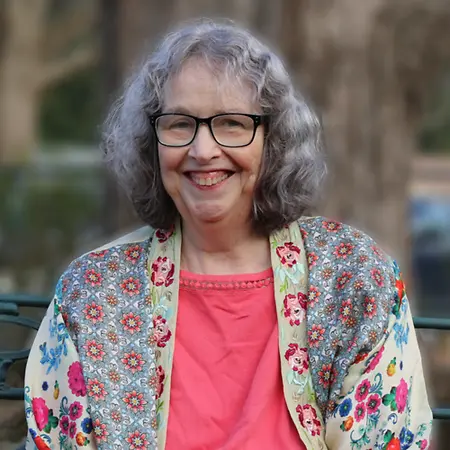
I wrote my book by working in a community with daily sprints an hour every weekday for 80 days. It wasn't great, but it was a start, and now it's out in the world.
Nikki M. Finlay, PhD · In Her Own Words
Her Story
About Nikki
Nikki M. Finlay, PhD, is an economist, educator, and author known for her work in making macroeconomics accessible to non-specialists. Based in the Atlanta metropolitan area, she focuses on translating complex economic concepts—such as inflation, unemployment, and recession—into clear, practical insights for everyday decision-makers. She is the author of The Economy Always Gets Better and writes under the platform “Economics for the Rest of Us,” where she continues her mission of improving economic literacy for a broad audience.
Over the course of more than 20 years in higher education, Dr. Finlay taught economics at Clayton State University, Georgia State University, and Gwinnett Tech. Her teaching career began in the early 1990s and evolved from graduate teaching assignments into a long-term commitment to classroom instruction focused on student engagement and accessibility. She is recognized for her student-centered approach, particularly her ability to adapt economic instruction for non-traditional and working learners. Her contributions to teaching excellence were acknowledged with a College of Business teaching award at Clayton State University.
In her current phase of work, Dr. Finlay has transitioned into writing, public commentary, and independent economic education following a shift in her mobility. Through her Substack newsletter and other writing platforms, she continues to break down economic trends in plain language for general audiences. She lives in Oxford, Georgia with her husband of more than 43 years, and balances her professional work with family life, writing, cooking, reading, and travel.
Her Interview
Ten minutes with Nikki
01What do you attribute your success to?
I attribute my success to my ability to truly understand what my students need and to connect with them in a way that makes difficult concepts click. I'm most proud of my teaching and my ability to get concepts that are difficult for a lot of people to understand across. We all learn differently, and I've always tailored my economics lessons to meet students where they are. I taught a lot of older students who had kids, responsibilities, and work, so they needed a different approach than younger students because your brain's not as spongy when you get older. That's why I made them practice in class, because I knew they wouldn't do it at home. The ones that practiced made A's, and the ones that didn't made C's. What I love most is when I explain something and somebody says 'oh, that's what's going on' or 'oh, that's how it works.' That moment of connection, when people realize they can understand this stuff and maybe make plans for the future, that's what it's all about. My superpower is that sometimes I connect the dots really well. I see things and can say 'oh, this goes with this.' The teaching award I received from the College of Business at Clayton State University showed that I was really in tune with what my students needed, and that validation meant the world to me.
02What’s the best career advice you’ve ever received?
The best career advice I've received recently is to give myself permission not to write the second book right away. I heard this when the first book isn't even out yet, and my husband wisely said, 'why don't we get this book sold and maybe doing well before we think about the second book?' That's really wise advice because I was already feeling pressure to have the next project lined up. I do have a second book in me and I really want to write about the labor market, but it requires a ton of research and I'm just not at the point in my life right now where I can do that. Learning to pace myself and focus on one major accomplishment at a time, rather than rushing ahead, has been invaluable guidance.
03What are the biggest challenges or opportunities in your field right now?
One of the biggest challenges in economics right now is that economists have gotten a bad reputation lately, and a lot of that is because many of them try to predict stuff, which is just foolish. We can't predict anything. The real opportunity, though, is in making economics accessible and valuable to everyday people. When I tell people what I do, they often ask me 'what do I do next?' or 'what do you think's going on in the economy?' That's really rewarding because it shows that what I know is still of value. The problem is that the jargon gets in the way for a lot of people. What we need to do is go around the jargon and say 'okay, this is what this means' in plain language. It's not complicated - it's just the cost of something or thinking about too many cooks in the kitchen. The cliches we grew up with are really helpful sometimes because we share that language. When I use that language instead of what an economist would typically say, we're closer to the same page, and people can say 'oh, that's what's going on. Now I can think about what comes next and maybe make plans.' That's the real opportunity in my field - helping people understand so they can make better decisions.
Join Influential Women and start making an impact. Register now.