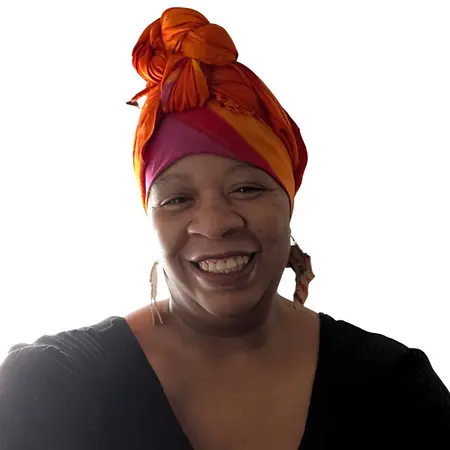
Influential Woman · Maternal Health
Nneka Jeaneil Hall
Maternal Health Advocate, Misc.
Hyde Park, MA 02136
Her Story
About Nneka
I am a maternal health advocate who educates and helps to build other maternal health advocates. I'm a doula trainer, a mom first - always a mom first - and I think I've had most influence over my not-so-littles and my little. I am a public health advocate and a neurodivergence advocate, and I educate on anything that has to do with reproductive health and supporting those through their reproductive health journeys. I'm currently writing curriculum for a variety of organizations on reproductive health issues, and I'm a researcher. I just completed my master's degree in mental health and wellness, so I'm sort of taking a break - actually, it's a break to create my workbooks to go along with my courses. I'm researching anything that is within the reproductive health realm in order to build my workbooks and manuals. I'm teaching online right now, and I do a lot of public speaking. I'm hired to do a lot of private courses and private talks surrounding anything maternal health, reproductive health, neurodivergence, and child-rearing. I teach anyone who asks, and I tailor what I speak on to match the population. I've spoken to groups with children as young as 6, and I've spoken to groups of women and men as old as in their 90s. It's been a rewarding experience. I came to this work from a place of loss - my third pregnancy ended in a 39-week stillbirth, and when I awoke from the fog, this is who I became. I've been in this work for 15 years, and I've done a lot more than I expected to do.
Her Interview
Ten minutes with Nneka
01What do you attribute your success to?
I attribute my success to a lifelong commitment to learning, the courage to transform my lived experience into collective healing, and a deep sense of responsibility to my community. My work is grounded in ancestral wisdom, intellectual curiosity, and the belief that grief literacy and culturally rooted care can change outcomes for Black families. I build what I wish existed, and I lead with integrity, compassion, and purpose.
02What’s the best career advice you’ve ever received?
The best lived experience I've ever received is that my lived experience is not a liability. It is a methodology.
03What advice would you give to young women entering your industry?
As a Maternal Health Advocate I would tell anyone entering my industry:
Lead with humanity before you lead with expertise.
Protect your integrity like it’s part of your license.
Learn the system, but don’t become the system.
Build your practice on evidence and lived experience.
Take grief seriously, it is the undercurrent of this work.
Find mentors who see your brilliance, not just your labor.
Your boundaries are part of your clinical skillset.
Stay a student of the body, the mind, and the community.
Remember that this work is sacred.
You belong here, not because the system invited you, but because the community needs you.
04What are the biggest challenges or opportunities in your field right now?
Maternal health is facing a set of challenges that are both deeply entrenched and urgently in need of transformation, and many of the most pressing issues stem from gatekeeping and siloed work. One of the biggest challenges is the persistent gatekeeping that determines whose knowledge is considered legitimate. Too often, institutions privilege academic credentials over lived experience, clinical voices over community voices, and traditional research over culturally grounded wisdom. This limits who gets funded, who gets invited to the table, and who is seen as an expert. Yet within this challenge lies an opportunity: the field is slowly beginning to recognize that the people closest to the problem are also closest to the solution. There is growing momentum to elevate doulas, bereavement workers, community healers, and Black maternal health leaders as essential contributors to research, policy, and care.
Another major challenge is the siloed nature of maternal health work. Hospitals, community organizations, mental health providers, doulas, violence‑interruption programs, and public health agencies often operate independently, even though families move through all of these systems. This fragmentation means that care is inconsistent, communication breaks down, and families fall through the cracks, especially after loss or trauma. But this fragmentation also presents a powerful opportunity: the field is increasingly aware that maternal health is not a single discipline but an ecosystem. There is a growing push toward cross‑sector collaboration that integrates mental health, grief support, community care, reproductive justice, and even violence prevention into a unified approach.
05What values are most important to you in your work and personal life?
The most important values in my work and personal life are the ones that keep me grounded in family, community, and integrity. Everything I do begins with the belief that families, including my own, deserve safety, dignity, and care. My work is an extension of how I show up at home: with compassion, honesty, and a commitment to protecting what is sacred.
I value family first, not just as a personal priority but as a professional principle. The way we support families during pregnancy, birth, loss, and healing shapes entire generations. I believe in creating systems of care that honor the fullness of people’s lives, their children, their partners, their ancestors, and the stories they carry.
I value connection over isolation, which means I work to break down silos and build bridges between disciplines, communities, and institutions. Healing is relational, and no one thrives alone. Collaboration, shared wisdom, and collective responsibility are essential to the work.
I value integrity, especially in spaces where gatekeeping and hierarchy can distort what truly matters. I lead with honesty, transparency, and a commitment to doing what is right even when it is not easy. Families trust me with their most vulnerable moments, and I honor that trust with my whole self.
I value compassion and grief literacy, because loss touches every family in some way. Holding space for grief, my own and others’, is central to how I move through the world. I believe that acknowledging pain is a form of love, and that healing is a family process.
I value rest, balance, and boundaries, because the work is heavy and the people I love deserve the best version of me. Caring for my own family means caring for my body, my spirit, and my capacity to show up fully.
I value legacy. I want my work to make life better for the families who come after us, my children, my community’s children, and the generations yet to be born. Everything I build is with them in mind.
Join Influential Women and start making an impact. Register now.