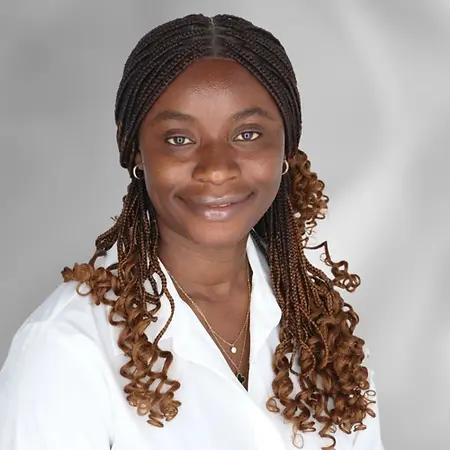
Her Story
About Ogochukwu
Ogochukwu Okoani, Ph.D. is a Senior Lecturer in Chemical Engineering with over fifteen years of experience in teaching, research, and academic leadership. She currently serves as a Graduate Research and Teaching Associate at Arizona State University while pursuing a second Ph.D. in Engineering Education and Systems Design. Her work bridges technical chemical engineering expertise with engineering education, focusing on preparing graduates for the workforce through hands-on learning, mentorship, and inclusive teaching practices. Dr. Okoani’s professional focus spans sustainability and environmental applications of chemical engineering, including post-combustion CO₂ capture, oil-spill remediation, and climate-change-related research. She combines technical training with innovative approaches in STEM education to support minority student persistence, rural engineering development, and gender inclusion. In her teaching, she emphasizes empathy and inclusion, fostering a sense of belonging for students of diverse capabilities and backgrounds. Throughout her career, Dr. Okoani has demonstrated leadership and service in academia. She served as Program Chair of the Chemical Engineering Department at the Institute of Management and Technology, Enugu (2020–2023), navigating COVID-era challenges, securing full accreditation for diploma programs, and attracting and overseeing the completion of a new chemical engineering laboratory sponsored by Tertiary Education Trust Fund (TETFUND). She also mentors undergraduate students, supervises research and capstone projects, connects students with industrial partners, and contributes to institutional research oversight and funding proposal review. Her mission is to empower the next generation of engineers and researchers through scholarship, mentorship, and innovation.
Her Interview
Ten minutes with Ogochukwu
01What do you attribute your success to?
I attribute my success to a combination of perseverance, resilience, and strong support systems.
Perseverance and resilience have been central to my journey. Completing a PhD while balancing the responsibilities of being a wife and mother required discipline, sacrifice, and an unwavering commitment to my goals. There were moments of exhaustion and self-doubt, but I remained focused on the bigger picture and the example I wanted to set for my family and students. Later, leading my department through the unprecedented challenges of the COVID-19 period further strengthened my resilience. Navigating uncertainty, transitioning to new modes of teaching and learning, supporting staff and students emotionally and academically, and still achieving program accreditation demanded adaptability, steady leadership, and determination.
Equally important has been the support I’ve received throughout my journey. My family has been my foundation - providing encouragement, understanding, and motivation during the most demanding seasons of my career. I have also been fortunate to have mentors and colleagues who believed in me, guided me, and challenged me to grow. Their counsel and reassurance often propelled me forward during times when I felt like giving up.
Ultimately, my success is not the result of individual effort alone, but of persistence combined with the strength of community, mentorship, and faith in long-term goals.
02What’s the best career advice you’ve ever received?
The best career advice I’ve ever received is: “You do not have to grow in isolation.”
Early in my career, I believed that success was largely about individual effort - working harder, staying longer, and figuring things out on my own. Over time, I came to understand that meaningful and sustainable growth rarely happens in isolation. Seeking collaborators, mentors, and support systems is not a sign of weakness; it is a sign of wisdom.
Collaboration opens doors to new ideas, perspectives, and opportunities that we may not encounter on our own. Mentors provide guidance shaped by experience - helping us avoid unnecessary pitfalls, think more strategically, and build confidence during uncertain seasons. Support systems, whether professional or personal, remind us that we are not alone in facing challenges.
This advice reshaped how I approach leadership and professional development. Instead of attempting to carry every responsibility alone, I intentionally build networks, nurture partnerships, and create spaces where others can contribute their strengths. Growth becomes more dynamic, innovation becomes richer, and challenges become more manageable when shared.
Ultimately, I have learned that progress is not a solitary journey. The strongest leaders and most fulfilled professionals are those who understand the power of connection, collaboration, and community.
03What advice would you give to young women entering your industry?
My advice to young women entering engineering is simple: persist in pursuing your dreams - you are more than capable.
Engineering, like many traditionally male-dominated fields, can sometimes feel intimidating at first. There may be moments when you are one of only a few women in the room, and at times you may even question whether you truly belong. In those moments, it is important to remember that your perspective, ideas, and skills are valuable. You have earned your place.
Do not allow stereotypes or self-doubt to limit your ambition. Competence is not defined by gender. Women bring unique insights, creativity, empathy, and problem-solving approaches that enrich engineering teams and strengthen outcomes. The industry needs diverse voices at the table - not only to design better solutions, but also to influence decision-making and shape policies that affect society as a whole.
Seek mentors, build supportive networks, and continuously invest in your skills. Be willing to speak up, take on leadership opportunities, and step outside your comfort zone. Most importantly, persist. There will be challenges, but resilience and confidence will carry you forward.
There are growing opportunities for women in engineering, and the field benefits immensely when more women step into it. Your presence is not just welcome - it is necessary.
04What are the biggest challenges or opportunities in your field right now?
One of the biggest challenges in my field right now is the persistence of systemic, male-dominated structures that can unintentionally make career progression more difficult for women. While significant progress has been made, leadership pipelines, decision-making spaces, and professional networks are still often shaped by longstanding norms that were not designed with diversity in mind.
In addition, many women continue to navigate competing caregiving expectations alongside their professional responsibilities. The dual demands of career advancement and family care can create additional pressure, particularly in environments with limited flexibility and institutional support. These structural and cultural realities can slow progression, affect visibility, and sometimes discourage talented women from remaining in the field.
At the same time, this challenge presents a powerful opportunity. The relative underrepresentation of women leaves significant room for growth, innovation, and transformation. As more women enter and advance within the profession, they bring diverse perspectives, leadership styles, and problem-solving approaches that enrich the field. Greater inclusion leads to more balanced decision-making, more thoughtful policies, and solutions that better reflect the needs of society.
This moment presents an opportunity not only to increase numbers, but to reshape systems — to build more equitable pathways, strengthen mentorship networks, and normalize flexibility without compromising excellence. By intentionally creating space for more women to join, contribute, and lead, the profession stands to become stronger, more innovative, and more sustainable.
05What values are most important to you in your work and personal life?
The values most important to me in both my work and personal life are empathy, inclusion, family, respect for diversity, and ensuring that all voices are heard.
Empathy guides how I lead and how I relate to others. Whether working with students, colleagues, or family members, I believe in taking the time to understand different perspectives and experiences. People perform at their best when they feel seen, understood, and supported.
Inclusion and respect for diversity are also central to my approach. I value creating environments where individuals from different backgrounds, cultures, and identities feel welcomed and empowered to contribute. Diversity is not simply about representation; it is about actively recognizing and valuing the richness of different viewpoints and ensuring they shape conversations and decisions.
Family remains my foundation. It grounds me, motivates me, and reminds me of the importance of balance and purpose. My professional achievements are meaningful, but they are most fulfilling when aligned with the well-being of those closest to me.
Above all, I strive to ensure that all voices are heard. In leadership and collaboration, I am intentional about creating spaces where individuals feel safe to express ideas, raise concerns, and offer solutions. Some of the most transformative ideas come from those who might otherwise remain unheard.
These values shape not only how I work, but who I am. They guide my decisions, my leadership style, and my commitment to building communities that are supportive, equitable, and impactful.
Join Influential Women and start making an impact. Register now.