Influential Woman · Museums and Arts Administration
Oleana Whispering Dove
Public Speaker and Museum Curator, Independent-Public Speaker and Museum Curator of Native American Exhibitions & Programming
New York, NY 10002
Her Story
About Oleana
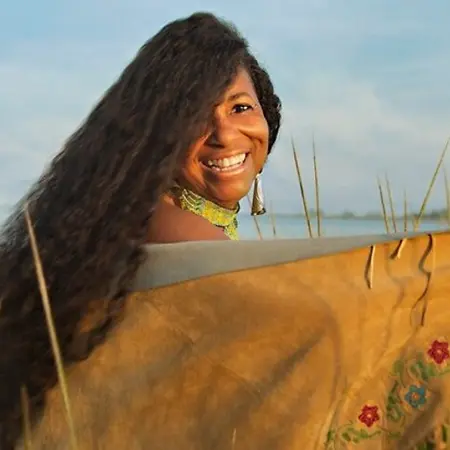
Oleana Whispering Dove is an independent museum curator and museum administrator with more than 25 years of experience in the cultural heritage and museum field. While managing life as a stay-at-home wife and mother, she deliberated on a return to social work or to pursue her innate interior design abilities. Accordingly, she transitioned into interior design studies at Parsons New School of Design, where an unexpected appreciation for antiquities led her into museum work. She went on to work for seven years at the Metropolitan Museum of Art, gaining deep institutional experience before choosing to focus on more regional-centered and Indigenous-led programming at Bartow Pell Mansion Museum.
This shift allowed her to align her professional path with her commitment to cultural preservation. She is widely recognized for her specialization in Northeast Indigenous history, with a focus on Native American communities across New York, New Jersey, and Connecticut. After leaving a large institutional role, she has developed and led Indigenous programming at city-wide Historic museums and cultural foundations, including exhibitions, film screenings, poetry panels, public talks, and Indigenous culinary presentations that bring historical knowledge into lived, sensory experiences.
During the COVID-19 pandemic, her work expanded into virtual and multi-institutional consulting, enabling her to share a growing toolkit of traveling programs tailored to diverse audiences and museum needs. In addition to her curatorial work, Oleana is a published poet and cultural speaker, with creative work that has been catalogued in major collections including the Schomburg Center for Research permanent collection. She is a frequent keynote speaker and advocate for Indigenous representation in cultural institutions, often collaborating with Indigenous leaders and participating in United Nations Indigenous forums. Through her work, including exhibitions, advocacy, and media projects, she continues to elevate Native American voices, emphasizing living cultural traditions and expanding public understanding of Indigenous identity beyond historical storybook narratives.
Her Interview
Ten minutes with Oleana
01What do you attribute your success to?
I credit my success to an in-depth command of the specialized historical material I present, paired with a proven ability to translate that knowledge into clear, engaging insights for a broad audience. This work is more than a profession—it’s a genuine purposefulness.
That purposefulness fuels my motivation, sharpens my focus, and sustains an ongoing commitment to growth and excellence. Of equal importance is my agility to not be hardwired for my desired goal to unfold in any anticipated way. It is my inherent understanding that not all goals occur in a straight line, and more often a desire will appear at the least expected time and in the least expected way, including from the least expected person. I'm able to remain grounded in my knowing that nothing is a coincidence and all roads lead to my highest destiny.
02What’s the best career advice you’ve ever received?
The best career advice I’ve ever received was during my duration at The Met, and it was to pay laser focus on the details. That simple guidance became a defining principle in my professional life, shaping me into someone highly detail-oriented with strong follow-through and consistency. While it sometimes carries over into my personal life, it has been essential in my work, where attention to detail truly makes the difference in quality and outcomes.
03What advice would you give to young women entering your industry?
My advice to young women entering this field is to fully engage in where you are right now and focus on building skills and consistency rather than rushing to chase a fixed idea of passion. Wherever your career has placed you stay long enough to learn, grow, and develop real strength in your work, because passion often emerges through experience and opportunities presented within your professional network.
With this in mind, be present, take ownership, and follow through—simple habits like that build trust and set you apart. In the long run, continuity and dedication matter far more than moving quickly from job to job. Choosing to anguish over your present circumstances, rather than summoning your abilities, is self-defeating, and so I urge you to be the person who makes themself of value regardless of appearances or level of employment.
04What are the biggest challenges or opportunities in your field right now?
The biggest challenge I'm dealing with right now is valuing the work that I do in terms of payment. In this regard, many institutions are able to pay a rate commensurate with my experience, but then a lot are not. I have to keep a minimum pay scale range which allows for flexibility depending on the institution. It's something I'm dealing with right now with one of the institutions that I accepted. I had to tell them that their offer was far below my normal pay rate - if you can at least bring it up to this x minimum, then we're good to go.
Ultimately, it's a decision based on how important the work and message are and so, I lean toward fulfilling a request where there is a higher potential for future, ongoing projects.
Another challenge is content-specific: the image of the Native American is that of the Western Native Americans. There is no nationwide understanding that Natives actually still live here in the tri-state of NY, NJ, and CT. Consequently, I thoroughly enjoy explaining why my native friends don't look like the stereotyped image that has dominated media since western tribes were removed and involuntarily placed on reservations., unlike the Northeast tribes who were involuntarily relocated within the same region of the origins. Additionally, when our president nixed all of the cultural programming this year, he took a lot of work away from a lot of people, and the gap in pay has really affected us all.
05What values are most important to you in your work and personal life?
Stick-to-it-ness and follow through are the most important values to me. Follow through, follow through, follow through, follow through! I really dislike the habit of starting and not following through. The key skill of focusing on details was a kernel that would take me to the next level, and consequently, I'm such a detail-oriented person now in terms of my work and my personal life that it can actually be off-putting in my personal life as I can scan the room for ideal table displays, improved seating arrangements, unemptied garbage cans, but it's absolutely necessary for your professional work.
Apart from this, it is essential to not identify solely with your work to the point that it permeates all aspects of your life. There are high percentages of us who overdevelop the professional muscle at the expense of our personal life muscle. We must aim for balance. When balance is attained, you can enjoy more fully the full scope and breadth of life.
As it relates to the body of my work, the culmination of my achievements as an author of a poetry book titled Reflections of a Whispering Dove, a co-producer of a short film titled Silent Tribute, a spokesperson for the UN article 37, and the inception of Lady Chieftains Suanksqua’s audio tour for Bloomberg Connects collectively reflects my adherence to the principle that we are the co-creators of our reality. Each accomplishment has its own inherent importance and likewise cannot compare to the other; rather, they collectively contribute to the totality of my legacy.
Join Influential Women and start making an impact. Register now.