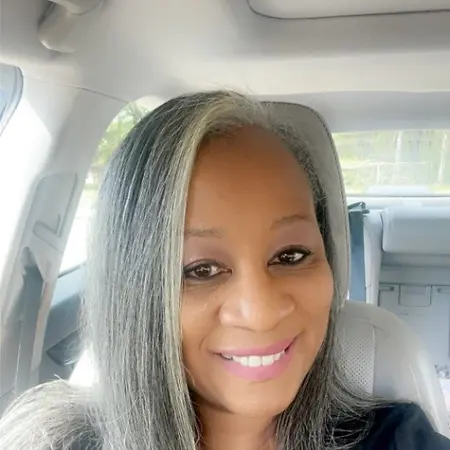
Her Story
About Pamela
Pamela Anderson-Carter is a dedicated social worker with over 38 years of experience supporting children, families, and communities in Meridianville, Alabama. Her career began at the Department of Human Resources, where she worked in foster care, protective services, and investigations, gaining firsthand experience with the challenges faced by at-risk youth. This work frequently brought her into schools, where she discovered her passion for helping students directly, eventually leading her to a long-standing career in school social work within Madison County Schools.
Throughout her tenure, Pamela has specialized in parent engagement, at-risk student intervention, truancy prevention, and attendance management. She has been instrumental in developing and expanding the district’s social services programs, growing a single social worker role into a 12-person department. As Senior School Social Worker, she supervises nine social workers, oversees truancy and court actions, and creates innovative programs for students who do not fit the traditional classroom model. Her approach combines compassion, accountability, and a strong belief that every child deserves the opportunity to succeed, bridging gaps between home and school to ensure meaningful outcomes.
Beyond her professional responsibilities, Pamela is passionate about mentoring youth through coaching basketball, emphasizing teamwork, discipline, and confidence. Many of the students she has coached maintain lifelong connections with her, reflecting her enduring impact both inside and outside the classroom. Even as she approaches retirement, her commitment to students remains unwavering, exemplifying her personal philosophy: “Do what you love and you’ll never work a day in your life.” Pamela’s career is a testament to her dedication to empowering families and fostering success for generations of children.
Her Interview
Ten minutes with Pamela
01What do you attribute your success to?
I attribute my success, number one, to my raising and my foundation. I could not have been successful without the strong foundation I received growing up. The very thing that we're trying to build in the students I work with every day is trying to fill in those missing blocks in their foundations so that they can build on it. I attribute my success to my mom and my dad, but my mom was very instrumental in who I am today. If you think I'm strong, my mom was stronger. She was an incredible powerhouse who raised 10 children, worked outside of the home, came to all my ball games, and traveled on weekends to my volleyball tournaments - she didn't miss anything. She was 100% supportive and brought home the bacon at the same time. All of her children graduated from high school, four are college educated, nobody's in jail, nobody's on drugs, everybody's homeowners, so we're all doing well. My mom is someone we should all aspire to be like, and I'm paying it forward through the work I do.
02What’s the best career advice you’ve ever received?
The best career advice I've ever received, and what I live by, is: Love what you do, and you will never work a day in your life. I tell people this all the time. When my son started college and said he wanted to do something because he was going to make a lot of money, I told him that's just not what he loves, and he needs to do what he loves. He said there's no money there, and I told him there's no money in social work either, but because I have loved what I do and worked hard at it, I'm compensated very well for a social worker. I told him you make who you're going to be in your professional life, and they pay you for what you're worth. Do not choose a field because you don't think you're going to make any money - money isn't everything. If you have to show up and work 40, 45, 50 years, I sure hope you love it. My coworkers say they can't wait till they get their 25 years, but I've been here 38 years. I'm financially prepared to go home and able to retire, but I'm just not ready to leave my career yet. I love my career and I'm nowhere near ready. I'll do this in some form or fashion until I die.
03What advice would you give to young women entering your industry?
The advice I give to my social workers right now, today, is first and foremost, represent who you are well. If you're going to do a job, do it well. Do not half-step, do not ever think that you're short-changing anyone, because you're shortchanging yourself. Show up, be present. If you do not love what you do, please look for something else, because working with children is too important of a job to not want to be there. Love what you do and find your mood, find your passion, find your purpose and your passion. That's the number one thing - you're not going to be successful until you love what you do. You can't go to work every day just going through the motions. You have to truly be passionate about the work, especially when it involves children and families who are counting on you to make a difference in their lives.
04What are the biggest challenges or opportunities in your field right now?
The biggest challenges right now are the number of students that are at risk - we have large numbers. The economy is quite a challenge, and we're dealing with students who are at high poverty levels. It's a challenge when they can't even put a roof over their head. We also have a large number of students who are academically deficient. In Madison County, we have 3 school systems that share the same resources - probably about 50,000 students total - but we share the same court system, the same DHR, food banks, we share everything, so resources are not enough and there's not enough to go around. It's probably a national issue. Right now, we're experiencing a lot of behavioral problems with young students, and parent engagement is a problem. These young parents are really different in what they prioritize and how they think and feel about education, discipline, and supporting teachers. It's very hard working with these parents today. They have no discipline skill set, and then they back their children when they've been disrespectful to teachers, so the teachers don't have a leg to stand on. I spend all day being able to talk to parents about what their child's behavior is going to lead to, and in my experience I can tell them what this will look like in 2 or 3 years - when 6 becomes 10, and then 16, and it's not going to benefit their child because the school system's going to function and they're not going to allow their child to disrupt 20 other students.
05What values are most important to you in your work and personal life?
I'm big on ethics and doing right by people. Equality and fairness are extremely important to me. We work with students in schools sometimes, and you have a discipline hearing come in where the principal did this with one child and this with another child, and the child that's more disadvantaged is getting the low end of the shaft instead of recognizing that there are reasons why this is happening with this child. But the other child has the parent with the money and the goods, and that gives them privilege. I am a no-go with that. I am like, hold on, we're not doing that. I am 100% for the underdog, and I fight every day. They already know I'm going to fight for them, so they don't even play with that. We're going to be fair, and we're going to be equitable. And equity is not the same thing for everybody - it just is not. I make sure that no matter what, we treat every child and every family with fairness and give them what they need to succeed, not just what's easiest or what benefits those with more resources.
Join Influential Women and start making an impact. Register now.