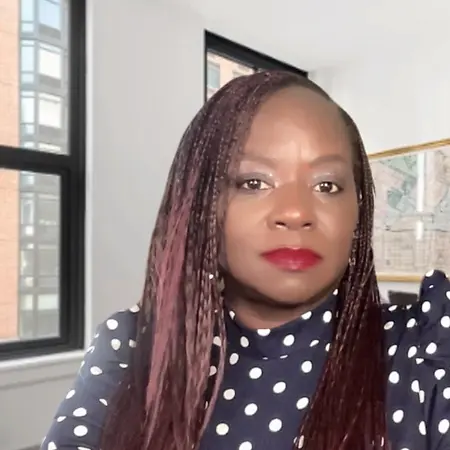
Her Story
About Pamela
I grew up in Trenton, New Jersey, and at 18, I enlisted in the military right out of high school. After basic training, I moved to Ohio to help my uncle with his newborn and pursue my education. I majored in history with a Black Studies minor at Cleveland State University, then earned my master's degree in teaching and secondary education from Kent State, which gave me my certification. The next day after I graduated, I started teaching high school history, and I absolutely loved it for 7 years. I went to a workshop at my current organization, and a woman leader I respected sent me there. Within 3 or 4 years, they asked me to join the organization, and she told me wherever she'd be, I'd have a home. I started as a program director in the Cleveland office, and after George Floyd in 2021, they created a new office and I became the associate director, then director, and in September I was promoted to Senior Director. I lead a small but mighty team of all BIPOC women. My work focuses on equity, culture, and belonging, both with schools and internal staff. I intersect with most departments in our organization because my work touches staff development, HR, online learning, marketing, communications, and development. I facilitate belonging conversations, arrange speakers in the field, and I'm always trying to innovate. This role is the merger of everything I love - it's grounded in empathy and learning, and this organization has helped me grow both professionally and personally. I've met people who made historical change in the world, like members of the Little Rock Nine, Diane Nash from the sit-in movement, and Congressman John Lewis. I never saw myself at this level before, and I'm humbled and appreciative of where I am now.
Her Interview
Ten minutes with Pamela
01What do you attribute your success to?
I would say spitefulness, honestly. I was that rebel child, that rebel teen, and until I got into the military, I was thriving on being difficult. But it was only because I wanted attention, and any attention was good. What made me successful is finally understanding what my mom was saying - I had to be in my 20s to get it. Then remembering some of the gems I learned in training through college or the military. And good leaders, in particular good women leaders, and in particular good Black women leaders - those are the ones that really shaped me. But I have to remember that there was a foundation that they built from, and I was that foundation.
02What’s the best career advice you’ve ever received?
I have a few pieces that have stuck with me. From the Army, my drill sergeants used to say lead by example, and don't have your people do anything that you wouldn't do. Those things are foundational. Then from Bossy Pants, there's a great quote at the beginning that says hire good people and get out their way. And the last one I'll share is don't block - Bill not block. These have all shaped how I approach leadership.
03What advice would you give to young women entering your industry?
First, believe in yourself, because that's an inside job. Too often women look to others to make us feel like we are on the right track, and then we take their opinions so to heart that we don't believe in our own instinct. Second, stop apologizing. You don't mean you're sorry for interrupting, you don't mean you're sorry for stating your opinion. You just want to get that into the room or on the table. I remember interviewing someone, a young person from Howard, and I took my interview hat off and told her you don't need to say 'does that make sense' or 'you know, no offense.' Those are the things I wish people would have snatched me up and said to me early on in my career, because often I gave it away. I gave my power away, I gave my beliefs and instincts away. I'm 50 now and I'm feeling a bit more secure. So believe in yourself - that's what I would say first. And invest in your own growth. Don't wait for other people to invest in you.
04What are the biggest challenges or opportunities in your field right now?
The biggest challenge is the backlash against DEI. Organizations and boards that are committed to that work can get past the threat, but I'm always looking at whether we're still committed to the work, to dismantling inequities. Those things keep me up at night, but right now we're in good shape. The other challenge is being a woman in leadership, and that often people don't realize what undermining looks like and what interruptions look like. Why is it that when a woman expresses something that she sees, you see it as emotional? I'm actually giving you strategy. There was something I read about how women are not heard as strategic thinkers. We're heard as being emotional or it's pushed toward the administrative. I remember I had done this whole new internal programming strategy with a menu of services, and my CO thanked me for the way I prepared copies. By saying copies, you make this into an administrative thing, and I'm your senior director. So I said, just to redirect, this is not just copies. This is my thinking and this is strategy. And when I talk to some men, they immediately start multitasking. I've started saying, do I have your attention? I'm at a point in my career where apologies are just words - I want changed behavior. I am listening and watching for you to show me that you meant what you said. And the last thing I'll say is, what's worth your energy? Is it worth my energy and my peace? That's where I am right now. Heart disease is taking us out of here. I just don't want to give too much of my health and time and energy to support things that don't pour back into me.
05What values are most important to you in your work and personal life?
Trustworthiness is the biggest one. I was watching a TED talk, and it really blew my mind. It said that trust is an impact of trustworthiness, and in order to be trustworthy, you need to be competent, honest, and transparent. For me, I'm at my best when I can be honest and transparent and trustworthy. I have also learned that sometimes you could do all the right things and people still will not like you. And you have to sometimes pour into the people who want you to pour into them, and I had to learn that the hard way.
Join Influential Women and start making an impact. Register now.