Her Story
About Pamela
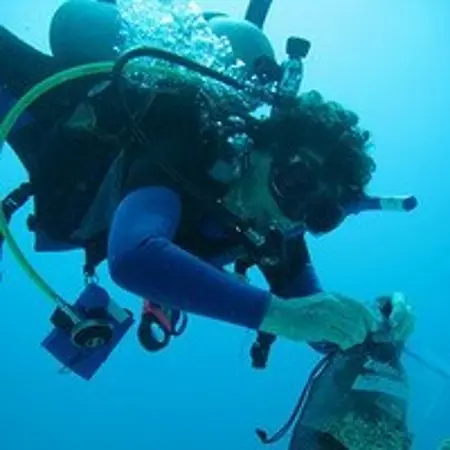
Pamela Hallock is a distinguished professor at the University of South Florida, where she has dedicated over four decades to advancing environmental science and marine biology. With a PhD in Oceanography from the University of Hawai’i at Manoa, she is widely recognized for developing the globally adopted bioindicator index for foraminifera, a landmark contribution that has shaped research standards in marine ecosystems worldwide. Her career has been marked by both groundbreaking research and a deep commitment to education.
Throughout her tenure, Pamela has mentored countless graduate students, fostering the next generation of environmental scientists. Notably, her former student Melanie McField went on to found a coral reef NGO that was later absorbed by the Smithsonian and gained international recognition, a testament to Pamela’s lasting impact as a mentor. Beyond her scientific contributions, Pamela has chronicled her early academic career and experiences in a memoir, offering insights into the life of a pioneering woman in oceanography.
As she approaches retirement this academic year, Pamela plans to continue writing and sharing her knowledge. Her work has not only advanced environmental research and education but also inspired a legacy of leadership, curiosity, and dedication to the preservation of marine ecosystems. Her influence continues to resonate across the global scientific community and among the many students and colleagues she has guided.
Her Interview
Ten minutes with Pamela
01What do you attribute your success to?
I attribute my success to lifelong curiosity, scientific rigor, and a deep commitment to mentorship, finding my greatest impact not only in research but in empowering students to grow, publish, and lead meaningful scientific careers.
02What’s the best career advice you’ve ever received?
The best career advice I’ve ever received is to uplift others in the field and ensure that knowledge continues beyond my own contributions, shaping a legacy of mentorship and collaborative scholarship.
03What advice would you give to young women entering your industry?
I would advise young women entering the field to pursue their scientific passions unapologetically, trust their analytical abilities, and seek strong mentors, remembering that impactful science is built through curiosity, persistence, and breaking new ground in spaces where women have historically been underrepresented.
04What are the biggest challenges or opportunities in your field right now?
The biggest challenges in her field include climate change, reef decline, and the pressing need for reliable environmental monitoring tools. These challenges also present opportunities for new scientists, particularly women, to innovate in marine conservation, coral reef preservation, and carbonate sedimentology.
05What values are most important to you in your work and personal life?
The values most important to her are integrity in research, intellectual honesty, and advancing science to support environmental health. She also prioritizes encouragement and patience in mentoring, believing confidence grows through guidance, and she enjoys kayaking, bird watching, coastal cleanups, and time with her three cats and two dogs.
Join Influential Women and start making an impact. Register now.