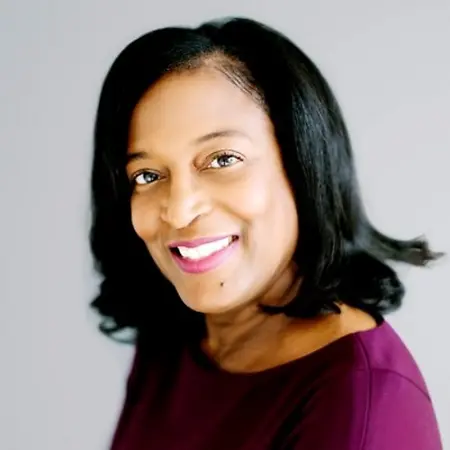
Influential Woman · Education and Communications
Dr. Pat Sanders
PhD
Professor of Communication, University of North Alabama
Florence, AL 35630
Her Story
About Dr. Pat
I have always loved reading, storytelling, talking to people, and meeting new people. I've had this sense of curiosity about learning my entire life. When I first went to college, I tried computer information systems but realized I would be in a room by myself, and I couldn't do that. When they started a radio, television, film, and journalism program, I hopped over and never looked back. I found my home in communications because it fit everything I've always loved doing - talking to people, meeting new people, learning about them, finding out their stories, and the newness of it all. I worked in broadcast news for almost 20 years, and each day was different. I met presidential candidates, artists, people like Michael Landon, President Bush, President Carter, though I never took a picture, which I regret. I burned out in news and prayed about my next career step. The door for education opened seamlessly for me. My first job was at a community college teaching public speaking classes for an academic year, then my university reached out about a position where they needed someone who could teach and direct a radio bureau they were establishing and was part of a statewide network. I got the job in 1999 and have been there ever since, moving up the academic ranks from instructor to full professor and lastly obtained merit. I served as chair of my department and as a director within my College of Arts, Sciences, and Engineering. Communications has always been something my life has been centered around - I love writing, speaking, and all things related to communications.
Her Interview
Ten minutes with Dr. Pat
01What do you attribute your success to?
I attribute my success to my father, who was my hero and passed away 10 years ago. My dad was not able to finish high school - he had to quit and was near the top of 13 kids. But he would sit us down as kids at his feet and tell us, 'You can do and be whatever you want to be in life. I didn't have the opportunity to finish school.' We talked him into getting his GED, and he was one of the smartest and most wise men I've ever met. He always told us, 'You will be educated,' and every one of us was. When I was working on my PhD full-time while working, I remember one night I was working on quantitative statistics and I was tired. My dad called dad and I was crying and said, 'I can't do this, I'm going to quit.' He was quiet for a minute and said, 'You've done all you can do today. I want you to put those books away, go to bed, and get you a good night's sleep. When you wake up in the morning, you pick your head up and you keep going. I've never known you to quit anything, even as a little girl. You're not going to quit now. Your mama and I are gonna be praying for you.' I did exactly what he said. I went to bed, got rest, got up, and I have PhD behind my name today. That's what drives me - my father's belief in me.
02What’s the best career advice you’ve ever received?
My career advice is to pursue what you love to do. This is an old cliche, but what would you do even if you didn't get paid for it? Like, I'm not paid to do my podcast, but I faithfully produce it and publish it every two weeks. I tell people to identify what it is you love to do, and then set yourself on that trajectory by writing down the things you need to accomplish to get there. There's a difference between having a job and a career. Usually, a career is something that people have heavily invested in, and they love doing it. A job is something you go to to get paid, to pay your bills, to live day to day, and a lot of times, people don't like those jobs. If you're going to work, the average person is going to work probably at least 25 to 40 years of their lifetime. You don't want to be in that situation and be miserable. There are very, very few days that I've gotten up and said, I really don't want to go to work, because I enjoy what I do. You need to love what you do, or at least like it.
03What advice would you give to young women entering your industry?
I always tell people when I'm talking to them: Always believe in yourself, and don't let anyone else determine who you are. A lot of people don't learn that until later in life. Pursue what it is you want to do and dream big. Now, we don't always meet those goals and those dreams, but do something related to that if you can. Always expand your knowledge, always be willing to learn. And always, always believe in yourself. And again, treat others right. Have ethics. There are differences between laws, policies, and regulations - those are things that we must do, because if you violate them, there are consequences. However, ethics are what you should do, and that's a decision that we make. Nobody can make you do anything. That's a personal choice. So I always try to tell them to have integrity and ethics and honesty and treat people right. But again, just believe in who you are, and don't let anyone ever make you feel less than. I remember interviewing a woman on my podcast one time, and she said, 'I want you to stop talking to me for a minute, and I want you to look around your office and tell me what you see on your wall.' I started telling her about my awards, and she said, 'You've done these things. Nobody did them for you. So don't ever think that you can't do whatever we were talking about.' I always tell people that all people are equal. No one is less than.
04What are the biggest challenges or opportunities in your field right now?
I think some of the biggest challenges right now for everybody is AI. We've had AI for decades, but it's now in this fourth revolution of interacting and actually integrating biology with machines. We have our first AI Ashley a couple of years ago, a full radio jock that was based off a real Ashley. If you did not know or have a discriminatory ear, you would swear that girl was in Oregon and in Wisconsin at the same time. I'm teaching my students script writing, storytelling, how to balance music, how to edit, and all of that stuff. AI can do it for you now. So I think that's one of the biggest challenges - losing our creativity, our ability to think for ourselves, to be able to critically analyze things, and to be human. Now, AI has its place. I love it for some things, but I tell my students all the time, don't let it replace you and what you can do and think for yourself. I think it's going to result in a dumbing down of society. It's one of those things where it's a dichotomy of one of our biggest blessings and curses at the same time, like the internet. We can communicate with people around the world in nanoseconds, but the con of that is you can put out something false or egregious. What we're doing to challenge that is getting baseline writing - I want you to write about this and write it here in the classroom. We've gone back to taking exams in person, rather than on computer.
05What values are most important to you in your work and personal life?
Number one on my list is integrity, honesty, and transparency. Treating people the way in which you want to be treated is essential. I believe in helping others to shine - if they do something well, I make sure we toot their horn and share that. But I think having integrity, honesty, and ethics are the most important, because if you have those, you're going to treat people right. You're going to be transparent. Also, have confidence - not arrogance, but confidence. There's a difference between the two. Confidence is when you know what you're doing and you're comfortable with it. Whereas arrogance is when you think you know more than anybody else, and you bring that personality or attitude into the room. Just treating people right is key. You try to validate them, empower them, and inspire them. Now, you're not going to make everybody happy, that's just the way it is. But you do your best. Don't let people make you doubt yourself. Most of us can do whatever we put our mind to, again, if we care for it. All of us are going to fail at something, but you can't stay down. You get back up. People fail, and then they lose hope, and they're not inspired to do anything. You just sort of grovel and stay in your situation. But you have to get back up.
Join Influential Women and start making an impact. Register now.