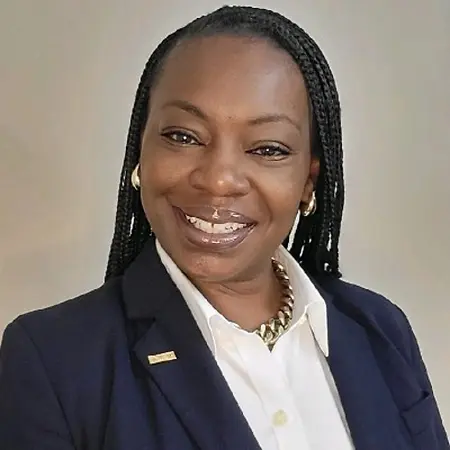
Her Story
About Patricia
I started my career as a design engineer in defense and shipbuilding, where I worked for many years. While working in a research and development department at Continental, an automotive company, I became curious about project management after observing project managers meeting with clients and leading teams. A young lady from South Africa introduced me to the field, which sparked my interest. When I returned to defense, the government was requiring certified project managers, not just experienced ones, which showed how serious they were about having the best people running projects. That's when my project management career really started to take off. I had two incredible mentors - Paulette Harris, who was rooted in defense and taught me about strong communication and understanding different audiences, and George Harrison, who came from FinTech and taught me about execution, critical thinking, and knowing when to pivot when a plan isn't working. After defense, I transitioned fully into project management in FinTech, where I work 100% in IT dealing with systems, networking, infrastructure, deployment, applications, and system migrations. I believe in being a servant leader - my job is to remove obstacles so my team of talented engineers can be great at what they do. I've built my reputation by being authentic, giving back, and being a trusted source. Now, departments wait for my availability because I focus on continuous improvement with every project.
Her Interview
Ten minutes with Patricia
01What do you attribute your success to?
I attribute my success to really getting to know each and every person on my team. I'm a great listener, and I understand people's strengths and weaknesses based on our conversations - not to play on them, but to know where I may need to support them more. For example, I have some engineers who are great at writing and some who are not, and that's fair. My job is not to make their job harder, so I'll help write their business cases or bring in a tech writer if needed. I introduce them to new skills in a safe way where they still feel comfortable doing their day-to-day work. I also believe strongly in being a servant leader - I let my team of talented engineers go off and be great at what they do. I protect them from disruptions, minimize conflicts, and make sure they get acknowledged for their hard work. I'm their cheerleader when they do something great, and I showcase their work because engineers tend to be quieter and work in the background, but they deserve their flowers. By being authentic, giving back, and being a trusted source, I've built my reputation to the point where departments now wait for my availability.
02What’s the best career advice you’ve ever received?
The best career advice I've received came from my two mentors, Paulette Harris and George Harrison. Paulette's strength was about communication - she really, really groomed me to be a strong communicator, understanding my audience, and understanding that one communication is not going to be applicable to everyone. That's a big ticket item. George was really about execution - yes, you can get your certification and play by the rules, but you need to have the ability and critical thinking to know when to pivot when the plan is not working. He understood what the customer needed and taught me to focus on delivering the most important things rather than delaying everything for nice-to-have features. He used the example of building a house - the most important thing is the house itself, not the granite countertops that might delay move-in by two months. Get buy-in from stakeholders on what can be delivered now versus later. Paulette also told me that if the stakeholders have no questions, that means you explained it correctly. Between these two mentors on opposite ends of the spectrum - one rooted in defense and one from FinTech - I learned so much and gained the ability to maneuver in any room, whether with C-level executives or the development team.
03What advice would you give to young women entering your industry?
My advice to young women is this: the people you're intimidated by - whether it's because of the color of their skin or because they're male - they don't have a heaven or hell to put you in. Once you look at a person for what they're worth, it's easy. There is nothing they can do to you outside of those four walls of employment. They're people, too. They have issues, too, just like you do. If they were to fall and cut their knee, they'd bleed just like you do. If you give respect and get respect, regardless of who someone is - I don't care if you are a C-level executive or the janitor - if either one of those asks something from me and they don't provide respect, I'm not going to respond differently. You have to understand that you're all equal. A lot of young women I mentor get intimidated when they look at the stakeholders, especially in this male-dominated industry, but you cannot let that stop you. Come as your authentic self, do your best, and don't be afraid to stand up for your work. When you've put your all into something and you've become a true professional at it, you deserve credit for it. That's when you know you've reached a place where you feel comfortable and ready to stand in front of and defend your work.
04What are the biggest challenges or opportunities in your field right now?
There is still great opportunity in project management, even though we're still making our marks as women. Originally, project management was an Indian-driven industry - when I worked at Continental, a German-based company that believed in bringing all types of cultures under one roof, I noticed a lot of the project managers were male Indian. Out of about 30 project managers, I only saw one woman. I think that is still a little bit of a disadvantage for women, but at this stage with everything that's available, it could be self-inflicted where young women may not feel like this is something they can do, or they're looking at trends and getting discouraged. However, the way project management has expanded, it has a little bit for everything now. We don't just do traditional waterfall projects - there's Agile and hybrid, and that speaks to different people and how they operate. I resonate more with Agile because it's a more protective project framework, but if you want more control, you might lean towards waterfall. The biggest disadvantage I see in the industry overall is misconsumption of information. A lot of companies are coming out with their own project management certification processes that are not accredited. The only accredited organization is PMI, the Project Management Institute, which is recognized worldwide, not just in the United States. People get caught up getting these unaccredited certifications, and then when it's time to start looking for a role, they get disappointed because the certification is not recognized.
05What values are most important to you in your work and personal life?
Service is the most important value to me - I think it's the most important thing any human being could have. In my world, it's really about being a servant leader. A lot of people look at project managers as bossy or controlling, but that is totally the opposite. If you want to be successful in your project and have a successful project team, you have to be there to serve. My job is to remove obstacles so my team can go off and be great. I have talented engineers who are awesome at their job, and I can't allow any stakeholders to come in and tell them how to do their job - if you need to talk to them, you talk to me first, and then I'll determine if it's important, but please don't disrupt my team. If they're having issues or conflicts within the team, my job is to minimize that and understand what the root cause is. Everyone's not going to get along, but I guide them through the process as a servant leader while letting them be great at what they do. As a servant leader, you also have to be the cheerleader - when the team does something great or does a good job, you can't be afraid to showcase their work. I understand the type of team I work with in engineering - they tend to be a quieter group of people, more in the background, but it does feel good for them to be acknowledged for all the hard work they do. I try to give them their flowers as much as possible.
Join Influential Women and start making an impact. Register now.