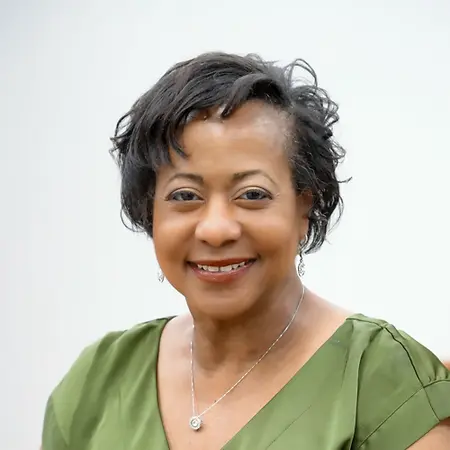
Her Story
About Penny
For the past 10 years, I’ve been deeply involved with NAMI of Stark County, where my passion for mental health advocacy grew out of my family’s personal experience supporting my brother through his mental health challenges. Walking through that journey opened my eyes to how taboo mental health remains, especially within the Black and African American community, and it inspired me to help other families navigate what we once had to figure out alone.
I became an instructor and have spent the last decade teaching free 6‑ to 8‑week courses that guide families through understanding the mental health system, accessing resources, and advocating for proper diagnosis and care. This work has become one of the most meaningful parts of my life.
My community impact has expanded beyond mental health. I now support faith‑based organizations that want to establish or strengthen their nonprofit presence. I help ministries obtain 501(c)(3) status, build sustainable structures, and launch community development projects that address real needs in inner‑city neighborhoods. I am currently assisting three ministries with program development and organizational growth.
In addition to my teaching and consulting work, I serve on the NAMI Stark County Board of Directors and actively participate in community events such as Juneteenth celebrations and Hall of Fame festivals to promote mental health awareness.
Professionally, I work full‑time as a project manager, bringing strong leadership, structure, and operational discipline to every environment I serve. Often, as the only woman and the only Black woman in the room, this experience shaped my resilience, confidence, and commitment to creating more inclusive spaces.
Her Interview
Ten minutes with Penny
01What do you attribute your success to?
I attribute my success first and foremost to God’s guidance. Every major turning point in my life — personally, academically, and professionally — has been shaped by His direction and grace. My faith has anchored me, especially during seasons when others doubted my potential.
When I was in elementary school, the school told my parents that I was “retarded” and could not learn. My mother refused to accept that label and told them plainly to do their job, or she would sue. I prayed, worked hard, and received tutoring. By sixth grade, I was on the honor roll. That moment taught me two things that have stayed with me my entire life: God determines my path, and perseverance can overturn any limitation placed on me by others.
That early experience shaped my resilience, my compassion for people who are misunderstood or overlooked, and my drive to serve communities through nonprofit work, mental health advocacy, and ministry. It also taught me to lead with courage to believe in people even when the world underestimates them.
My success is the result of God’s leading, a mother who fought for me, and a lifelong commitment to rise above challenges and help others do the same.
02What’s the best career advice you’ve ever received?
The best career advice I’ve ever received is to use every part of your story and lean in to learn, even when you’re being rejected or belittled. Never let them see you break.
Throughout my career, I have often been the only Black woman at the table, and those experiences, along with my family’s mental health journey and my passion for faith‑based community work have shaped how I lead. Every chapter, including the difficult ones, has strengthened my ability to support families, ministries, and communities with empathy, structure, and resilience.
03What advice would you give to young women entering your industry?
My motto is "You are only moved by what you believe". For young women, if you can learn to be adaptable, you will go far. And by adaptable, I mean learning from every style of person in your office, the quiet ones, the direct ones, the seasoned ones, the ones who challenge you. When you learn from all of them, you build a foundation that will carry you for the rest of your career.
What I see too often is the opposite. A young person comes in wanting everything quickly. They feel entitled to the position, the title, the recognition, without taking the time to grow, observe, and embrace the process. Wisdom is built slowly. Character is built through patience. And success is built through learning.
That’s why I teach. Those principles, humility, adaptability, and a willingness to learn, are guidelines that will never lose their value.
04What are the biggest challenges or opportunities in your field right now?
One of the biggest challenges I’ve encountered in my work with NAMI Stark County is addressing the deep‑rooted stigma surrounding mental health within the community, particularly in Canton and across Stark County. Mental health remains a taboo topic in many cultural and faith‑based spaces, and I often find myself navigating conversations where people use outdated or harmful language simply because they don’t know any better. Recently, someone asked me if a person with a mental health condition was “retarded.” That moment became an opportunity to educate, to explain that mental illness is not a cognitive disability or a character flaw, but a legitimate health condition, just like diabetes or high blood pressure. By the end of the conversation, they said, “I never even thought about it like that, Penny.” Moments like that reinforce why education and advocacy are so important.
Another challenge is increasing board engagement. Our NAMI staff consistently show up, they’re at festivals, community events, awareness campaigns, and outreach activities. Yet board participation remains limited. I believe that if we serve on a board, we should represent the organization with the same visibility and commitment we expect from our staff. Leadership is not just governance; it’s presence. It’s showing the community that we stand behind the mission we oversee.
Because of these challenges, I focus on leading by example. Whether I’m educating families, speaking with community groups, or encouraging fellow board members to be more present, I work to bridge gaps — between stigma and understanding, between governance and community, and between what we say we value and how we show up.
05What values are most important to you in your work and personal life?
The thing I value most is making every person I encounter feel loved, seen, and special. If you were to walk down the street and see someone who doesn’t look like you, someone you might assume is homeless, nothing communicates dignity more than a simple “yes ma’am” or “yes sir.” What I’ve learned is that when people feel valued, they become more open, more trusting, and more willing to engage in change.
I learned that lesson deeply when I lived in Lansing, Michigan. I was part of a ministry connected to a local church, and we volunteered at the Volunteers of America homeless shelter. We walked in with 100% ignorance, thinking we were going to “save” people we had already labeled in our minds. It was a humbling experience that exposed my own blind spots.
What I discovered was that I had been completely ignorant of the culture, experiences, and humanity of people facing homelessness. I realized I had walked in with prejudice I didn’t even know I carried. And everything I thought I knew, every assumption, was completely wrong.
That experience changed me. It shaped the way I see people and the way I love people. It taught me never to assume I know someone’s story, and to offer every person the same respect, compassion, and dignity I would want for myself. It’s why I lead with love first, because every person deserves to feel valued.
Join Influential Women and start making an impact. Register now.