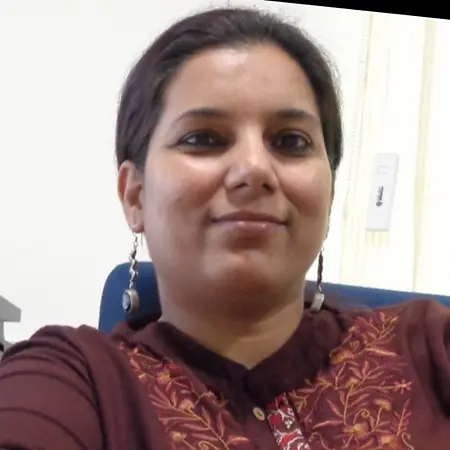
Her Story
About Pinky
My journey in science has been like a rollercoaster ride. As a kid, I was always interested in science and initially aimed to become a doctor, but I couldn't secure a medical seat in India due to intense competition and limited availability. I decided it didn't matter because I enjoyed biology, and whatever route kept me associated with science made me happy. I completed my bachelor's degree in microbiology honors and continued for my master's in the same field. During my master's, I got very excited about genetics and was exposed to Drosophila as a model system - I was intrigued by the ability to see real tissues using a dissecting microscope and the wonders of staining cells, looking at something unimaginable and beyond imagination. I pursued my PhD at the National Center for Biological Sciences in Bangalore, part of the Tata Institute of Fundamental Research, one of India's top-tier research institutes. There I conducted experiments in the neurogenetics of taste and olfactory pathways using Drosophila. My PhD mentor, Dr. Veronica Rodriguez, who is no longer with us, shaped my career tremendously - she was so dedicated, always available for students, and would go beyond anything to help anybody. After my PhD, I moved to Germany for a postdoc to explore my flexibility in addressing different questions in neurobiology, working with neurons and glia in a neurodegenerative model system focused on glial biology and myelination (or ensheatment in flies). I moved to the U.S. for better opportunities in science, joining another postdoc working on taste and olfactory systems. During this time, my son was born, and tragically, my mother died, which deeply affected us - it took two days to reach India to see her one last time. I decided to move back to India and secured a prestigious Wellcome Trust DBT grant to start my own lab working on taste using flies. However, at the end of 2020, my dad was diagnosed with lung cancer, and I spent time between the hospital and lab. He passed away in January 2021, which took a toll on my mental health and finances. I decided to return to the U.S., and in March 2023, I joined the University of Pennsylvania as a senior research investigator at Perelman School of Medicine. Penn is unique because they took me as a senior research investigator even though I was a PI in India - the position allows me to work independently while training people. Since joining almost three years ago, we've been doing great work, including a recent paper in eLife and others on BioArchive and in the pipeline. I'm learning so much about sleep research, which is new to me, and I feel there's so much we can explore using flies as a model system.
Her Interview
Ten minutes with Pinky
01What do you attribute your success to?
I attribute my success to the incredible mentorship I received, especially from my PhD mentor, Dr. Veronica Rodriguez, who is no longer with us. She shaped my career tremendously - she was so dedicated, always available for students, and would go beyond anything to help anybody. Whatever she taught me has left a great impact on my research career, and I learned so much from her. But what I personally feel is the most wonderful measure of my growth as a scientist is seeing all the students who worked in my lab during my tenure in India now in different international labs, either doing postdocs or PhDs. That is more satisfactory than getting papers out or working in science - it's my reward for whatever I've done so far in science. Delivering lectures for students is fine, but when I see that whatever knowledge I gathered, my skills, whatever experience I have has helped others to explore science and find their paths in science, that is the best reward, and I feel very, very happy for that.
02What values are most important to you in your work and personal life?
I always feel that although we are doing great science and all that, what is most important is what we return to the society - we should not forget that. I try to do my bit wherever possible, whether it's going to remote areas to give scientific talks to students, helping elderly people with Alzheimer's understand their condition better, or mentoring underprivileged children about their career paths. I believe in going beyond the lab settings and making science accessible to those who need it most. I'm a very passionate teacher, and I like to help people understand what's going on rather than get panicked, and find ways to live in a better way and get involved with society normally.
Join Influential Women and start making an impact. Register now.