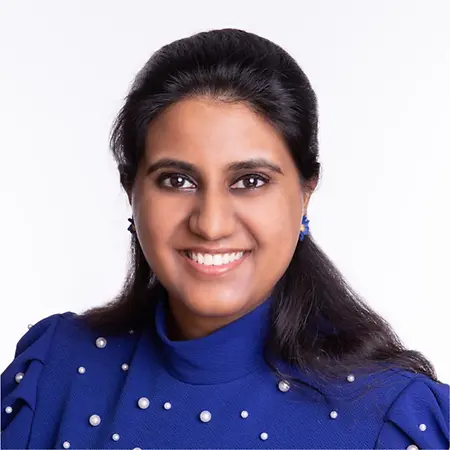
Her Story
About Pooja
With nearly 20 years in the field, I've built my career at the intersection of technology and human-centered design. My journey began with a strong technical foundation in physics and computer science, but I became fascinated by designing for humans and society, which led me to pursue an MBA in Design Strategy from California College of the Arts about a decade ago. That decision to go back to school full-time after being in the industry for over a decade taught me patience, how to value time to grow and invest in myself, and how to communicate and pitch ideas in ways that change perspectives without offending people. I've worked across diverse sectors - from retail and consumer industries to enterprise companies like Oracle and Adobe, where I focused on end-to-end journeys and onboarding experiences, and then into fintech leading crypto experiences for millions of users. Now at Autodesk for the past 4 years, I lead content design across platform experiences, focusing on human-centered design leadership in the AI era. My work centers on asking what people can achieve with these technologies and how we amplify human ingenuity in moments of disruption. I spend my days unpacking perspectives, challenging assumptions, uncovering possibilities, distilling viewpoints, and empowering the teams I lead. I also invest significant time in communities, giving talks and helping people embrace this revolutionary moment with joy and grace. Currently, I lead a powerful team of agent content designers - a disruptor group within the company exploring solutions through the lens of language, design, and human-centeredness, building things no one else in the company is building.
Her Interview
Ten minutes with Pooja
01What do you attribute your success to?
I attribute my success to a lot of people - starting with my own parents, mentors, coaches, excellent managers I've had, as well as managers who've not been that excellent and who have also taught me how to grow and come out of difficult situations. If there's one person I would single out, it would be my mom. She's both my biggest critic as well as my biggest fan, and even now as she's aging, there's always a little voice in my head in moments where I'm torn, and I didn't realize that was actually my mom's voice. She was a teacher but became a stay-at-home mom and gave her entire life essentially in raising me while my dad would be hard at work. I am deeply grateful to her for shaping me the way I am. Beyond my mom, my current manager at Autodesk, Carla Utloff, teaches me every single day the power of human empathy and the power of good listening, and I continue to learn from her. Another guiding voice was Madhuri Kolatkar, who was at Oracle for a really long time - she guided me when I was torn about pursuing my education versus staying in tech and continuing to excel at my job.
02What’s the best career advice you’ve ever received?
The best career advice I've received was when I was torn between choosing education and choosing to stay within tech and continue crushing it at my job. I was already on a strong trajectory to excel in my current job, and there was no reason for me to go back and be on a struggle bus with education, going back to grad school. One of my mentors told me: go in the direction of where you can learn the most. That advice continues to serve me till this day. We will always have moments where we feel like, oh, this feels comfortable, and I think asking yourself the question - where am I going to grow the most, or stretch myself the most - is sometimes the best calling. It would rather be better for us to choose with what we know best, but going for that lesser taken path is not a bad idea.
03What advice would you give to young women entering your industry?
I think three things. First, go into this with open eyes and open mind, because we don't have all the answers. We don't have a crystal ball to predict what's gonna come in the next five or ten years. Keeping an open mind about the changes is a healthy way to step into the workforce. And organize - we all have to do our due diligence, research, learn, and take extra hours if we don't have time to read and understand and make sense of this change ourselves, firsthand. That shapes some of the perspectives people have about 'I think I get it, and I'm willing to try it' versus dismissing it or being an echo chamber to the already existing skepticism about everything - about culture, people, change, and the AI era. Second, I will always say, if you have a chance to go back and pick up a degree or study something, do it, regardless of what season of life you're in. It's a great way to go deep into your own self, learn something, and feel empowered about it. I'm a big proponent of education, and not everyone can afford to go to a school or college, but do whatever you can within your means. That needs intentionality - being intentional about your growth. Lastly, take care of yourselves. Emotional health and mental health is huge, and sometimes in the struggle of finding that first break or first job, you often put your health at risk. I know I did that during the years I was picking up my degrees - I would often skip sleep and not focus on my diet, and it was always an either-or question. I don't think it needs to be - figure out your health in your 20s or sooner, and continue doing what you can. That is going to pay dividends far more than any job ever will.
04What are the biggest challenges or opportunities in your field right now?
The biggest challenge I had to overcome is getting out of my own way. For a really long time, even growing up as an only child, with that independence and empowerment comes a lot of ease into doing things your way, and when you look at the workplace, that kind of thinking doesn't scale. It's a team game, and you have to understand the people you're working with to move the work forward. For me, learning empathy was a big one, and I remember this so vividly, especially when I started managing teams. I thought that didn't come naturally to me, and for some reason I think that women are born with an overdose of empathy in their DNA, but I felt like I had to be very intentional about that - put myself in others' shoes. I also did not grow up in the US, I was born and raised in India, so for me that cultural difference was huge, and especially if you're working with humans and trying to understand their lives, it takes a lot of empathy to understand where someone is coming from and what perspectives they have, for me to modulate my leadership style. The second thing I've learned is that technology will continue to evolve, and every generation has something. There is an agency in choosing which side we want to be in, and I think we should, as humans, look at that as a privilege, because a lot of times it's easy to be skeptical and nervous and fearful about change, but it's also perhaps equally easy to keep an open mind, be curious, and be okay with failing, and warm up into a new technology. It's very hard to muster optimism when you have so many things going against you, or it feels so in the moment. For me, the learning is that optimism is a muscle. I don't think optimism comes naturally for everyone. We have to cultivate that muscle and exercise that muscle so that we can start looking at challenges and things that feel insurmountable in the moment with a new lens.
05What values are most important to you in your work and personal life?
I think love is a big one - loving what you do, giving that love back to the people who are in your orbit. That's so important, because at the end of the day, that's what our life is meant to be, to be in spaces where we can activate that love and also have fun while doing it. I often look for passion, just genuine curiosity and passion when I'm hiring people, because that trumps everything else - the skills and other things that come as part of the job. The second thing is generosity. It's important to also make time to give back and be generous in sharing what you know and in having others learn from you. For me, that is an important value, which I do not recognize as generosity, but I'm routinely known to go the extra mile to do small things like write out handwritten cards for team members and thank them, and there's nothing in it for me other than just showing appreciation. Generosity in words and in actions goes a long way. And then I think the third value is just resilience - resilience of the mind and staying resilient in times of change. There's so much turbulence in the industry and even in our broader world today, and how do we continue to go inward and muster the energy, the good wisdom to actually navigate that. Those three are hardcore values for me.
Join Influential Women and start making an impact. Register now.