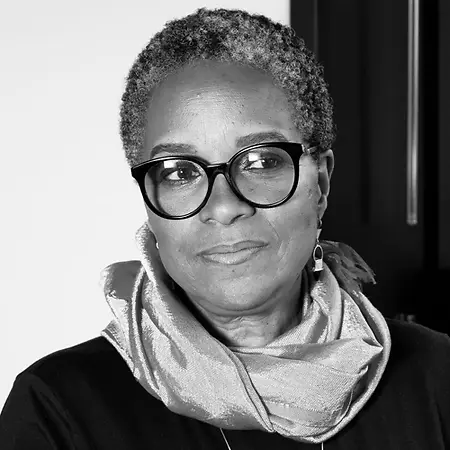
Influential Woman · Arts, Culture, Academia
Portia Cobb
Professor Emeritus | Interdisciplinary Artist, University of Wisconsin-Milwaukee
Milwaukee, WI 53211
Her Story
About Portia
Portia Cobb is a Professor Emerita and interdisciplinary artist whose four-decade career has bridged experimental filmmaking, documentary practice, and academic leadership. Raised between Santa Monica and Los Angeles, she completed her secondary education at the Los Angeles High School of the Arts before beginning her professional life in radio, working as a copywriter and on-air host and even hosting a specialized reggae program—an early creative outlet that sharpened her instincts for storytelling and broadcast performance. Seeking to deepen her artistic path, she returned to school as a young mother, earning a Bachelor's degree in Communications from Mills College in Oakland, California, a campus environment she credits with grounding her creative foundation. She went on to complete a Master's degree in Film at San Francisco State University, where she immersed herself in experimental and ethnographic documentary production as part of the Graduate Student Film Collective FOCUS.
In 1992, Cobb joined the faculty of the University of Wisconsin-Milwaukee as an assistant professor in the Department of Film, Video, Animation and New Genres, earning tenure in 1996 and rising to Associate Professor. Over more than three decades, she built a teaching practice centered on courses she developed herself, including Radical Cinemas, Ethnographic Video, and Multi-Cultural America, the latter using film as a lens for examining race, ethnicity, and identity while incorporating a service-learning component that connected students with underserved communities. She also directed the Community Media Project, led international study programs exploring Black life and culture through the arts in London, and served as a Call & Response Artist-in-Residence at the Lynden Sculpture Garden, where she created "Rooted: The Storied Land, Memory and Belonging," a site-specific heritage garden honoring her great-aunt Lizzie, a Gullah woman born in the post-emancipation South Carolina Low Country. Her artistic collaborators on that project included textile artist Arianne King Comer, vocalist Benjamin Seabrook, a local line-dancing troupe, and culinary anthropologist Chef Scott Alves Barton.
Beyond the classroom, Cobb has built an artistic identity centered on video art, photography, mixed media, and performance, exhibiting and collaborating internationally, including artistic exchanges in Brazil. Her contributions have been recognized with honors such as the 29th Annual Black Excellence Award in the Arts from the Milwaukee Times Newspaper in 2014 and the Most Outstanding Woman of Color in Teaching award from the UW System in 2007. She officially retired from the University of Wisconsin-Milwaukee in May 2026, earning the title of Professor Emerita, and continues to pursue new creative work exploring themes of the Black Atlantic and African Diaspora. Throughout her career, Cobb has emphasized mentorship as central to her philosophy, crediting her own mentor, the late Moira Roth, with teaching her creative freedom and encouraging her to find her voice—a lesson she now passes on by urging young women artists to seek mentors of their own and by remaining open and nurturing toward the next generation of creative talent.
Her Interview
Ten minutes with Portia
01What do you attribute your success to?
I attribute my success to my passion for poetry, art, and film, combined with the mentorship I received early in my career and my commitment to staying true to my own voice as an artist. That mentorship, along with persistence through my education and the opportunities I seized in radio, film, and academia, shaped the path I've been able to build.
02What’s the best career advice you’ve ever received?
The best advice I received came through the example and guidance of my mentor, Moira Roth, during my undergraduate years. She truly put me on my path and helped me claim my voice as an artist. She introduced me to many women in the arts and even brought me to New York to document women artists. Most importantly, she taught me to be free in my creative work.
03What advice would you give to young women entering your industry?
I always tell young women entering the arts to find a mentor. When I meet younger women artists, I feel a responsibility to nurture them and share my experience openly. I encourage them to build real relationships with experienced practitioners and to learn directly from those who've walked the path before them. I also believe it's important to be open and supportive of the next generation rather than feeling threatened by their arrival.
04What are the biggest challenges or opportunities in your field right now?
One of the biggest challenges I see is the misinterpretation of experimental and art-based film practice by those who equate filmmaking solely with mainstream Hollywood — there's a real divide between experimental art and commercial film that isn't always understood. At the same time, I see great opportunity in interdisciplinary collaboration, international artistic exchange, and renewed creative practice, particularly now in my post-retirement years.
05What values are most important to you in your work and personal life?
Integrity and being true to oneself are the values I hold most important, both in my work and in my personal life. I believe strongly in being my own advocate and not leaving my story or my work open to others' interpretation. Clarity in my practice and the willingness to stand up for my own voice have guided me throughout my career.
Join Influential Women and start making an impact. Register now.