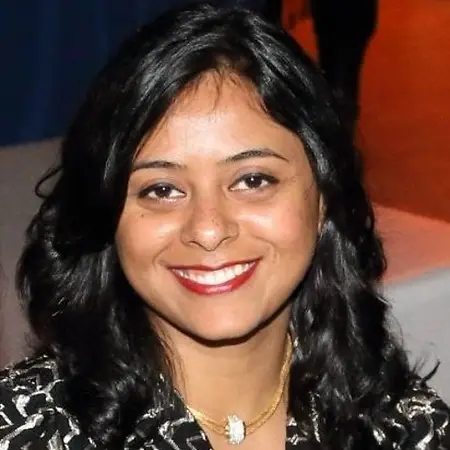
Her Story
About Pragya
My career path started as an engineering student in India when I was first introduced to MATLAB, a programming language that's one of our products. As a signal processing engineer, I got hooked on it and continued using it throughout my education. I came to the U.S. for my master's at NYU and kept using MATLAB and the products for my research. Before coming here, I had done some teaching in India, and that's when it really clicked that I loved teaching and the education part of empowering people through knowledge. That stayed with me throughout my master's where I continued teaching in different TA positions. When I was graduating, I went to a career fair and MathWorks was there, which was like a dream company for me. I gave in my resume, interviewed, and made it. I joined into a department where fresh grads get to try different roles, and that's when I discovered MathWorks has a training department doing professional education. I wasn't keen on academia, but professional education in a commercial base really resonated with me. After my first 8 months at MathWorks, I transferred to training services and have been there ever since. I started as a training engineer and slowly went up the business route. Now I manage North America commercial training delivery for MathWorks with a team of engineers. My focus is really on business strategy, helping our account teams understand how to position our products for customer success and adoption, with training as a key piece of that puzzle.
Her Interview
Ten minutes with Pragya
01What are the biggest challenges or opportunities in your field right now?
I think one thing that is on everyone's mind is Gen AI. It's changing how we operate and how we do things. My main business right now is training, and the question is, do we need training the same way? Do people need to be educated the same way that they used to last year? No, because I think with agents and Gen AI helping us, we need to think differently and educate differently. That's not just for the professionals and scientists I'm teaching, but even for kids. There's a lot of unknown, and we need to be very agile and open to what's coming our way. We need to look for weak signals and trends, making sure that we are ready to pivot. We need to be looking at some scenario planning, which is a little bit more long-term, and some of those signals might be very weak, but we have to think about what we do today to be successful in the future. I think those are all challenges that I need to be thinking about, that we all need to be thinking about.
Join Influential Women and start making an impact. Register now.