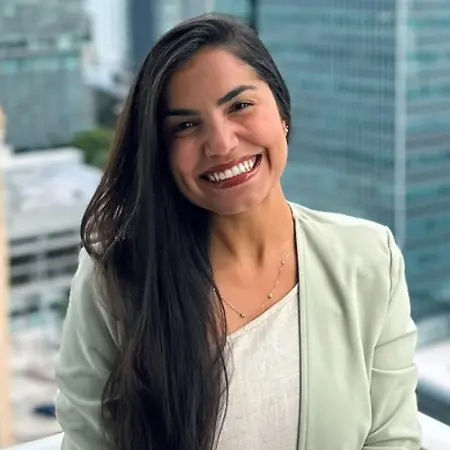
Her Story
About Priscila
Dr. Priscila de Paula Silva is a Tenure-Track Assistant Professor in Electrical and Computer Engineering at The University of Texas at El Paso. Her research focuses on predictive reliability and resilience modeling for critical technologies, including artificial intelligence, cyber-physical systems, and cybersecurity. By leveraging advanced statistical and machine learning methods, she develops strategies to safeguard systems against both adversarial threats and natural disruptions, contributing to the advancement of robust, fault-tolerant technologies.
Prior to joining UTEP, Dr. Silva earned her PhD and MS in Electrical and Computer Engineering from the University of Massachusetts Dartmouth, where she conducted extensive research in software reliability engineering. Her work encompassed fault-tolerant systems, availability modeling, Bayesian estimation, and performance evaluation of computer networks. She also gained hands-on experience in the electrical engineering field through internships at ArcelorMittal and research projects at UFOP – Universidade Federal de Ouro Preto, where she focused on power efficiency and innovative electrical measurement solutions.
Dr. Silva is deeply committed to education, mentorship, and community engagement. She has volunteered extensively in STEM outreach initiatives, including creating physics teaching materials for public schools and serving as a mathematics teaching assistant. Fluent in both English and Portuguese, she actively participates in collaborative, multi-institutional research efforts and is dedicated to empowering the next generation of engineers and researchers through innovative teaching and applied technological research.
Her Interview
Ten minutes with Priscila
01What do you attribute your success to?
I attribute my success to the opportunity to move from Brazil to the United States, which allowed me to pursue my education and build a career in engineering. Adapting to a new language and culture was challenging, but it led me to earn a PhD in 2025, publish peer-reviewed research, and develop data-driven tools used to study system reliability and resilience. These experiences ultimately helped me secure a faculty position in a research-focused university, where I now combine research, teaching, and mentorship. I measure my success by seeing other scientists cite my work and use my research to build more reliable and resilient systems. I also measure it by having students who are curious about my research, seek my advice, and choose to enroll in my classes. Knowing that I am helping shape a new generation of electrical and computer engineers in the AI era is success to me.
02What’s the best career advice you’ve ever received?
The best career advice I’ve received is to never doubt my own abilities and to believe that I can accomplish my goals, no matter how ambitious they may seem.
03What advice would you give to young women entering your industry?
I would advise young women to remain curious and committed to continuous learning. No matter the field, building strong skills in statistics and programming is incredibly valuable. In engineering and research, especially in security and technology, staying informed, adaptable, and technically empowered is key to long-term growth and success.
04What are the biggest challenges or opportunities in your field right now?
The biggest challenge in reliability and resilience engineering is ensuring that complex systems remain dependable when things go wrong. It is difficult to understand what can cause systems to degrade and to prepare for changes that are inherently hard to predict. The opportunity lies in using data and predictive tools to help organizations anticipate problems and recover more quickly. In short, the challenge is developing the expertise to truly understand and protect system reliability, while the opportunity is leveraging data and tools to make that possible.
05What values are most important to you in your work and personal life?
Integrity, responsibility, and empathy are most important to me. I value doing meaningful work with rigor and honesty, while supporting and uplifting the people around me.
Join Influential Women and start making an impact. Register now.