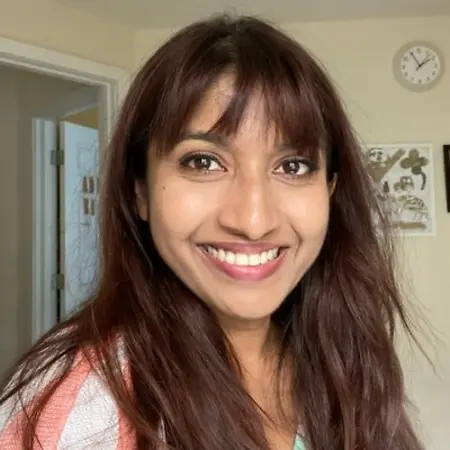
Her Story
About Priyanka
I've been an entrepreneur for about 8 years now, and this is my third company. I come from a background of being a product manager, but I've taught as a hobby for over 20 years. I started my career as a software developer with an electronics and telecommunication engineering degree, then did my MBA. Throughout my career, I've been working as a volunteer with local schools as a volunteer teacher and substitute teacher, and I worked with Peace Work Organization collaborating on bringing educational programs for students in Belize. Right before the pandemic, I wanted to bring both my loves together - technology and education - so I founded a company to make an app that would help children write stories and draw and express themselves creatively using technology. I launched PopSmart Write, a writing app, and PopSmart Trivia, a quiz app for playing games with friends or family. During the pandemic, I started some online classes to get these apps into the hands of students so they could express themselves when schools were off. Those online classes took a form of their own and became classes where students came and learned how to write and do experiments. I got my first physical center in summer 2023, and as of now, we have two centers in the greater Seattle area. Today, PopSmart Academy provides enrichment programs and classes to students from grade 1 through grade 12 in creative writing, science, public speaking and debate, entrepreneurship, and 3D design and modeling. My students have gone on to win national championships and medals at different competitions across the country. I'm also writing a book about curiosity and inculcating curiosity in young minds that's being published in fall of this year.
Her Interview
Ten minutes with Priyanka
01What do you attribute your success to?
I had very humble beginnings - my dad worked two jobs, and I had a paycheck-to-paycheck kind of upbringing when I was little. From there to having built this company where students come in and they don't want to leave, they want to continue, they want to explore, and they love being in the space, they love being in the class - that's really meaningful to me. Most of my clients or students or customers actually come from word of mouth, so I think that's saying something. I'm really proud about that. Taking something and building it from ground up and getting to a point where customers actually really talk about it and spread the word feels really good. It gives me a lot of joy to even see the students go on and showcase their talents outside of the classroom, like in national science volunteer events, or at public speaking forums, or at model UNs.
02What advice would you give to young women entering your industry?
Keep an open mind, and go with one that feels correct right now, that you feel passionate about right now. Life is a marathon. It doesn't end when you're 18, it doesn't end when you're 25, it won't end when you're 40, so life offers opportunities for pivot. Don't get too tied up that you need to think about your entire life and plan it out right this moment when you're turning 18 and making your decision of choosing a college. If at this point you feel like you're really passionate about biology right now, go for it. We live in really exciting times. The time when I grew up, I call those swim lane times - we used to be in swim lanes. Oh, you like biology? This is the only option you got. But I think we live in times where all of these paths have a huge opportunity to intersect. I have students who come in and say, I really love drawing, but at the same time, I also like biology, but I don't want to become a doctor. If you love biology, you do not need to become a doctor. That's not the only path that is there. So I would say, do what you feel passionate about right now. And if you feel after 15 years that you need to pivot, you need to change what you're doing, then you will do it. You will just be 10 years wiser than you are today, and you'll be doing a much better job.
03What are the biggest challenges or opportunities in your field right now?
Being in the education space, we're kind of at the precipice where we're all talking about AI, so our world is changing so fast. But I honestly think that we're not doing justice by not teaching our next generation, our young learners, everything that has to do with AI. We're only telling them that it's not good to use AI, but I think the best way to do it would be to actually teach them how to use it, so that we can actually tell them the ways that they should not be using AI. Students today are not coming to the classroom looking for information - information is out there in the palm of their hand. They can search up things on their computer or on their phones. But they are not coming to the classrooms for information, because that's theirs. They are coming to the classroom to make sense of that information, to kind of tie that to why are we even learning about this, how is it that we are going to use it. So they're coming to the classroom to connect those dots, and I think there is so much we can do in education which we are not doing. We're not catching up to it, because I understand that it's changing, but there is that opportunity. The opportunity is that it is changing. Being kind of outside the system, because I am not part of any school district, I'm always keeping up with these opportunities to bring those to my classroom. As for challenges, one of the challenges that I have seen being as an educational company is to find the right people to hire. It takes a lot to be a mentor, or a coach, or a teacher, so finding people who love to do what they're doing and at the same time are really good at it has been challenging. The other thing is we kind of operate in a space where our customers and users are different - customers are the people who are paying us, the parents, and users are the students who are coming to our classroom. So sometimes you have to walk that tightrope of managing expectations, because they can be a little bit different. I love that challenge, actually. It's really fun to operate in that space where these two demographics are different, and you have to balance and manage expectations for both of them.
04What values are most important to you in your work and personal life?
I would say three things. The first one is curiosity. It's really important. We just organized a big event this Saturday, a science competition, a science bowl for students in middle and elementary, illustrating the same thing - question everything. I think students are born curious, but as we grow, we are told this is the way we do it, and then we stop questioning things. It doesn't matter what subject I'm teaching, I always intend to help them remember that - question everything, ask questions, never accept the status quo, challenge it all the time, because that's where innovation lies, and we kill innovation by not being curious. It's really important to me, not just for my work but at home as well. I'm consistently telling my own children to be curious. And if they're not getting good grades because they questioned something and wrote an answer that may not be absolutely correct, but questioned something that made everyone think, I'm okay with that. The second thing that's important to me is integrity. A lot of the problems can be solved by being curious, but I think we also need to build that integrity, doing the right thing and committing to work that we have agreed on. It takes real mettle to actually pick up that plastic bottle when no one is looking - that integrity is important. And the third thing is being kind. I think it's really important to be kind, not nice, but being kind. The difference between being nice and kind is that nice can sometimes be, oh, I'm just not going to point out what you're doing may not help you, because I'm trying to be nice. But no, I think the kind thing to do is to actually stand there with you and tell you what's the correct way to do it. In my work, I see a lot of students participating in competitions where they are going head-to-head with their peers, their friends. One of the things I tell them is when you're going into these competitions, think of it as their peers, so be kind to one another, and the rest will take care of itself.
Join Influential Women and start making an impact. Register now.