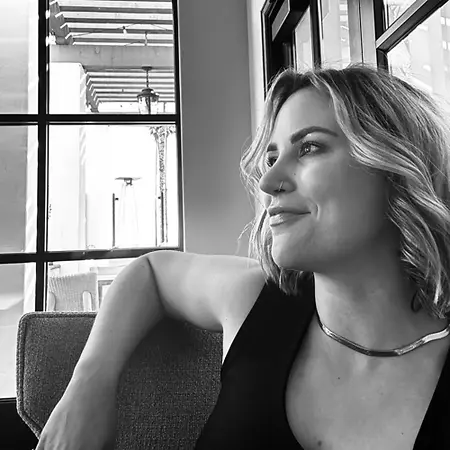
Her Story
About Rachel
I've never had a straight path, and I've stopped apologizing for it.
I was born overseas and moved more times than I can count growing up. That kind of upbringing either breaks you or builds a certain flexibility — the ability to read a room, start over, adapt fast. For me it became a way of living.
My parents were an interesting combination. My dad spent his career in operations — logistics, budgets, systems thinking. My mom was an interior designer — spatial, aesthetic, deeply visual. Growing up at that intersection, I absorbed both without realizing it. When I eventually landed in UX, it felt less like a discovery and more like an arrival.
The long way there included co-owning and running a property management company for six years with my sister and a third partner. We grew the portfolio nearly 70% organically — just the three of us. When we sold in 2020, right before the pandemic, we were burnt out in the way that only years of high-stakes, undervalued operational work can make you. We needed something completely different. So naturally, we started an indoor microgreens farm.
It sounds absurd, and it kind of was. But it was also one of the most clarifying experiences of my career. We built it from nothing — home deliveries during lockdown, five local grocery stores, restaurant partnerships, a salad share program with local brands. It was successful. We also realized the work was deeply monotonous, and the economics of hiring people to scale it just didn't work. We made the conscious decision to close it, which carries its own particular kind of grief even when it's the right call. What it taught me was how differently a ground-up business operates compared to acquiring and scaling an existing one. Both are hard. Both are different.
That's when I started exploring UX design. I finished BrainStation's program, landed an interview from my final case study presentation, and didn't get the job. I knew I wasn't going to spend months blasting out applications — and I'll be honest, I felt the weight of being almost a decade older than most of the people in that cohort. So I sat down and asked myself: where do I have real leverage?
I hesitated at first — I was burnt out from property management and wasn't sure I could face it again. But AppFolio was the software we'd used for six years running our company, and that was leverage I couldn't ignore. I applied, and a recruiter called within two hours.
Four years later, I'm designing for Realm-X — AppFolio's AI-powered generative assistant for property managers — and our team operates like a startup inside an enterprise SaaS company. We move fast, we're exploratory, and we take real ownership. That environment has pushed me to grow in ways I didn't expect, and I've tried to be intentional about not keeping that growth to myself.
I run monthly learning sessions — an open, low-pressure space for designers to share what's working, what isn't, interesting articles, case studies, half-formed ideas. No prescribed format. Just honest process sharing. I've used it as a place to bring AI and agentic design learnings to the broader design org, and most recently worked with the Realm-X design team to build a framework helping other designers think through when and how agentic AI fits their product surfaces. To me, everybody moving forward together is the whole point.
That instinct connects to something deeper in how I work. I'm a systems thinker. I like building process and structure — not to control outcomes, but to reduce unnecessary unknowns so teams can focus on the hard problems that actually need human judgment. One framework I built was picked up by a colleague and implemented at her organization. That's genuinely one of my favorite outcomes: building something useful enough that someone else can run with it.
The work I care most about right now sits at the intersection of all of this — AI, design, ethics, and who gets a seat at the table. The models shaping our world are trained on the information that exists, produced by the people who've historically been most visible and most confident in technical spaces. That skews in a known direction. I think it matters enormously that women engage with this technology — not just as users, but as the people building it, shaping it, and pushing back on it. The same goes for designers in engineering-heavy spaces. We need to be in those rooms. Our presence influences how these systems work, and that influence is not a small thing.
I'm still figuring out what I want to be when I grow up. I've made peace with the fact that that might always be true.
Her Interview
Ten minutes with Rachel
01What do you attribute your success to?
I've moved through a lot of different lives. I was born overseas, moved probably a dozen times before I was 18, and kept challenging myself into adulthood. Somewhere in that, I internalized: just do it. That willingness to pivot is a big part of why I've been able to move quickly — through businesses, through career changes, then into AI work that didn't exist a few years ago.
Being a jack-of-all-trades is really just the result of that. I used to be self-conscious about it. Now I see it as the advantage. Adaptability isn't a consolation prize for not specializing — it's its own skill.
I'll also say: I still deal with intense self-doubt. Imposter syndrome is real, and I think it should be. If you're not feeling some of that, you're probably not pushing yourself. I'm just learning to carry it rather than let it paralyze me. Still working on the balance.
02What’s the best career advice you’ve ever received?
"You're a human being before you're a designer."
Replace "designer" with any profession and this will still be true. A manager told me that early on, and it's stayed with me ever since. It reframed how I think about how I approach work, collaboration with people, and about what it actually means to do both life and work well. I got lucky to start somewhere with that mentality. I know it's not the norm — especially in tech, and especially for women.
03What advice would you give to young women entering your industry?
Lean hard into that human brain of yours. Everything is shifting — how we work, how we find information, how we interact. That's not going away. And in the middle of all that speed and change, designers are still the people responsible for the user and their experience.
The mindset shift I'd encourage is moving away from thinking about screens for humans, and toward thinking about data, information flow, and what actually needs to be visible versus what can happen in the background. We're designing for agentic systems now, not just interfaces. That requires more strategic thinking and better problem definition than most people expect — and that's exactly where your energy should go.
The tools are incredible for this. Use them to think deeper, pressure-test ideas, and ask better questions, not to skip that process. The output is only as good as the intention behind it.
And ask questions out loud. I still catch myself siloing — trying to figure everything out alone. There's no reason for it. Your team, and people in general, will respect you more for asking, not less.
04What are the biggest challenges or opportunities in your field right now?
The challenges look different depending on where you are in your career.
For juniors, the entry point is genuinely hard right now. But the tools are a real advantage — not as a shortcut, but as a thinking partner. Use them to go deeper into problems, not around them.
For experienced and senior designers, the challenge is different. The speed of development in tech right now is relentless, and the pressure to move fast is real. But that speed is actually the opportunity if you reframe it. When the delivery cycle compresses, it doesn't mean we think less; it means we have more capacity to invest upfront in understanding what problem we're actually solving. That's where the real work is.
As far as opportunities, this is the shift I'm most excited about: designers becoming definers. Not just executing on a brief, but being the people in the room asking harder questions — is this the right problem, for the right people, at the right time? That kind of strategic thinking and judgement has always mattered, but it's never been more critical than now.
And you can't do that alone. The best problem definition happens when you pull your team together — different disciplines and different vantage points — into the same conversation. Asking questions isn't exposing a gap. It's how gaps get found before they become expensive. That's not a weakness. That's the job.
05What values are most important to you in your work and personal life?
Accountability, generosity with knowledge, and humanity first — those are the three things I come back to.
Accountability is less about being hard on yourself and more about being someone people can count on. That means clarity in how you communicate, follow-through on what you commit to, and transparency when things aren't going the way they should. Those things compound over time. They're how trust gets built.
Generosity with knowledge is something I feel strongly about. I don't understand the impulse to hoard what you know (or anything for that matter). Like asking someone where they got their shoes and they get cagey about it. It baffles me. I feel exactly the same way about skills, process, tools, experience. Share what you know. It comes back to you and it moves everyone forward, which is always the better outcome.
Humanity-first is maybe the most important one. And more relevant now than ever. The best leaders I've had always reminded me: you're a human being before you're a designer. That sounds simple, but it's easy to lose in fast-moving, high-pressure environments. How we treat each other, how much space we create for people to show up as full human beings — that's not separate from doing good work. It's what makes good work possible.
Join Influential Women and start making an impact. Register now.