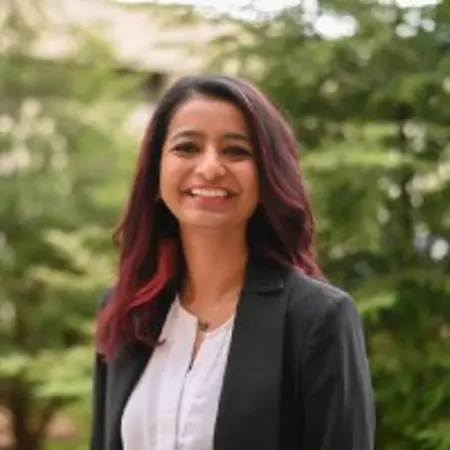
Her Story
About Rachita
I've been a practicing clinical genetic counselor since 2018, which makes it 8 years this January. My journey began with a bachelor's degree in biotechnology and a master's degree in biotechnology from India, where I worked in cancer research on the back end in a wet lab situation. I then pursued additional training in psychology before coming to the United States to receive my clinical training and classroom education at UCSF and Kaiser Permanente in Northern California, where I learned from the best of the best. I previously worked at the University of Louisville, providing oncology genetic counseling services for their Brown Cancer Center, and did outreach clinical genetic counseling for Hardin Memorial Cancer Center in Elizabethtown, Kentucky, and Mitchell Memorial Cancer Center in Owensboro, Kentucky. We were able to provide telehealth services even before the onset of the pandemic to improve access to care for rural patient populations. In November 2019, I moved to Washington University (WashU) in St. Louis, where I've been working as an oncology genetic counselor ever since. When I joined, oncology genetic counseling services at WashU had been unavailable for about 2 or 3 years, so it was exciting to join a well-established institution while also having the ability to establish newer clinics and improve access for the greater geographical region. I'm deeply involved in clinical training and classroom training of students, which I consider my biggest achievement. I've also co-authored a chapter in a gynecology oncology textbook about genes, cancers, and multidisciplinary care. I have a master's in interdisciplinary education certificates and continue to update my trainings for public health research and patient care. I like to think of myself as a consistent learner - I don't think I ever want to get out of that mode of learning, and I believe every day in life is a learning experience.
Her Interview
Ten minutes with Rachita
01What do you attribute your success to?
I attribute my success to my faith, my family, and my circle of close friends. Without their support, I do not think I would be where I am. I believe that having a strong sense of community is essential - we can't move forward in life without it. At the same time, having independence is equally important, so I'm grateful for people around me who value my sense of independence and ambition. I also think having a balance between work life and home life is very important, and I'm trying to prioritize that more. Having a group of people who are understanding and are able to listen to you, whether it be at work or in your home life, is highly important.
02What’s the best career advice you’ve ever received?
The best advice I've ever received is to not let the imposter syndrome take over. That voice runs strong in our profession, which is mostly women, and I think all of us struggle with that imposter syndrome from time to time. So make sure you keep that voice shut. Don't let the voice inside your head that tells you you're not good enough overpower your achievements. I've observed so many accomplished, successful women who just don't believe in themselves, and I don't think that's right. You should definitely trust your abilities. We all handle so much on a day-to-day basis, and there's enough room for all of us at the table - we're all important, we all have a role to play.
03What advice would you give to young women entering your industry?
Trust your purpose, trust that the choices you make and the path that life leads you on is the best path for you, and do not let the voice inside your head that tells you you're not good enough overpower your achievements. Don't let imposter syndrome take over, because that runs strong in our profession. It's mostly women in genetic counseling, and I think all of us struggle with that from time to time. So many accomplished, successful women just don't believe in themselves, and I don't think that's right. You should definitely trust your abilities and remember that we all handle so much on a day-to-day basis.
04What are the biggest challenges or opportunities in your field right now?
The biggest challenge in my field right now is the fact that we are not recognized by Medicare and Medicaid as healthcare professionals. Our field has actually put forth a bill through Congress to get that recognition, and it's currently being considered by Congress. The lack of acknowledgement from healthcare institutions to hire more professionals like myself limits access to genetic care. Genetics, even though highly specialized, is part of every aspect of medicine today, and patients need to be educated. True informed consent processes need to take place when it comes to genetic information. I think one way we need to improve access is getting that recognition from insurance companies, because when we increase reimbursement, we increase hiring. This would allow more people to access the specialized care they need.
05What values are most important to you in your work and personal life?
I think having a balance is very, very important, and I'm trying to prioritize that more. Having a group of people who are understanding and are able to listen to you, whether it be at work or in your home life, is highly important. I don't think we can move forward in life without having a strong sense of community. At the same time, I think having independence is equally important, and as important as having community, so people that are around you that value your sense of independence and ambition. I also don't think you can work in a field that thrives on compassion without having a creative outlet - that's why I pursue so many creative interests like Indian classical dance, Hindustani classical music, poetry, artwork, painting, and embroidery.
Join Influential Women and start making an impact. Register now.