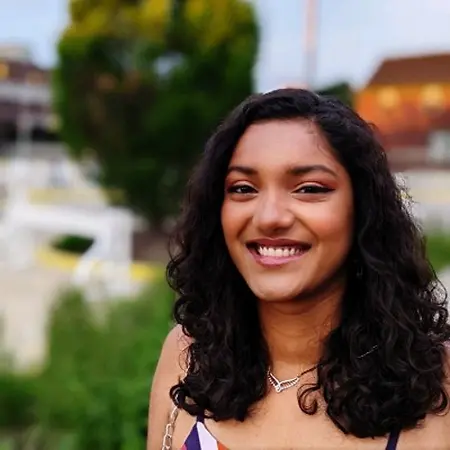
Her Story
About Radhika
I have been in my field for over 9 years now. I started doing projects during undergrad, and I quickly figured out that research is something I enjoy way more than structured coursework - the problems that have not been solved provide me a basis for wanting to solve them. So I took on the research trajectory and pursued my master's and PhD in the domain of geomatics, which is basically using advanced sensors for doing mapping. This field spans from close-range mapping like what we see in autonomous driving, where we're mapping the close-range environment around the vehicle, all the way to satellite-based imagery and large-scale mapping. I kept my research pretty application agnostic in the sense that I always focused on the theoretical aspects of any problem first, and then looked at what the practical applications would be, which would be pretty diverse given my field. The career trajectory I took professionally after I finished my PhD was actually in many different domains - I did smartphone-based positioning for pedestrians, I did virtual reality for indoor environments for mapping using the same sensors, and right now I'm in the autonomous driving domain. Everything that brings it together is having a strong theoretical foundation which I can actually apply to many different applications and build a strong application on top of the foundation that I have. My main area of expertise today is bringing AI together with advanced sensors - my specialization is with cameras and LiDAR, which I use for mapping and perception of the real world.
Her Interview
Ten minutes with Radhika
01What’s the best career advice you’ve ever received?
The best career advice I ever received was from an emeritus professor who was a very close professional mentor to me during grad school. I was coming from a culture where it is mostly that you respect the superiors in your field and you value their advice, which is true in most cases, but it also, in my case, manifested as if somebody has asked me to do something, even if I might have my doubts about it, I would still probably sometimes feel like maybe I should still do it, and then through evidence show that this isn't working. The advice that I received is that everybody has a different way of thinking, a different thought process, and that if I actually have a different thought process which should be as credible as anybody else, I should make it a point to voice my opinions within a meeting whenever I feel like it does need to be, instead of waiting for a later moment where I have enough proof to back whatever I'm saying. It could also be that I have some intuition that somebody else hasn't thought about, and that I shouldn't wait to have backing for my opinions, and rather just be confident in putting forward my opinions as they are and actually have a discussion around it.
Join Influential Women and start making an impact. Register now.